What Is Value-Added Warehousing & Fulfillment? (And Why It Matters for Scaling Brands)
Standard fulfillment stops working when your brand starts scaling. This guide covers the value-added warehousing services that protect margins, enforce brand standards, and handle operational complexity — with real case studies and measurable results.


HyperSKU
Posted on June 12, 2026
At some point in building an ecommerce brand, the operational model that got you here stops being good enough to get you to the next stage.
Pick and pack works fine when your catalog is simple and your orders are straightforward. But when you are running a multi-SKU product line, selling collectibles or limited-edition drops, managing custom bundling requirements, or shipping high-margin items internationally, standard warehousing starts creating problems instead of solving them. Packaging arrives damaged. Shipping costs erode the margins you worked hard to build. Complex fulfillment rules get executed inconsistently, or not at all.
This is the point where value-added warehousing and fulfillment becomes a strategic decision rather than a nice-to-have.
For DTC brand owners and POD sellers at the scaling stage, the warehouse is not a storage facility. It is the last point in your supply chain where you can actively protect your margins, enforce your brand standards, and execute the kind of order complexity that standard fulfillment operations simply are not built for.
This guide covers what value-added warehousing actually means in operational terms, which services matter most for brands at the scaling stage, and what real execution looks like, with documented case studies and measurable results.
What Is Value-Added Warehousing and Fulfillment?
Value-added warehousing and fulfillment (VAWF) refers to any warehousing operation that goes beyond standard receive-store-ship logistics to provide customized, brand-specific handling at the individual order or SKU level.
In a standard fulfillment model, the warehouse receives inventory, stores it, and ships it when an order comes in. The product leaves in roughly the same condition it arrived: same packaging, same configuration, same presentation. That model is efficient for simple catalogs. It is not designed for complexity.
Value-added warehousing operates differently. The warehouse becomes an active part of your supply chain, executing operational tasks that standard facilities do not support: repackaging inventory to reduce freight costs, building multi-SKU kits to custom specifications, enforcing order-level fulfillment rules, inserting branded materials, performing pre-shipment quality checks, and adapting packaging to meet regional compliance requirements.
The distinction matters because the business impact operates on multiple levels simultaneously.
Margin protection. Packaging decisions made at the factory are optimized for storage and display, not freight. Repackaging inventory at the warehouse level before it ships is often the single most direct lever available for reducing per-unit shipping costs, without requiring supplier changes or product modifications.
Brand consistency at scale. As order volume grows, manual brand execution becomes harder to maintain. Value-added fulfillment replaces ad hoc handling with documented SOPs, ensuring every order reflects the same standards regardless of volume.
Operational complexity, executed reliably. Multi-SKU kitting, conditional fulfillment rules, randomized distribution protocols, region-specific labeling. These are the requirements that cause standard warehouses to fail and brands to lose customers. VAWF infrastructure is built to absorb that complexity and execute it consistently.
The core principle is straightforward. The warehouse is the last point in your supply chain before the product reaches your customer. What happens there directly determines the cost of delivery, the condition of arrival, and the quality of the unboxing experience. Treating it as passive storage is a missed opportunity. Treating it as an operational asset is what scaling brands do.
Value-Added Services That Scale Ecommerce Brands
A. Custom Kitting & Precision Fulfillment Protocols
For brands selling products with operational complexity baked into the concept, the fulfillment challenge is not just about getting orders out the door. It is about executing a specific set of rules, consistently, across every single order.
Multi-SKU kitting and custom fulfillment protocols move that operational complexity from the factory floor to the warehouse level. Instead of relying on suppliers to assemble, sort, or configure orders correctly before shipping, the warehouse takes ownership of those steps. This matters especially for brands managing bundle logic, limited-edition drops, or product lines where the fulfillment method is part of the product experience itself.
The challenge is not conceptual. It is executional. Getting kitting right at scale requires documented protocols, trained warehouse staff, and a system that does not degrade under volume.
Case Study: Blind Box Merch Brand
A fashion brand introduced a limited blind box merch line with six collectible styles. The outer box was part of what the customer was buying. Before working with HyperSKU, roughly 50% of boxes were arriving damaged. Randomized fulfillment across six styles, including a controlled hidden variant, had no system behind it.
HyperSKU built a documented warehouse protocol covering style rotation rules, pre-labeled variant identification, multi-box duplicate prevention, and secured inventory management for the hidden S variant. Outbound packaging was redesigned with pearl cotton, bubble film, and reinforced corner taping to eliminate transit damage without increasing freight costs.
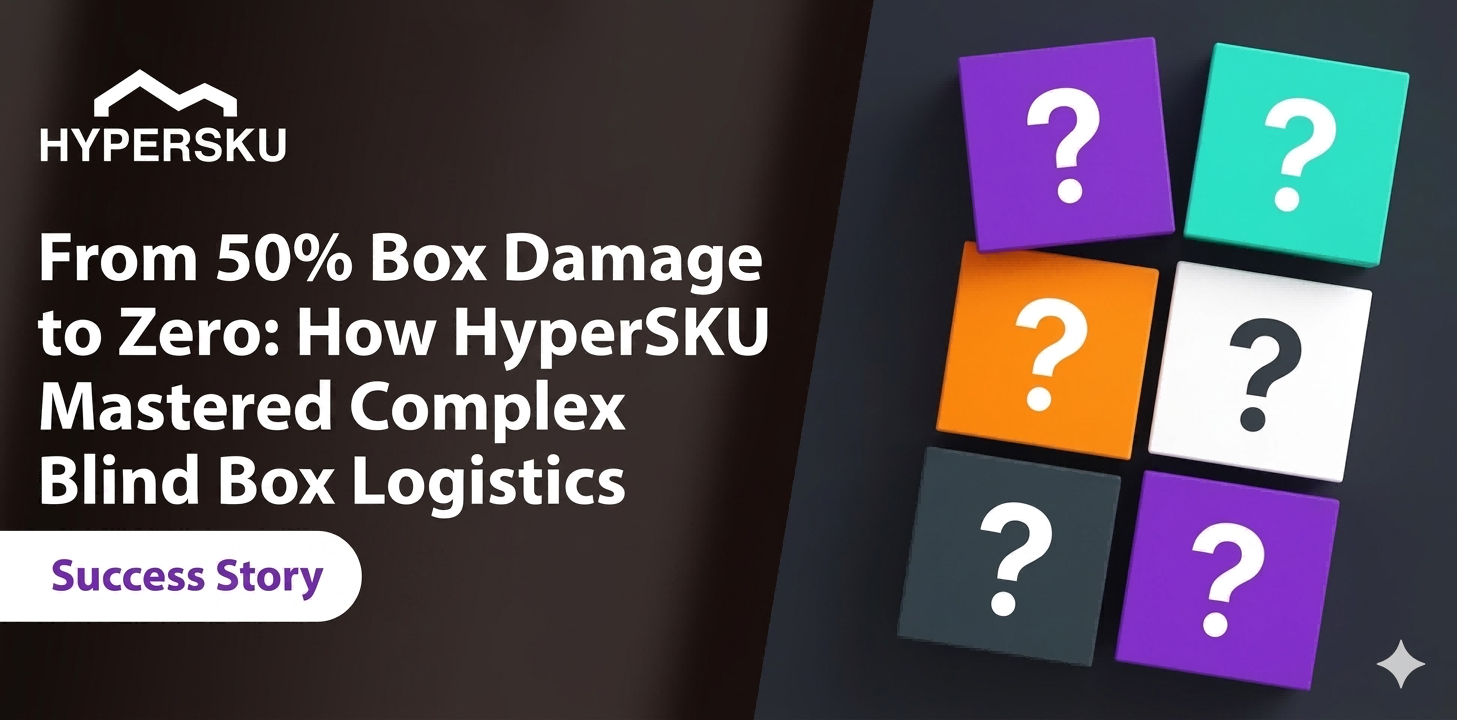
Custom Kitting & Precision Fulfillment
From 50% Packaging Damage to Zero
A fashion brand’s blind box merch line required randomized fulfillment across 6 collectible styles and zero tolerance for packaging damage. HyperSKU built a documented warehouse protocol from scratch and redesigned the outbound packaging around the product’s collectible nature.
0%
Damage rate after
488
Orders fulfilled, zero protocol violations
B. Dimensional Weight Optimization & Repackaging
Factories pack for display and protection. That is a reasonable priority when inventory is sitting on a shelf or traveling by bulk freight. It becomes a cost problem the moment those same packages enter international parcel shipping, where carriers charge by dimensional weight rather than actual weight.
Dimensional weight pricing means a large, lightly stuffed package is billed at a rate reflecting its physical volume, not how much the contents actually weigh. For soft goods, bags, apparel, and similar categories, the gap between actual weight and dimensional weight can be significant. Brands often absorb this cost without identifying it as a solvable problem, treating inflated shipping fees as a fixed variable rather than something that can be engineered down.
The fix does not always require changing suppliers or renegotiating freight contracts. In many cases, it happens at the warehouse level during inbound processing, before the order ships.
Case Study: European Bag Brand
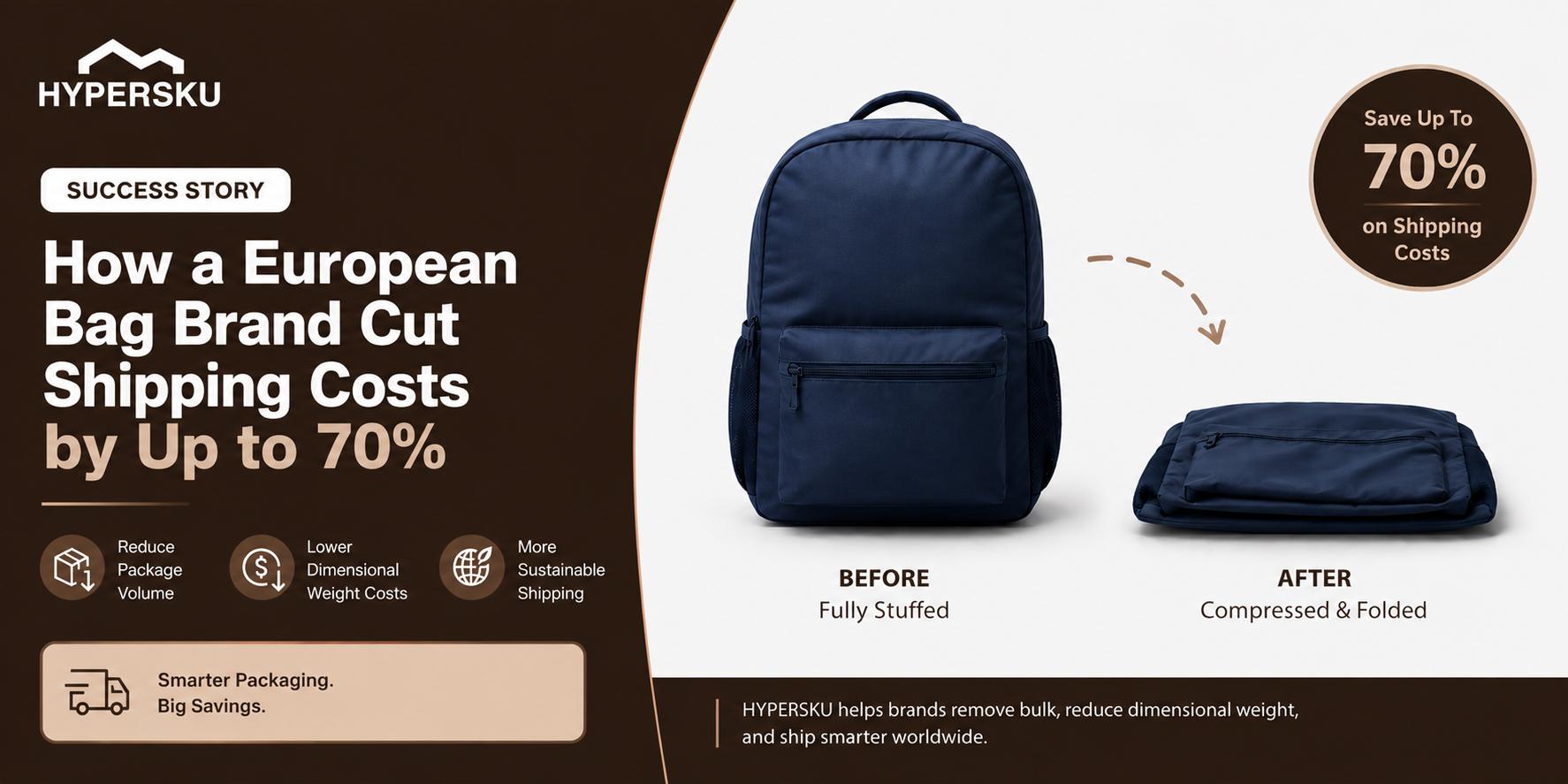
An EU-based accessories brand was paying $52.00 per backpack and $99.71 per tote bag in shipping fees. The root cause was factory filler material inflating the dimensional weight of every unit. The product quality was not in question. The supplier relationship was intact. The entire margin problem traced back to one operational detail: how the bags were packed when they left the factory.
HyperSKU’s inbound repackaging workflow removed the filler, folded the bags flat, and repacked them at their true dimensional size before each outbound shipment. The team also flagged the potential for light crease marks upfront, giving the brand the information needed to make an informed decision before proceeding. Thank you cards and custom packaging were added to maintain the unboxing experience alongside the leaner pack size.
Dimensional Weight Optimization
Shipping Costs Cut by Up to 70% — Without Changing Suppliers
A European bag brand was paying $99.71 per tote bag in shipping fees because factory filler material inflated dimensional weight on every unit. HyperSKU’s inbound repackaging workflow removed the filler, compressed the bags to their true size, and transformed the freight profile of every outbound shipment.
70%
Reduction in tote bag shipping cost
46%
Reduction in backpack shipping cost
C.Pre-Shipment Quality Control & Market Compliance
Sourcing from overseas manufacturers introduces a layer of quality and compliance risk that does not resolve itself. Products that pass factory inspection can still arrive at the warehouse with defects, mislabeling, or packaging that does not meet the regulatory requirements of your target market. By the time those issues surface at the customer level, the cost is not just the product. It is the return, the refund, the review, and the trust.
Pre-shipment quality control at the warehouse level intercepts those problems before they ship. This is not a replacement for factory QC. It is a second checkpoint, closer to the customer, covering the specific standards that matter for your market and your product category.
For brands selling into North America, Europe, or Australia, compliance requirements go beyond generic quality checks. Labeling must meet region-specific standards. Barcodes must be placed correctly for retailer or platform acceptance. Packaging may need to be adapted to meet import regulations or market-specific presentation requirements. These are details that cause shipments to be rejected, held at customs, or returned by end customers.
HyperSKU’s warehousing services include inbound inspection workflows covering product defect screening, compliant relabeling, barcode verification, and repackaging tailored to target market requirements. Inventory that does not meet the agreed standard is flagged and resolved at the warehouse, before it enters the fulfillment pipeline.
For scaling brands managing multiple SKUs across multiple markets, having that checkpoint built into the warehousing operation removes a category of risk that is otherwise very difficult to manage at volume.

Value-Added Fulfillment Services
What HyperSKU’s Fulfillment VAS Includes
From per-item quality inspection to brand label sewing and vacuum compression for freight efficiency, HyperSKU’s value-added fulfillment services are designed around the operational needs of scaling ecommerce brands.
Download BrandLift PackageHow to Evaluate a Value-Added Fulfillment Partner
Not every fulfillment provider that offers value-added services has the infrastructure to execute them reliably as your brand scales. The gap between what a partner lists as a capability and what they can actually deliver consistently at volume is where most brands run into problems.
Three criteria are worth applying when evaluating a VAWF partner at the scaling stage.
Documentation & SOP Capability
Cost Transparency & Proactive Optimization
Execution Consistency at Scale
Documentation and SOP capability. Can the partner take your operational requirements and translate them into written, executable warehouse protocols? A fulfillment provider that handles complexity through verbal instructions or informal arrangements will not maintain consistency across high order volumes or staff changes. The blind box case in this article is a useful benchmark: six fulfillment rules, written down, executed across 488 orders with zero violations. That is what documented execution looks like.
Cost transparency and proactive optimization. Does the partner identify cost inefficiencies on your behalf, or do they wait for you to raise them? The dimensional weight case in this article involved HyperSKU identifying a repackaging opportunity that reduced per-unit shipping costs by up to 70%. That kind of intervention requires a partner who understands your margin structure and treats cost optimization as part of the service, not an extra conversation.
Execution consistency at scale. A value-added service that works at 50 orders per month needs to work at 500 and 5,000. Ask for documented results. Ask how SOPs are maintained during volume spikes. Ask what happens when inbound inventory arrives damaged or noncompliant. The answers will tell you whether a partner’s capabilities are real or aspirational.
HyperSKU is built for brands at exactly this stage. With warehousing and fulfillment infrastructure spanning China, the US, and the EU, a native Shopify integration, and a track record of executing complex fulfillment requirements at scale, HyperSKU functions as a supply chain infrastructure partner rather than a logistics vendor.
Final Thoughts
Value-added warehousing and fulfillment is not a premium add-on for enterprise brands with complex logistics budgets. It is the operational infrastructure that scaling DTC and POD brands need when standard fulfillment starts creating problems that hurt margins, damage brand reputation, and slow growth.
The two cases in this article illustrate the range of what that looks like in practice. A blind box brand eliminated a 50% packaging damage rate and built a randomized fulfillment system that executed without a single protocol violation across 488 orders. A European bag brand reduced per-unit shipping costs by up to 70% through an inbound repackaging workflow that required no supplier changes. Both outcomes came from the same source: a fulfillment partner that treated operational complexity as a solvable problem rather than a fixed constraint.
For brands at the scaling stage, the warehouse is where margins are protected or lost, where brand standards are upheld or compromised, and where operational complexity either gets absorbed cleanly or starts generating customer complaints. Choosing the right fulfillment infrastructure is not a back-office decision. It is a growth decision.
Ready to Turn Your Fulfillment Into a Growth Advantage?
HyperSKU handles the operational complexity so you can focus on scaling. From precision kitting to shipping cost optimization, your fulfillment infrastructure starts here.
Get Started FreeFAQs About Value-Added Warehousing & Fulfillment
What are examples of value-added services in a warehouse?
Value-added warehousing services include custom kitting and assembly, dimensional weight optimization and repackaging, pre-shipment quality control and inspection, compliant relabeling for target markets, branded packaging and insert insertion, and returns processing. These services go beyond standard pick-and-pack to provide order-level customization and brand-specific handling.
What is the difference between standard fulfillment and value-added fulfillment?
Standard fulfillment covers receiving, storing, and shipping inventory in the condition it arrives. Value-added fulfillment adds a layer of customized handling at the SKU or order level, including repackaging, kitting, quality checks, and compliance-related relabeling. The practical difference is that value-added fulfillment treats the warehouse as an active part of your supply chain rather than a passive storage and dispatch facility.
How does value-added warehousing reduce shipping costs?
The most direct lever is dimensional weight optimization. Carriers charge international parcel shipping rates based on volumetric weight, not actual weight. Products packed with factory filler material or in oversized boxes are billed at a rate that reflects their volume rather than their contents. Repackaging inventory at the warehouse level, before it ships, reduces the dimensional weight of each unit and lowers the per-unit freight cost without requiring supplier changes or product modifications.
What are some examples of value-added services in ecommerce fulfillment?
In an ecommerce context, value-added fulfillment services typically include multi-SKU kitting and bundle assembly, custom packaging and branded unboxing materials, inbound quality inspection and defect screening, regional compliance relabeling for markets such as North America, Europe, and Australia, dimensional weight optimization through repackaging, and specialized handling protocols for product categories like collectibles, apparel, or fragile goods.
Is value-added warehousing suitable for small ecommerce brands?
Value-added warehousing becomes most relevant when a brand’s product complexity or shipping volume starts creating problems that standard fulfillment cannot absorb. This does not require enterprise scale. A brand managing multi-SKU bundles, selling into multiple regional markets with different compliance requirements, or losing margin to inflated shipping costs is already at the stage where value-added services deliver measurable returns. The key is finding a partner whose service model is built for brands at the scaling stage, not just for high-volume enterprise accounts.