How to Sell on Etsy in 2027:A Beginner’s Guide
Learn how to sell on Etsy in 2027: open a shop, meet Etsy’s new photo and AI rules, understand fees, and fulfill orders in one beginner’s guide.


HyperSKU
Posted on November 10, 2026
Learning how to sell on Etsy has always started with the same steps: open a shop, list your products, and get paid. In 2027, there is one more thing to get right before you publish a single listing. Etsy has updated its listing image and AI policies, and most listings now need a real, unedited photo of the actual item.
This guide explains how to sell on Etsy step by step, what you are allowed to sell, what Etsy’s new photo and AI rules require, what fees to expect, and how to fulfill your orders.
Key takeaways
- Etsy only allows items that are made, designed, handpicked, or sourced by the seller. Dropshipping and reselling are not allowed, except in specific cases.
- Etsy announced new listing image and AI rules on October 22, 2026, and clarified them on November 6. Most listings now need at least one unedited photo of the actual item against a real background.
- Etsy plans to begin proactive enforcement in early 2027, with advance notice.
- If you sell original designs or custom products, a production partner can handle making, quality control, and shipping, as long as you disclose it.
Is Etsy Still Worth It in 2027?
Etsy remains one of the easiest places to start selling online. There is no monthly fee to open a shop, you can reach buyers who are already looking for unique and personalized items, and you can start with a small number of listings.
The trade-offs are real, though. Fees add up on every sale, competition is high, and Etsy’s rules are getting stricter, especially around AI and listing photos. Etsy works best for sellers with something original to offer: their own designs, personalized products, or handmade items.
What Can You Sell on Etsy?
Before you open a shop, check that your products fit Etsy’s Creativity Standards. Etsy’s Seller Policy requires everything listed to be made, designed, handpicked, or sourced by the seller.
| Category | What it covers |
|---|---|
| Made by a seller | Physical items you make yourself, by hand or with personal or computerized tools |
| Designed by a seller | Your original designs, including digital downloads and designs produced by a production partner, which you must disclose |
| Handpicked by a seller | Eligible vintage items you curate |
| Sourced by a seller | Craft supplies, party supplies, and buyer-personalized items produced by a production partner |
What is not allowed: Etsy’s policy says dropshipping and reselling are not allowed, except in the specific cases outlined in its help article, such as craft supplies. If you buy a ready-made product from a supplier and list it as yours, it does not qualify.
Where production partners fit in: If you create an original design and someone else produces it, that can qualify as “designed by a seller.” Etsy requires you to disclose the production partner in your listings and to give accurate information about where the item ships from. This is the route most custom product and print-on-demand sellers use.
How to Sell on Etsy Step by Step
Step 1: Create Your Etsy Account
Go to Etsy’s sell page, click Get started, and sign in or register. You will need to verify your email and identity.
Step 2: Set Your Shop Preferences and Name
Choose your shop language, country, and currency. Then pick a shop name between 4 and 20 characters. Choose something memorable and not tied to one product, so you can expand later. If possible, check that the same name is available on your social accounts.
Step 3: Choose What You Will Sell
Start from something original. Think about:
- Designs you create yourself
- Custom or personalized products
- Items you make or assemble
- Products where you can explain your role in making them
Search Etsy for your product type, check how many results appear, and look at the price range of the top listings. Do not rely on another seller’s design, and do not copy listings.
Step 4: Create Your First Listing
Etsy needs at least one listing before your shop opens. For each listing, you will add:
- Photos
- A title and description with the terms buyers search for
- Price, quantity, and variations
- Shipping information and processing time
- Production details, including whether the item was made or designed by you, and any production partner
Read Etsy’s photo rules in the next section before you upload anything.
Step 5: Set Up Payments and Billing
Add your bank details for Etsy Payments, and add a card for Etsy fees. Then review your shop policies and open your shop.
Step 6: Customize Your Storefront
Fill in your About section, add a banner and shop logo, and write clear shop policies for shipping, returns, and custom orders. Complete profiles help buyers trust a new shop.
Etsy’s New Photo and AI Rules for 2027
This is the biggest change for new sellers in 2027, and it affects almost every listing.
Etsy announced updates to its listing image and AI policies on October 22, 2026, followed by further clarification on November 6. Here is how the two updates compare:
| Topic | October 22 announcement | November 6 clarification |
|---|---|---|
| Real product photo | Most listings must include at least one unedited photo of the actual item against a real background | One photo per listing is sufficient, including listings with multiple variations. It does not need to be the first image |
| Permitted adjustments | The required photo was described as unchanged and unedited | Cropping, resizing, watermarks, and file-format changes are allowed without AI-powered tools. Lighting adjustments and background changes are not allowed on this required photo |
| Other listing images | Editing, including AI assistance, remains allowed if images accurately represent the product | This remains unchanged. Edits must not hide flaws or misrepresent what buyers will receive |
Product-specific exceptions still apply. For example, authorized stock photo mockups may be used when a production partner prints your original design on a standard base product, such as a T-shirt or mug. Etsy’s Seller Policy also mentions limited exceptions for custom items and items made with production partner assistance, so check the exceptions for your product type before you rely on them.
Other AI Rules to Know
- AI-generated functional guides are prohibited. Patterns, recipes, and instructions must be your own work, and they need a real photo of the finished result.
- Fully automated listings are prohibited. Etsy does not allow listings generated entirely by bots without human involvement.
- AI art is still possible, but you need a clear creative role, and you must disclose AI use where Etsy requires it.
- Etsy is adding detection tools. The listing form can flag images Etsy detects may use AI, and buyers can report listings they think use AI in a misleading way.
What Do Sellers Need to Do?
Review both new and existing listings:
- Add a qualifying real product photo where required.
- Check that all images accurately represent the product and that you have permission to use them.
- Review the exceptions for your product type before relying on mockups or digital previews.
Etsy encourages sellers to update their listings as soon as possible. It plans to begin proactive enforcement in early 2027, with advance notice. Sellers may already be responsible for refunds if a buyer receives a materially different item and the listing does not meet the updated image requirements.
Rules like these can change, so check Etsy’s latest Listing Image Requirements and its official update for current guidance. Retail Dive’s coverage is a useful summary of why Etsy made the change.
A Quick Seller Checklist
- Every physical listing has at least one real, unedited photo of the actual item against a real background
- That photo has not been lighting-adjusted, background-swapped, or AI-edited
- My other images accurately show what the buyer will receive
- I have the right to use every image
- I have not used AI to write patterns, recipes, or instructions
- My production partner and shipping origin are disclosed
- I have checked the exceptions for my product type
How to Take Etsy Photos That Pass and Sell
Shoot the real item. Use the actual product, photographed in a real setting, with natural light or simple lighting. Take this photo first, and leave it untouched except for cropping and the allowed file adjustments.
Add supporting images. Show scale, close-ups of materials, packaging, and the item in use. These images can be edited, but they must accurately represent the product and must not hide flaws.
Show every variation. If your listing has several colors or sizes, show the main options clearly so buyers know what they will receive.
Keep a record. Save your original photos and file names. If a buyer or Etsy questions a listing, original files help.
Real Photos vs Retouched Photos
Retouching is useful, but it has limits on Etsy. A retouched or AI-assisted image can work as an additional listing image if it accurately represents the product. It cannot be your required unedited photo. Edits must never hide flaws or change how the product really looks, such as its print, color, or condition.
When you order photos, ask for the unretouched originals to use as your required photo, and use the retouched versions for your other images.
How HyperSKU Can Support Your Etsy Photos
HyperSKU can help arrange real product photos for products sourced and fulfilled through HyperSKU.
Send your dedicated agent the relevant product links or SKUs and your photo requirements. Your agent will assess availability, product complexity, and your order needs, then confirm what can be provided and the estimated turnaround time.
Requests are assessed individually. Providing photos does not guarantee Etsy approval, and sellers remain responsible for their listings.
Through our BrandLift services, HyperSKU offers:
- Product photography: Professional photos of your product, plus later fine-tuning of the pictures
- Product photo retouching: Cleanup edits, such as removing watermarks from images you own or have permission to use, for your additional listing images
- Model photography: Indoor and outdoor shots, retouching, and short video, which can work well for lifestyle and supporting images
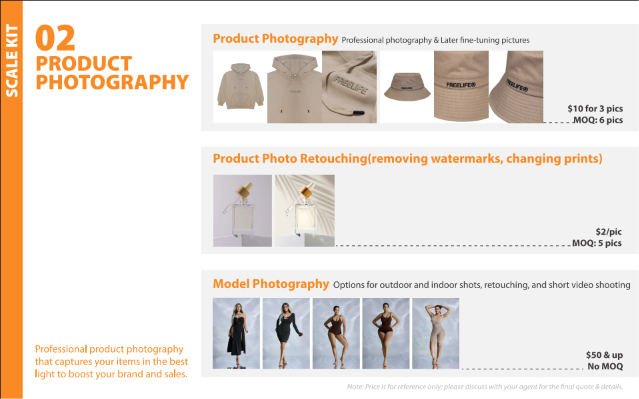
Minimums and pricing depend on the service and your order, so discuss the details and your final quote with your agent. For the full details, read HyperSKU’s guide to Etsy listing photos and AI requirements.
Etsy Fees and Pricing
Etsy charges several fees. Here are the standard US rates:
| Fee Type | Rate | Applies To |
|---|---|---|
| Listing fee | $0.20 per listing | Each listing, renewed every four months or when it sells |
| Transaction fee | 6.5% | Item price plus shipping |
| Payment processing (US) | 3% + $0.25 | Etsy Payments, on each order |
| Offsite Ads (if triggered) | 15% (or 12% for shops with $10k+ sales) | Orders that come through Etsy’s offsite advertising |
Here is an illustrative example. These numbers use US rates and are for illustration only. Check Etsy’s current fees before pricing your products.
| Order Component / Fee Breakdown | Without Offsite Ads | With Offsite Ads |
|---|---|---|
| Item price | $40.00 | $40.00 |
| Shipping charged | $5.00 | $5.00 |
| Order total | $45.00 | $45.00 |
| Listing fee | $0.20 | $0.20 |
| Transaction fee (6.5%) | $2.93 | $2.93 |
| Payment processing (3% + $0.25) | $1.60 | $1.60 |
| Offsite Ads fee (15%) | n/a | $6.75 |
| Total Etsy Fees | $4.73 (~10.5%) | $11.48 (~25.5%) |
The same order costs you roughly 10.5% in Etsy fees without Offsite Ads and about 25.5% with them. Build these costs into your prices before you launch, along with production, packaging, shipping, and returns.
How to Fulfill Etsy Orders
You have three main options:
| Option | Best For | Trade-off |
|---|---|---|
| Make and ship it yourself | Handmade sellers with small volumes | Full control, but your time limits growth |
| Use a production partner | Sellers with original designs or custom products | You must disclose the partner and the shipping origin |
| Production partner with an order integration | Sellers who want orders, quality control, and tracking handled in one place | Less hands-on control over each production step |
If you sell your own designs or custom products, HyperSKU can act as your production and fulfillment partner. You can explore HyperSKU’s customization services and our custom products to see how original designs become finished products
How the HyperSKU Etsy Integration Works
When you connect your Etsy shop to HyperSKU through the Etsy integration:
- Orders sync automatically. Incoming orders appear in your HyperSKU dashboard under Order List, ready for you to review and pay.
- Processing and quality check. Standard processing takes 2 to 3 business days. Once items arrive at the warehouse, the team runs a quality check before packing and shipping.
- Tracking syncs back. When your package is handed to the carrier, a last-mile tracking number is generated and automatically synced to your Etsy store.
- A dedicated account manager handles issues. Because of Etsy’s privacy policies, some orders can occasionally sync late, and your account manager can create them manually.
Connecting your Etsy store is free. HyperSKU also recommends setting your Etsy processing time to 1 to 7 days to allow for sourcing, quality checks, and shipping, so orders are not marked overdue. For custom products, allow extra time for sampling and production.
How to Get Your First Sales
Use search terms buyers actually type. Check Etsy’s autocomplete for your product type, then use those phrases naturally in your title, description, and tags. Write original copy for every listing.
Price with the full cost in mind. Include production, fees, shipping, packaging, and returns.
Photograph well. Photos are what buyers judge first. Make sure your real product photo, and your supporting images, show the item as it will arrive.
Reply quickly. Fast answers to buyer questions build trust and protect your shop’s reputation.
Consider a small ad budget. Etsy Ads can help new listings gather early data. Start small and watch your profit, not just your impressions.
Gather reviews. After delivery, a short thank-you message can help you earn early feedback.
Common Mistakes New Etsy Sellers Make
- Listing a product without a real, unedited photo of the actual item
- Editing the required photo with filters, lighting changes, new backgrounds, or AI tools
- Using AI to write patterns, recipes, or instructions
- Copying another shop’s designs or descriptions
- Listing resold or dropshipped goods as made or designed by you
- Forgetting to disclose a production partner or the shipping origin
- Setting a processing time that is too short for made-to-order products
Final Thoughts
Learning how to sell on Etsy in 2027 means getting two things right: a product that is genuinely yours, and listing photos that show exactly what buyers will receive. The sellers who do well will treat Etsy’s new photo and AI rules as part of their normal workflow, not an afterthought.
If you sell original designs or custom products and want a partner to handle production, quality control, photos, and shipping, HyperSKU can help. Connect your Etsy shop, explore customization services, or contact your dedicated agent about real product photos.
Ready to Scale Your Etsy Store with Custom Products?
Connect your Etsy shop, automate order synchronization, and scale your original designs with HyperSKU’s custom product solutions.
Explore Custom SolutionsFAQs About Selling on Etsy
How do I sell on Etsy as a beginner?
Create an Etsy account, set your shop preferences and name, create your first listing, set up payments and billing, and open your shop. Make sure your products are made, designed, handpicked, or sourced by you, and read the new photo rules before you list.
How much does it cost to sell on Etsy?
There is no monthly fee to open a shop. In the US, you pay a $0.20 listing fee, a 6.5% transaction fee, and 3% + $0.25 payment processing on each sale. Offsite Ads add another 15% (12% for shops with $10,000 or more in sales) on orders they drive.
Does Etsy allow dropshipping?
No, with limited exceptions. Etsy’s policy says dropshipping and reselling are not allowed, except in the specific cases outlined in its help article. You can sell your original designs produced by a disclosed production partner.
Do I need a real photo for every listing?
Most listings must include at least one unedited photo of the actual item against a real background. One photo per listing is sufficient, including for listings with multiple variations, and it does not need to be the first image. Some product types have exceptions.
Can I use AI images on Etsy?
For the required real photo, no. Other listing images can be edited, including with AI assistance, as long as they accurately represent the product and do not hide flaws. AI-generated patterns, recipes, and instructions are prohibited.
When will Etsy enforce the new photo rules?
Etsy plans to begin proactive enforcement in early 2027, with advance notice. Sellers may already be responsible for refunds if a buyer receives a materially different item.
Can HyperSKU help with Etsy listing photos?
HyperSKU can help arrange real product photos for products sourced and fulfilled through HyperSKU. Contact your dedicated agent with your product links or SKUs and photo requirements. Requests are assessed individually, and providing photos does not guarantee Etsy approval. HyperSKU’s BrandLift services also include product photography, photo retouching, and model photography, with details and final quotes confirmed through your agent.