9 Essential Ecommerce Apps Every Serious Shopify Store Should Install In 2026


ZipChat
Posted on March 13, 2026
What This Is
In 2026, a winning Shopify store is not simply a products-on-a-website business; it’s a finely tuned ecosystem of apps that continuously grow sales, improve customer satisfaction, and protect margins. This guide offers a carefully curated 9-app stack that empowers serious Shopify merchants:
- Boost conversion and AOV (average order value)
- Customer Retention and Repeat Purchase Rate
- Automate support and marketing processes
- Future-proof their growth against changing ecommerce dynamics
When you plug in these apps the right way, your store doesn’t just run, it grows effectively, economically, and profitably.
Why It Matters
Customer Acquisition Costs (CAC) are rising more rapidly than ever; retention, conversion efficiency, and operational resilience have become the dominant drivers of profitability. It’s not just enough to add other apps; each tool must contribute measurable value.
A well-formed app stack can lead to real-world results:
- Upsell, cross-sell, and product recommendations to boost AOV by 10–25%
- Retention improvement of 15–35% through automated campaigns (email, SMS, push)
- Capture 10-20% more abandoned carts with targeted notifications and proactive chat
- 10–40% Savings in Support Costs By Automating 80% of User Interactions
The end result is a direct increase in your margins, improved LTV:CAC ratios, and predictable revenue streams that will run your Shopify store as a resilient, profit-driven business, rather than a collection of free tools.
Key Benchmarks for Online Stores
To see if your app stack is running, these 2026 benchmarks create measurable targets:
- Conversion rate: 2.5–4%+
- Repeat purchase rate: 25–40%
- LTV:CAC ratio: Minimum 3:1
- Email revenue contribution: 25–40% of total store revenue
These numbers are not arbitrary. They reflect what top-performing stores achieve by strategically combining conversion, retention, trust, and automation tools.
What This Guide Covers
This article walks you through:
- The 9 essential apps every serious Shopify store should install in 2026
- ROI breakdown per app category—understanding which apps drive the most value
- When each strategy fails—common pitfalls and failure thresholds
- A diagnostic growth framework—a practical approach to auditing your store
- 2026+ future outlook—emerging trends, AI-driven automation, and behavioral shifts shaping the next phase of ecommerce
What “Essential” Means in 2026 (Not Just Popular)
In 2026, an app is “essential” only if it directly strengthens your business outcomes. It’s no longer enough for a tool to be popular or feature-rich; what matters is strategic impact.
An essential app must:
- Drive revenue directly – via conversion optimization, several upsells, or lifecycle campaigns
- Create better unit economics – lower CAC, higher LTV, or improved margins
- Automate margin protection processes – support, retention, order management, etc
- Build revenue model resilience – being able to withstand market changes, seasonal opportunities, or increased ad costs
Financial Lens
The question shifts from:
“Does this feature look cool?”
To:
“Does this enhance LTV, AOV, conversion rate, or margin?”
This perspective forces every app decision to be viewed through the lens of hard financial metrics instead of subjective convenience or novelty.
The 4 App Pillars That Customers Find Exciting in a Shopify Store
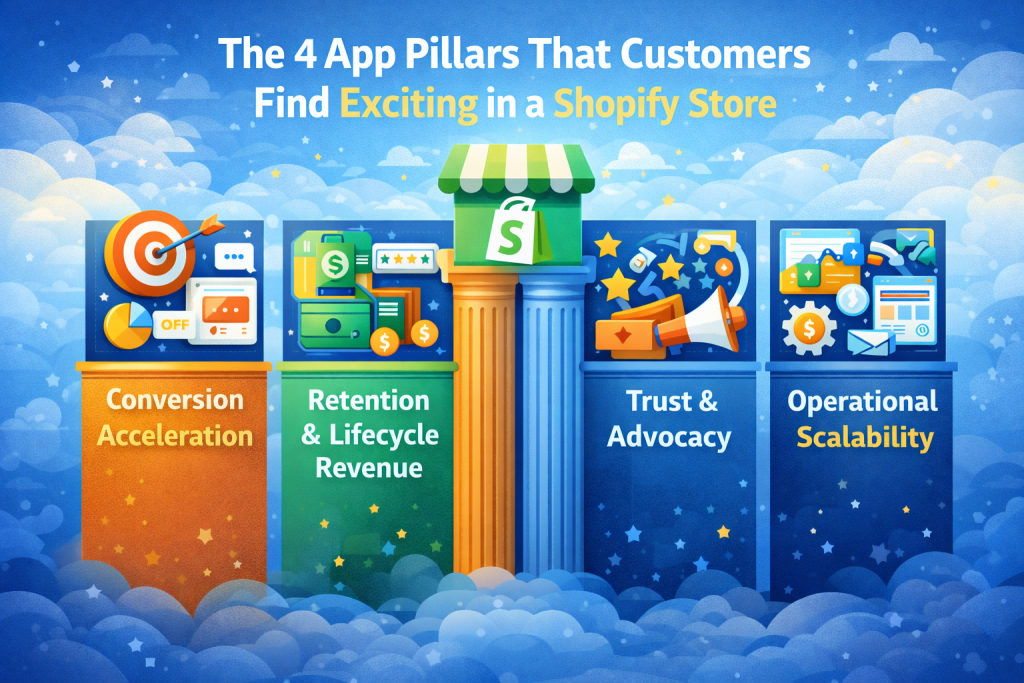
- Conversion Acceleration
Apps that actively drive buying intent through personalized recommendations, proactive chat, social proof, or targeted offers. - Retention & Lifecycle Revenue
Tools that get customers coming back, improve repeat purchase rates, and increase revenue per customer. - Trust & Advocacy
And mechanisms like reviews, referral programs, and social proof that create trust, reduce purchase hesitation, and drive word of mouth growth. - Operational Scalability
Systems that automate repetitive tasks, centralize data, and deliver actionable insights to allow your team to eliminate manual processes and drive growth.
Comparison Table
| Tool / Platform | Best For | Features | Pricing | Rating |
|---|---|---|---|---|
| Zipchat | Conversion acceleration & revenue resilience | Product recommendations (AI), proactive chat, cart recovery, omnichannel support (WhatsApp, Messenger, Email), post-purchase automation | From $49/month | 4.9/5 |
| PushOwl | Retention & cart recovery | Browser push notifications, SMS & email campaigns, abandoned cart recovery, back-in-stock alerts | Free plan available; paid plans from $19/month | 4.8/5 |
| Klaviyo | Advanced lifecycle revenue & CRM | Deep segmentation, predictive analytics, automated flows, AI-powered recommendations, SMS & email integration | Free up to 250 contacts; paid tiers start from $25/month | 4.8/5 |
| Omnisend | Simplified multichannel automation | Drag-and-drop campaign builder, prebuilt automation workflows, segmentation, analytics | Free up to 500 emails; paid tiers from $5/month | 4.7/5 |
| ReferralCandy | Advocacy & word-of-mouth growth | Automated referral rewards, flexible incentives, affiliate tracking, performance analytics | From $39/month | 4.5/5 |
| Opinew | Social proof & conversion | Photo/video reviews, automated review collection, SEO-friendly widgets | Free plan; paid from $19/month | 4.4/5 |
| ContentStudio | Content & social management | AI content planning, scheduling, social listening, analytics dashboard | Plans start at $19/month | 4.7/5 |
| HubSpot | Centralized CRM & customer intelligence | Contact & deal management, email tracking, marketing automation, analytics | Free basic CRM; paid tiers from $9/month | 4.4/5 |
| Printify | Inventory-light product expansion | Custom product creation, global fulfillment, mockups, no upfront inventory | Free to start; product costs + premium $24.99/month | 4.7/5 |
The 9 Essential Apps
A serious Shopify store in 2026 isn’t simply a tech platform with products and traffic; it’s powered by a carefully assembled app ecosystem designed to both increase revenue as well as strengthen customer relationships, and protect margins.
The following 9 must-have apps range from AI-powered conversational commerce like Zipchat to marketing automation, referral growth engines and service social proof tools to operational enablers that are all growth levers ensuring visitors turn into buyers, customer retention is in place and cost-effective operations are scaled.
Each app is chosen for its ability to deliver measurable business results. This makes them a must-have for forward-thinking Shopify merchants.
1. Zipchat — Conversational Commerce Revenue Engine
If you want a great app that does more than just answer customers’ questions, Zipchat is the real deal. Zipchat is made to transform Shopify traffic into revenue. Unlike other ecommerce apps that are support-oriented, Zipchat combines AI, automation, and sales psychology to connect with shoppers at the perfect moment.
The result? More conversations, better conversion rates, and lower pressure on your support team! Zipchat really doesn’t feel like a typical chatbot. It’s like a savvy sales rep who knows your products, has an understanding of shopper intent, provides recommendations to shoppers actively, and nudges them toward checkout.
If you are focusing heavily on speed, precision, and impact on sales for your ecommerce website, Zipchat provides the most well-rounded experience for fast growing ecommerce brands.
Features
- AI that initiates conversations proactively according to shopper behavior
- Personalized product recommendations sourced from your own Shopify catalog
- Quick replies to questions like shipping, returns, sizing, and more
- Native upsell and cross-sell logic to increase AOV
- Webchat + Email + WhatsApp Multi-channel messaging
- Zero-code setup with guided onboarding
Financial Impact:
- Conversion lift potential: 5–20%
- Reduced support staffing costs through automation
- Higher average order value through guided selling
Pricing: From $49/month (based on usage)
Rating: 4.9/5
2. PushOwl — Retention & Cart Recovery Engine
PushOwl is a multichannel retention platform that allows businesses to re-engage customers and recover lost sales through email, SMS, and push notifications. PushOwl enables Shopify stores to turn visitors into repeat customers on autopilot with automated abandoned cart messages, back-in-stock notifications, and personalized campaigns.
Features:
- Abandoned cart recovery automation
- Back-in-stock and product availability alerts
- Segmented push notifications for targeted campaigns
- Integrating with Shopify analytics to measure performance
Pricing: Free plan available; paid plans from $19/month
Rating: 4.8/5
3. Klaviyo — Advanced Lifecycle Revenue CRM
Klaviyo is a marketing automation platform that enables click-based data for stores to deliver personalized shopping experiences through email and SMS. Fields like deep segmentation, predictive analytics, and highly-automated lifecycle flows make the right message delivered to the right people at the right time, which means higher retention and revenue.
Features:
- Deep segmentation and behavioral targeting
- Predictive analytics for revenue forecasting
- Automated flows for welcome, abandoned cart, and post-purchase campaigns
- Integration with Shopify for email as well as SMS
- AI-powered product recommendations
Pricing: Free up to 250 contacts; paid tiers start at $25/month
Rating: 4.8/5
4. Omnisend — Simplified Multichannel Automation
Omnisend is your all-in-one ecommerce smart marketing automation platform that helps online businesses to run email, SMS, and push notification campaigns from one simple dashboard. It allows brands to create subscriber lists, automate personalized messages, and perform targeted campaigns that convert their visitors into customers.
It streamlines complex marketing processes through built-in AI tools, seamless integration capabilities, and user-friendly features.
Features:
- Email, SMS, and push automation
- Drag-and-drop email builder with personalization
- Ready-made work processes (e.g., forsaken cart, welcome setup)
- Content generation and effective audience segmentation with AI Integrations with Shopify, WooCommerce, Wix, etc
Pricing: Free plan up to 500 emails; paid plans from $5/month
Rating: 4.7/5
5. ReferralCandy — Advocacy & Word-of-Mouth Multiplier
ReferralCandy is a referral marketing platform that enables ecommerce brands and businesses turn customers and partners into advocates through rewards, discounts, cash, or store credit. It makes it easy to launch successful referral campaigns that lower CAC and also monitor performance in real time through an analytics console.
It is quick and easy to set up, and it integrates with many of the major ecommerce tools to provide scalable, cost-effective growth through word-of-mouth marketing.
Features:
- Branded pages and links are automatically generated and controlled for referral and affiliate programs
- Offers different types of reward programs (discounts, store credits, cash payments, gift cards) and multi-level incentive structures
- Analytics, fraud detection & real-time tracking for measuring program performance
- Seamless integrations with ecommerce platforms & marketing tools
- Customizing the referral experience (widgets, emails, landing page) according to brand identity
Pricing: From $39/month
Rating: 4.5/5
6. Opinew — Social Proof & Conversion Trust Layer
Opinew is a Shopify app that collects and displays customer reviews, enhancing trust and boosting conversions. t supports rich content, including photos and videos, and integrates natively with Shopify stores to bring user-generated content front-and-center for the buying experience.
Features:
- Automated collection of product reviews
- Photo and video reviews for enhanced social proof
- SEO-friendly review widgets
- Customizable display layouts
- Integration with email and marketing campaigns
Pricing: Free plan; paid plans from $19/month
Rating: 4.4/5
7. ContentStudio — Content & Social Growth Engine
ContentStudio is an all-in-one content marketing and social management platform for Shopify merchants to plan, create, schedule & analyze all your content in one place. It enables stores to drive engagement and top-line growth in the funnel using AI-generated content and analytics.
Features:
- AI-powered content planning and creation
- Social media scheduling and automation
- Analytics and performance reporting
- Content discovery and curation tools
- Collaboration features for teams
Pricing: Plans start at $19/month with a free trial
Rating: 4.7/5
8. HubSpot CRM — Customer Intelligence Backbone & Email Marketing
HubSpot CRM is a one-stop shop that brings customer data, sales, and marketing all into one platform. It allows Shopify stores to make informed decisions by tracking the entire lifecycle of leads and customers, retaining customers, and streamlining operations.
Features:
- Contact and deal lifecycle management
- Email tracking and sequences
- Marketing automation tools
- Analytics dashboards and reporting
- Shopify and other sales tool integrations
Pricing: Free basic CRM; paid plans from $9/month
Rating: 4.4/5
9. Printify — Inventory-Light Product Expansion
Printify is a print-on-demand platform that enables Shopify merchants to sell custom products without having any inventory upfront. It connects to a worldwide network of print partners, allowing for low-risk product testing and expansion into other categories.
Features:
- On-demand product creation and mockups
- Global fulfilment network so you can ship fast
- No upfront inventory requirements
- Shopify and other ecommerce platforms integration
- Customizable branding options
Pricing: Free to start; premium plan $24.99/month + product costs
Rating: 4.7/5
Diagnostic Framework: Why Your Shopify Store Isn’t Scaling
Even with traffic and products, many Shopify stores can’t scale because revenue, retention, and operations aren’t optimized to work together. This diagnostic framework will allow you to spot crucial weaknesses and prioritize fixes.
1. Low Conversion Rate?
If your ecommerce site attracts visitors but few convert, it may be due to:
- Trust Layer Missing: In the absence of reviews, social proof, or explicit guarantees, buyer conviction is lost.
- Poor conversational commerce: lack of proactive engagement or guided shopping experience leaves visitors undecided.
- Bad UX: Long loading times, a complex checkout process, or unclear navigation are frustrating potential buyers.
2. High Traffic, Low Revenue?
Generating visitors without corresponding revenue signals retention and monetization gaps:
- No retention automation: Customers aren’t nurtured post-purchase or through lifecycle campaigns.
- No cart recovery: Abandoned carts are not being reclaimed through automated reminders.
- Poor segmentation: Generic marketing messages fail to resonate with specific customer segments.
3. Good Revenue, Low Profit?
Revenue alone doesn’t equal profitability. Look for operational and efficiency issues:
- CAC too high: Paid acquisition costs outweigh the lifetime value of customers.
- Too many redundant apps: Overlapping tools increase costs without measurable benefits.
- Weak referral engine: Missing or ineffective advocacy programs fail to capture organic business growth opportunities.
ROI Scenario: $100K/Month Shopify Store
This scenario illustrates the tangible impact of implementing a well-curated 2026 app stack:
Before Stack Optimization
- Conversion rate: 2%
- Repeat purchase rate: 20%
- Cart abandonment: 70%
After Implementing the 2026 Stack
- Conversion rate: 2.8% (+40% improvement)
- Repeat purchase rate: 30% (+50% improvement)
- Cart abandonment recovery: 15%
- Incremental revenue potential: +$18K–$35K per month
By combining apps that optimize conversion, retention, and automation, a store can experience significant ecommerce success and increase revenue without additional traffic or ad spend.
2026+ Future Outlook
Looking forward, Shopify merchants must prepare for a rapidly evolving ecommerce landscape where AI and automation reshape customer expectations:
- AI shopping agents browsing for users: Personal shopping bots will drive purchase decisions.
- Predictive personalization engines: AI-powered recommendations will be based on real-time customer behavior.
- Zero-click search & AI answers: Consumers will expect instant answers without traditional search or product discovery.
- First-party data dominance: Ownership and intelligent use of customer data will determine competitive advantage.
- Revenue resilience > traffic growth: Stores that optimize conversion, retention, and automation will outperform those relying solely on ad-driven traffic.
Mobile Ecommerce Apps
Mobile commerce will continue to dominate, with shoppers expecting fast, intuitive, and personalized mobile experiences. Mobile ecommerce apps will not simply reflect their web versions; they will take advantage of push notifications, in-app AI assistants, and other forms of one-click checkout systems to increase interaction and conversions.
Merchants that adopt these mobile-first strategies and integrate them with their Shopify app stack will see the largest growth of the on-the-go buyers and enjoy a competitive edge advantage into 2026 and beyond.
Conclusion
Serious Shopify stores don’t use random apps; they make systems that grow revenue, lower friction, and protect margins. In 2026, revenue resilience is better than growth hacks.
While PushOwl is good for customer retention, Klaviyo offers a better deal for lifecycle marketing, and Printify gives you a good option to scale a product’s low-risk offerings.
If you want a great app that does more than just answer customers’ questions, but rather acts like your digital salesman, offers proactive engagement, provides recommendations to shoppers actively, and nudges them toward checkout, Zipchat is the real deal.