Shopify BFCM 2026: How to Scale Profit, Not Just Revenue
Don’t let record-breaking GMV hide thin margins this peak season. Discover how to balance front-end Shopify BFCM promotions with back-end supply chain realities, navigate December carrier surcharges, and protect your Q4 profitability.

HyperSKU
Posted on November 18, 2026
Shopify BFCM 2026 runs from Black Friday on November 27 to Cyber Monday on November 30. Every year, Shopify merchants break global Gross Merchandise Value (GMV) records across this four-day window—yet behind the celebratory screenshots, thousands of stores finish Q4 with razor-thin margins or net losses.
Why? Because high top-line revenue hides rising acquisition costs, deep discount erosion, December carrier surcharges, and January return waves. Winning Shopify BFCM in 2026 requires aligning your front-end storefront offers with your back-end supply chain economics before peak traffic arrives.
What’s Different About Shopify BFCM 2026?
Consumer behavior and acquisition economics have shifted significantly heading into peak season:
- First-Time Buyers Dominate Traffic: Industry data shows that over 60% of BFCM shoppers are first-time visitors to the store they purchase from. While these shoppers spend more on their initial order, their six-month repeat purchase rate is substantially lower than that of non-BFCM customers. Your first-order unit economics—and delivery experience—carry the entire burden of profitability.
- AI-Assisted Product Discovery: Shoppers increasingly rely on AI shopping assistants to compare product specifications, total landed costs, and delivery timelines before clicking through. Many visitors bypass your homepage and land directly on product detail pages (PDPs), making transparent shipping cutoffs and accurate product feeds essential.
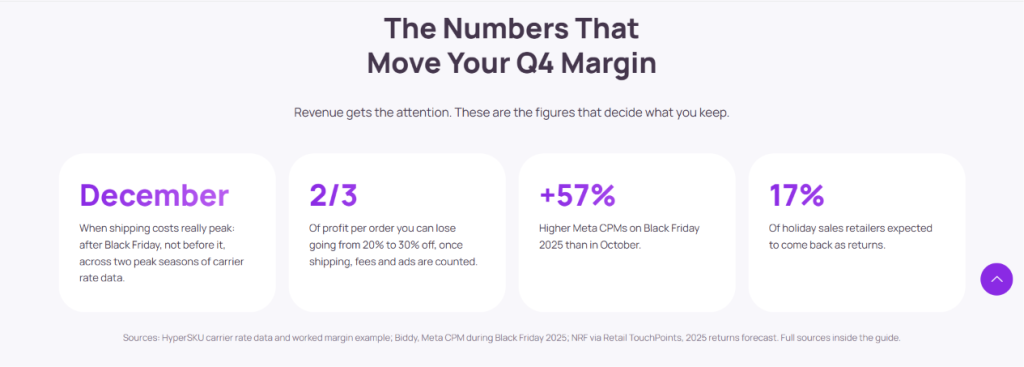
- Paid Traffic Costs Surge Before Black Friday: According to data compiled in the HyperSKU Ultimate BFCM Guide for Global Sellers (2026 Edition), Meta CPMs spike by +57% on Black Friday compared to October. Relying exclusively on last-minute cold paid traffic during Cyber Week leaves almost zero room for error.
The Margin Math: Why Deeper Discounts Can Kill Your Profit
Most BFCM guides focus on how to craft irresistible discounts. Few calculate what those discounts actually leave in your bank account after product cost, shipping, payment processing, and ad spend are deducted.
In our worked margin analysis from the HyperSKU 2026 BFCM Whitepaper, increasing a discount from 20% off to 30% off can wipe out up to two-thirds (2/3) of your profit per order.
BFCM Promotion Types: AOV vs. Margin Impact
| Promotion Type | Impact on AOV | Impact on Unit Margin | Best Use Case |
|---|---|---|---|
| Sitewide 30%+ Discount | Moderate | Severe erosion | Clearing aging, slow-moving inventory |
| Curated Product Bundles | High | Protected | Pairing hero SKUs with high-margin accessories |
| Tiered Spend Thresholds | High | Controlled | Encouraging larger carts (e.g., Spend $100, Save $15) |
| Free Gift with Purchase | Moderate–High | Protected | Adding lightweight, high-perceived-value items |
Instead of slashing prices across your entire catalog, structure offers that lift Average Order Value (AOV) so your fixed fulfillment and customer acquisition costs are spread across a larger basket.
Want the exact margin breakdown and Q4 cost calendar?
Download the free, no-signup HyperSKU Ultimate BFCM Whitepaper for Global Sellers (2026 Edition) to see full unit-economic scenarios, carrier rate timelines, and a printable readiness checklist.
Build a More Profitable BFCM Promotion: 5 High-Conversion Models
A promotion can generate plenty of orders and still leave you with little profit. While most marketing guides evaluate offers strictly on storefront conversion rates, every discount structure changes how orders are picked, packed, weighed, and cleared through customs behind the scenes.
Before locking in your weekend deals, weigh the front-end appeal of these five proven promotion models against their real-world supply chain impact:
Sitewide Discount
Easy for first-time buyers to grasp and quick to launch across ads.
Blanket markdowns ignore weight and duty gaps—restrict deep discounts to lightweight, high-margin SKUs.
Curated Product Bundles
Pairs hero SKUs with accessories to lift AOV and spread first-mile costs.
Keep bundle components in one warehouse so orders ship in a single parcel rather than splitting freight.
Tiered Spend Thresholds
Rewards larger carts (e.g., Spend $100, Save $15) without discounting single items.
Check if extra items push parcels over 500g or 2kg carrier brackets before locking in tier discounts.
Gift with Purchase (GWP)
Creates urgency and perceived value without slashing core catalog prices.
Pick compact, non-sensitive gifts (no batteries or liquids) that fit inside existing mailers without extra customs delays.
Free Shipping Threshold
Gives shoppers a clear cart target to unlock free delivery and cuts checkout abandonment.
Set your threshold 15–20% above pre-holiday AOV to build a financial buffer against December carrier rate hikes.
Channel Playbooks: Where to Push Traffic Right Now
With ad costs spiking during Cyber Week, efficiency is everything. Tailor your channel allocation based on audience warmth:
Email & SMS (Your Highest-ROI Channel): Don’t wait until Friday morning. Send VIP “Early Access” links to your subscriber lists 48 hours prior to public launch. This rewards loyal customers, drives immediate cash flow, and acts as a live technical test for your Shopify checkout scripts.
Paid Social (Meta & TikTok): Given that Meta CPMs surge significantly during Black Friday week, cold prospecting budgets will burn quickly. Shift a larger share of your budget toward warm audiences—retargeting cart abandoners, recent video viewers, and past purchasers.
Google Search & Shopping: Ensure your product feeds, pricing, stock availability, and shipping cutoffs are 100% synchronized with your store. Mismatched pricing or out-of-stock data will waste high-intent click spend.
The 4-Day Battle Plan: Navigating Black Friday Through Cyber Monday
Never run the exact same messaging and creative angle across all four days of the weekend. Keep your store dynamic with a daily cadence:
- Black Friday (Nov 27) — The Traffic & New Customer Peak: Lead with your strongest offer, best-selling hero SKUs, and highest-impact site banner to maximize new visitor conversion.
- Small Business Saturday (Nov 28) — The Brand Story Shift: Switch up your ad angles to highlight brand craftsmanship, independent values, or founder stories, appealing to shoppers looking to support independent stores.
- Sunday (Nov 29) — The Retargeting Window: Traffic naturally dips slightly. Focus heavily on retargeting ads, reminding weekend browsers of expiring carts and dwindling inventory.
- Cyber Monday (Nov 30) — The Final Hours Push: Create strict urgency with “Final Hours” messaging and prominently display holiday shipping deadlines so buyers know orders will arrive before the holidays.
Tailored Strategies For Shopify Sellers by Business Model
Different business models face distinct operational bottlenecks during BFCM. Choose the playbook that fits your storefront:
Dropshippers: Avoid testing unproven, experimental products during peak week. Concentrate 80% of your ad spend on products with verified, reliable supplier fulfillment track records, and double-check processing times with your supply chain partner.
POD & Custom Sellers: Production turnaround times stretch during November. Place prominent “Order-by Dates for Holiday Delivery” notices across your product pages and checkout drawer to minimize customer service tickets and chargebacks.
DTC Brands: Use BFCM to clear slow-moving inventory by bundling them into mystery boxes or gift sets, preserving core margins for your high-velocity seasonal lines.
Navigating the Q4 Supply Chain & Shipping Cost Calendar
One of the costliest misconceptions in eCommerce is assuming shipping rates peak before Black Friday.
Across two peak seasons of carrier rate data analyzed by HyperSKU, shipping costs and peak-season carrier surcharges actually peak in December—after Black Friday. Merchants who price their November promotions using October shipping rates often watch their margins evaporate when Cyber Week orders ship out in early December.
To protect your fulfillment margins across international markets:
- Account for December Carrier Surcharges: Build a buffer into your Q4 shipping rates and free-shipping thresholds to absorb post-Black Friday carrier adjustments.
- Audit US, UK, and EU Duty & Tax Rules: Cross-border sellers shipping into North America and Europe must verify customs declarations, IOSS/VAT handling, and landed-cost thresholds ahead of volume spikes. Unexpected customs delays also trigger payment processor payout holds when tracking updates stall.
- Publish Clear Holiday Cutoff Dates: Work backward from your fulfillment partner’s final holiday transit deadlines and display clear “Order-by for Holiday Delivery” dates on your product pages, cart drawer, and announcement bar.
Need expert backing and bulletproof Q4 fulfillment capacity?
Download the HyperSKU Ultimate BFCM Whitepaper for Global Sellers (2026 Edition) to access professional supply chain insights, peak-season carrier timelines, and expert strategies built to keep your scaling orders moving without friction.
Storefront & Conversion Optimization Before Peak Traffic Hits
Once your margins and shipping buffers are locked in, ensure your Shopify storefront converts mobile traffic without technical friction:
- Prioritize Mobile Load Speed: Mobile devices drive nearly 80% of Cyber Week browsing traffic, yet mobile conversion rates still lag behind desktop. Remove unused third-party Shopify apps, audit heavy tracking scripts, and compress hero banners to WebP format.
- Test Discount Logic Under Real Conditions: Add items to your cart on a mobile device, hit tiered discount or free-gift thresholds, remove an item, and verify that cart totals and checkout scripts recalculate cleanly.
- Capture Post-Purchase Revenue: Use lightweight cart cross-sells and post-purchase one-click offers on the Thank You page to boost AOV without slowing down initial product page load times.
- Enforce a Pre-BFCM Code Freeze: Lock down theme edits, checkout extensions, and new app installations at least seven days before Black Friday.
Fulfillment Readiness: Turning BFCM Buyers into Repeat Customers
Acquiring a customer during BFCM is expensive. Retaining them comes down to what happens after they click “Pay Now.”
- Secure Inventory Capacity Early: Stockouts on hero SKUs during Black Friday weekend waste ad spend and damage brand trust. Work with an agile sourcing and fulfillment partner like HyperSKU to lock in factory capacity, inspect product quality pre-shipment, and split inventory strategically without over-committing cash to untested products.
- Plan for High-Demand & Custom SKUs: If you sell private-label, print-on-demand, or custom seasonal items, finalize production timelines well ahead of November—especially for specialized products requiring custom materials or packaging.
- Prepare for the 17% Return Wave: Retail forecasts estimate that roughly 17% of holiday purchases end up returned. Clear sizing guides, accurate product descriptions, and proactive shipping notifications reduce “Where is my order?” (WISMO) tickets and prevent avoidable refunds.
Actionable Shopify BFCM 2026 Preparation Timeline
With Black Friday just days away, long-term planning is off the table—it’s time for execution. If you’re finalizing your store’s last-minute setup right now, use this live countdown checklist to protect your margins, lock down your checkout, and keep fulfillment running smoothly through the weekend.
BFCM 2026 Countdown: Immediate Action Plan
| Timeframe | Immediate Priority Actions |
|---|---|
| Right Now (Mid-Nov) | Lock & Test: Stress-test mobile checkout, verify discount code stacking, and publish clear holiday shipping cutoffs. Review your unit margins to ensure discounts don’t outpace profit. |
| The Week Before (Nov 20–26) | Freeze & Warm Up: Freeze theme edits and app changes. Launch early-access VIP offers via email/SMS to test your flows before public traffic hits. |
| BFCM Weekend (Nov 27–30) | Real-Time Monitoring: Monitor net contribution margins alongside ROAS. Rotate creative angles between Black Friday, Saturday, and Cyber Monday; watch stock thresholds closely. |
| Post-BFCM & December | Fulfillment & Retention: Track transit times through peak December carrier surcharge windows, send proactive tracking updates, and segment BFCM buyers for Q1 retention. |
Final Thoughts:Win Shopify BFCM 2026 on Profit, Not Just Revenue
The most successful Shopify brands treat BFCM as an operational stress test rather than a four-day discounting sprint. When you know your exact margin floor, anticipate December shipping dynamics, and back your storefront with reliable fulfillment, every order contributes to sustainable growth.
Ready to map out your Q4 numbers? Download the free HyperSKU 2026 BFCM Whitepaper for the complete Q4 cost calendar and readiness checklist!
Ready to map out your Q4 numbers and streamline fulfillment?
Download the free HyperSKU 2026 BFCM Whitepaper for the complete Q4 cost calendar and readiness checklist, or connect directly with the HyperSKU team to power up your global supply chain before peak traffic hits.
Connect with HyperSKU Team Set up your free account in minutes · Sourcing & fulfillment readyFrequently Asked Questions About Shopify BFCM 2026
When is Shopify BFCM 2026?
Shopify BFCM 2026 runs from Black Friday on November 27 to Cyber Monday on November 30, 2026.
Should I discount my entire Shopify store for BFCM?
Sitewide discounts simplify marketing but severely erode profit margins. Instead, prioritize curated product bundles, tiered spending thresholds, or gift-with-purchase incentives to protect your unit economics.
How do I know if my BFCM promotion is actually profitable?
A: Measure your Contribution Margin rather than gross revenue. Deduct product manufacturing costs, shipping fees, payment gateway commissions, ad spend (CPA), and a return allowance from your selling price.
What is the difference between Black Friday and Cyber Monday for Shopify sellers?
A: Black Friday drives peak raw traffic volume and your highest share of first-time new customer acquisitions. Cyber Monday acts as the final urgency-driven conversion push before holiday shipping deadlines close.
When do Q4 shipping rates and carrier surcharges peak?
According to supply chain carrier data, shipping rates and peak surcharges actually reach their highest levels in December, after Black Friday concludes. Be sure to factor this into your pricing models.