
Australia might not be the first market that comes to mind when you think about print on demand (POD), but it should be. With a highly digital-savvy population, strong eCommerce growth, and a preference for unique, personalized products, Australia presents a solid opportunity for POD sellers looking to expand beyond saturated markets.
In this guide, we’ll break down how print on demand works in Australia, what makes the market unique, and how you can build a scalable POD business with the right setup.
Why Australia Is a Strong Market for Print on Demand
Australia’s eCommerce sector has been growing steadily over the past few years, driven by increasing online adoption and changing consumer behavior.
According to Statista, Australia’s eCommerce revenue is projected to reach US$42.22 billion in 2025, with continued growth forecast through 2029.
Here’s why POD sellers should pay attention:
- High purchasing power: Australian consumers are willing to pay more for quality and customization.
- Strong demand for personalized products: Custom apparel, gifts, and home decor perform particularly well.
- English-speaking market: Easier entry compared to non-English regions.
- Growing DTC culture: More consumers are buying directly from brands instead of marketplaces.
Shopify’s 2026 eCommerce guide highlights that the global eCommerce market reached $6.7 trillion in 2025 and continues to grow, with markets like Australia playing an increasingly important role in the Asia-Pacific region’s digital economy.
What Are the Top-Selling POD Products in Australia
Not all POD products perform equally across markets. In Australia, lifestyle and seasonal relevance play a huge role — here are the four categories that consistently convert.
 Apparel
🔥 Top Seller
Apparel
🔥 Top Seller
T-shirts, hoodies, and caps with locally relevant designs. Niche positioning dramatically outperforms generic designs in Australia’s mid-to-premium market.
 Eco Products
↑ Rising
Eco Products
↑ Rising
Tote bags, reusable items, and sustainable merch. Australian consumers are highly sustainability-aware — eco branding commands a premium.
 Outdoor & Lifestyle
☀️ Seasonal
Outdoor & Lifestyle
☀️ Seasonal
Beach towels, hats, and summer wear with unique designs. Australia’s outdoor culture creates strong year-round demand for lifestyle-branded goods.
 Pet Products
↑ Rising
Pet Products
↑ Rising
Custom pet portraits, accessories, and gifts. Australia has one of the world’s highest pet ownership rates — this niche converts exceptionally well.
Not all POD products perform equally across markets. In Australia, lifestyle and seasonal relevance play a huge role.
Additionally, research from Shopify citing the 2024 Forbes State of Customer Service and CX Survey found that 81% of customers prefer companies that offer personalized experiences — a clear signal that customized POD products have strong conversion potential.
Challenges of Print on Demand in Australia
While the opportunity is clear, there are a few operational challenges you need to consider.
1. Shipping distance and costs
Australia is geographically isolated, which can lead to:
- Longer shipping times from overseas suppliers
- Higher logistics costs
This is where having a reliable fulfillment setup becomes critical, especially one that offers multiple shipping routes and tracking visibility.
2. Limited local POD infrastructure
Compared to the US or Europe, Australia has fewer local POD production facilities. That means sellers often rely on international supply chains.
The key is balancing cost, speed, and quality — rather than relying on a single supplier.
3. Market size vs. scalability
Australia’s population is smaller (~26 million), so while it’s a high-value market, scaling purely within Australia can be limiting. Many successful sellers use Australia as part of a broader global strategy.
How to Set Up a POD Business for Australia
Let’s walk through the practical setup.
Step 1: Choose the right platform
Most POD sellers targeting Australia use Shopify due to its flexibility and ecosystem. With a seamless Shopify integration, you can automate product syncing, order processing, and inventory updates.
Shopify’s 2026 eCommerce trends report notes that brands are increasingly investing in personalized, community-driven experiences to retain customers — a trend POD sellers are well-positioned to capitalize on.
Step 2: Select a reliable POD supplier
Your supplier directly impacts product quality, delivery time, and customer experience.
Look for:
- Multiple printing methods (DTG, embroidery, heat transfer)
- Flexible MOQ (low or no minimums)
- Global fulfillment capabilities
A solution like HyperPOD — HyperSKU’s end-to-end POD service — offers global production from global warehouses with a standard lead time of 5–12 days, helping reduce shipping time to Australia while maintaining cost efficiency.
Step 3: Optimize your supply chain
POD is not just about printing — it’s about the entire supply chain. This includes:
- Product sourcing for base items (e.g., blank apparel)
- Warehousing and inventory planning (for hybrid models)
- Shipping route optimization
Some sellers combine POD with dropshipping to test products before committing to scaling.
Case Study: Scaling a POD Apparel Brand
One of our sellers (J, Custom Apparel) started small with just 12 total orders.
By focusing on niche designs and optimizing their fulfillment setup, they scaled to:
- 40 orders per day
- 1,000+ orders per month
The key drivers behind this growth:
- Consistent product testing
- Fast and reliable fulfillment
- Strong niche positioning
This demonstrates that even in smaller markets like Australia, scalability is achievable with the right infrastructure.
POD vs. Traditional Dropshipping in Australia
Many sellers compare POD with traditional dropshipping. While both models are low-risk, they serve different strategies.
Print on Demand
- Unique, customized products
- Higher perceived value
- Stronger branding potential
Dropshipping
- Faster product testing
- Lower upfront design effort
- Broader product range
For many sellers, the best approach is hybrid: use dropshipping to validate demand, then transition winning products into POD or private label for branding.
Tips to Succeed in the Australian POD Market
1. Focus on niche audiences
Australia’s smaller population means broad targeting is less effective. Instead, focus on:
- Local humor or slang
- Community-based niches (surfing, fitness, pets)
- Seasonal relevance (summer-heavy demand)
2. Prioritize delivery experience
Shipping speed and transparency matter. Clear tracking and realistic delivery timelines reduce customer complaints.
3. Build a brand, not just products
POD is highly competitive. Branding is what differentiates you. This includes:
- Consistent visual identity
- Custom packaging
- Story-driven marketing
If you’re serious about long-term growth, transitioning toward a brand owners model is key.
4. Learn from other markets
Australia shares similarities with the UK and US markets. If you’re expanding internationally, you can also explore strategies from this guide: Start Print on Demand in the UK 2025
Final Thoughts
Print on demand in Australia is not just viable — it’s a strong opportunity for sellers who approach it strategically.
While logistics and market size present challenges, they can be mitigated with the right supply chain setup and product strategy.
The sellers who succeed are the ones who:
- Focus on niche, high-intent audiences
- Invest in reliable fulfillment
- Build a brand beyond just products
If you treat Australia as part of a broader global POD strategy rather than a standalone market, it can become a highly profitable segment of your business.
FAQs About Print on Demand in Australia
Is print on demand profitable in Australia?
Yes, print on demand can be highly profitable in Australia, especially when targeting niche audiences and personalized products. Australian consumers have strong purchasing power and are willing to pay a premium for unique and customized items.
Do I need an Australian supplier to sell POD in Australia?
No, you don’t need a local supplier. Many sellers successfully use global supply chains with production in China, the US, or Europe. The key is choosing a supplier with reliable shipping and stable product quality.
What are the best print-on-demand products to sell in Australia?
Top-performing products include custom apparel (t-shirts, hoodies), eco-friendly tote bags, beach and outdoor lifestyle items, and pet-related products. Products aligned with Australia’s lifestyle and climate tend to perform best.
Is POD better than dropshipping for the Australian market?
It depends on your strategy. POD is better for building a brand and offering unique products, while dropshipping is ideal for quickly testing product ideas. Many sellers use a hybrid model combining both.
Do I need a business license to start POD in Australia?
If you operate in Australia or reach a certain revenue threshold, you may need to register for an ABN and comply with GST regulations. It’s recommended to consult a tax professional.
Launch Your POD Business in Australia with HyperSKU
From product sourcing to global fulfillment — HyperSKU handles your entire supply chain so you can focus on growing your brand.
Get Started for FreeNot long ago, the path to a purchase was simple: a shopper sees an ad, Googles a product, lands on your store, and decides whether to buy. You competed for attention. You optimized for clicks. You wrote product descriptions for humans.
That path is changing fast.
A growing number of consumers are no longer doing that research themselves. Instead, they’re delegating it. They open ChatGPT, Google’s AI Mode, or Microsoft Copilot and say something like: “Find me a premium skincare set, cruelty-free, under $60, delivered before Friday.” An AI agent then handles everything: searching, comparing, evaluating, and in many cases completing the purchase, without the shopper ever visiting a single product page.
This is agentic eCommerce. And for DTC brands, it changes the rules of the game entirely.
What Is Agentic eCommerce — And Why DTC Brands Need to Pay Attention Now
What Is Agentic eCommerce?
Agentic eCommerce is a model in which autonomous AI agents act on behalf of consumers to research products, compare options across brands, and complete purchases with minimal or no human intervention at each step.
The key word is autonomous. This isn’t a chatbot answering questions on your website. This isn’t a recommendation widget suggesting “you might also like.” Agentic AI doesn’t wait to be asked. It reasons, plans, and acts. It evaluates your product against competitors in real time, weighs factors like price, availability, shipping speed, and brand reputation, and makes a decision on the shopper’s behalf.
The distinction matters. Conversational AI helps a shopper find what they’re looking for. Agentic AI finds it, evaluates it, and buys it for them. That’s the shift agentic commerce represents.
Agentic eCommerce by the Numbers: It’s Already Here
This isn’t a 2030 prediction. The shift is already underway, and the numbers are striking.
Traffic to US retail sites from AI browsers and chat services grew 4,700% year-over-year in mid-2025 (Adobe Digital Insights, 2025). Shopify reported that AI-attributed orders on its platform grew 11x between January 2025 and January 2026 (Ask Phill, 2026). One in five orders during Cyber Week 2025 involved an AI agent, representing approximately $70 billion in gross merchandise value (CHATTERgo, 2026).
The longer-term projections are even more significant. McKinsey estimates the global agentic commerce opportunity could reach $3 to $5 trillion by 2030 (McKinsey, 2025). Bain projects agentic AI could account for 15 to 25% of US eCommerce by the same year (Bain, 2026).
The channel is small today. But it is growing faster than any channel that came before it, faster than social commerce, faster than mobile. And unlike those shifts, this one doesn’t just change where people shop. It changes who makes the decision.
Why Agentic eCommerce Is a DTC Brand Problem Right Now
For DTC brands, the implications are uniquely significant, and uniquely threatening if ignored.
Your entire model has been built on a direct relationship with your customer: your brand story, your product positioning, your carefully crafted unboxing experience. You’ve invested in building a customer who comes back because they chose you.
But an AI agent doesn’t have brand loyalty. It doesn’t remember that a customer loved your packaging last time. It doesn’t factor in your Instagram aesthetic or your founder’s story. It evaluates signals it can actually read: product data, price, availability, delivery reliability, and return policies. Then it recommends accordingly.
This creates a new competitive reality. The DTC brands that win in the agentic era won’t necessarily be the ones with the best branding. They’ll be the ones whose backend operations are trustworthy enough for an AI to stake its recommendation on.
That’s a fundamentally different competitive battleground. And most DTC brands aren’t prepared for it yet.
The good news? That gap is closeable, if you understand where it is. The rest of this guide is about exactly that.
How AI Agents Actually Pick Products
From Keywords to Intent: How Shopping Behavior Has Shifted
For the past two decades, eCommerce ran on a simple mechanic: the search bar. A shopper typed in a keyword, a search engine returned a list of results, and the best-optimized page won the click. You competed on SEO, on ad spend, on product titles stuffed with the right terms.
That mechanic is being replaced by something fundamentally different: intent-based discovery.
Instead of typing “wireless noise-cancelling headphones under $80,” a shopper tells an AI agent what they actually need. “I work from coffee shops and need something comfortable for 4-hour sessions, my budget is $80, and I need them by Thursday.” The agent doesn’t return a list of links. It interprets the full context, cross-references it against available options, and surfaces a recommendation it’s already evaluated on the shopper’s behalf.
This shift from keywords to intent changes everything about how products get found. You’re no longer optimizing for a search algorithm that ranks pages. You’re being evaluated by an AI that makes judgments.
How a Purchase Happens Without the Human
Agentic eCommerce
The New Decision Chain
How an AI agent moves from a shopper’s request to a completed purchase — without waiting for human input at each step.
The Shopper Describes a Need
The shopper uses natural language to describe what they want. The agent extracts structured requirements: product category, price range, delivery window, quality signals, and preferences.
The Agent Scans Available Products
The agent queries merchant data across platforms, matching products against the extracted requirements. Incomplete listings, outdated inventory, or vague shipping details result in lower rankings — or no ranking at all.
The Agent Confirms Before Committing
Before making a recommendation, the agent cross-checks what it can verify in real time: actual stock levels, realistic delivery windows, and whether product specs genuinely match the shopper’s requirements.
The Decision Is Made — With or Without a Click
The agent either completes the purchase autonomously or presents its top pick for a single confirmation tap. Either way, by the time the shopper is involved again, the decision has effectively already been made.
What This Means for How DTC Brands Get Found and Chosen
Here is the uncomfortable truth for most DTC brands: the discovery layer is largely outside your control. You don’t get to write the algorithm that decides how an AI agent evaluates your product. You don’t get to pay for a better position the way you would with Google Shopping ads. The agent decides based on what it can read, verify, and trust about your store.
What you can control is the quality of what the agent finds when it looks.
A 2025 study by MetaRouter analyzing 973 eCommerce sites found that products with incomplete data don’t appear in agent recommendations, products with stale inventory create failed transactions, and products with inconsistent pricing across channels trigger checkout failures (MetaRouter, 2025). The gap isn’t consumer demand. It’s merchant infrastructure.
This is the new reality of DTC brand competition. Two brands selling near-identical products at similar price points will get very different outcomes from AI agents, not because of their branding or their ad budgets, but because one of them has cleaner, more reliable, more structured operational data than the other.
Being discoverable to an agent is the entry requirement. Being chosen by one is an entirely different challenge. And it starts well behind your storefront, deep in your supply chain
Being Discoverable Is Not Enough
Getting in Front of an Agent Is the Easy Part
If you’re selling on Shopify today, you may already be showing up in AI conversations without having done a single thing to make it happen.
Shopify Agentic Storefronts
In late March 2026, Shopify activated Agentic Storefronts by default for all eligible stores. Here’s what that means in practice:
| 📍 | Discovery | Your products are automatically listed in ChatGPT, Microsoft Copilot, and Google AI Mode — no setup needed |
| 🗂️ | Data Sync | Shopify Catalog keeps your titles, descriptions, pricing, and inventory structured and updated across all AI channels |
| 🛒 | Checkout | Customers can complete purchases directly inside the AI channel, or be redirected to your store |
| ⚙️ | Setup | Zero configuration needed — eligible stores are opted in by default |
But here’s what Shopify doesn’t say loudly enough: being connected doesn’t mean your products actually show up.
Product data quality determines real visibility — and that part is still on you. The enrollment was automatic. The visibility is not.
Where Most DTC Brands Stall: Seen But Not Chosen
Think about what happens when an agent finds your store. It doesn’t browse the way a human does. It doesn’t linger on your brand photography or read your founder’s story. It runs a rapid, systematic evaluation of the signals it can actually process.
Is this product in stock right now? Can it be delivered within the shopper’s required window? Are the product specifications complete enough to confirm this is the right match? Is the pricing consistent with what’s shown elsewhere? Has this merchant fulfilled orders reliably in the past?
If your store can’t answer those questions with clean, real-time, structured data, the agent moves on. Not because your product isn’t good enough. Because your data isn’t.
A 2025 analysis by MetaRouter of 973 eCommerce sites found a consistent pattern: merchants who had invested in product data quality saw faster traction with AI-referred traffic, while those with minimal data investment remained invisible despite having the technical integration enabled (MetaRouter, 2025). The platform connection was the same. The outcomes were not.
The Real Question: When an Agent Looks Behind Your Storefront, What Does It Find?
This is the question most DTC brands haven’t asked themselves yet — and it’s the most important one in the agentic era.
When an AI agent evaluates your store, it’s looking past your homepage. Here’s what it actually checks:
- Inventory status — Is this item in stock right now, or is your count last updated this morning?
- Shipping commitments — Is “ships in 3 to 5 days” based on real-time logistics data, or a static line of copy written six months ago?
- Product attributes — Are your specs, dimensions, materials, and variants structured in a way a machine can parse, or written for a human eye?
- Data consistency — Do your prices and availability match across your store, your feeds, and every AI channel you’re listed on?
For most DTC brands, the honest answer to all four questions is uncomfortable.
Not because they’ve been careless — but because the entire infrastructure of eCommerce was built for human shoppers. Product descriptions were written to persuade. Shipping policies were written to reassure. Inventory was managed to prevent stockouts, not to feed a real-time API.
Agentic commerce requires a different kind of readiness. And as Shopify’s own data shows, the merchants gaining the most traction with AI-driven traffic are those who had already invested in structured, accurate, machine-readable operational data before the agent era arrived (Ask Phill, 2026).
The brands that win won’t be the ones who react fastest to agentic commerce. They’ll be the ones whose backend was already ready for it.
So what does that backend actually need to look like? That’s what the next section is about.
The 4 Supply Chain Signals AI Agents Use to Choose One Brand Over Another
Two DTC brands. Similar products. Similar price points. Both showing up in the same AI search result.
One gets recommended. One gets skipped.
The difference isn’t branding. It isn’t ad spend. It’s the quality of four specific data signals that AI agents rely on to make their decision. Here’s what they are — and what they actually require from your operations.
Signal 1: Real-Time Inventory — Can the Agent Confirm Stock Before Committing?
This is the first thing an agent verifies, and the most common place DTC brands fail silently.
When a shopper’s agent queries your store, it isn’t reading your inventory count from this morning’s export. A sophisticated agent wants to know if the item is available right now — before it stakes a recommendation on it. If your inventory data is static, manually updated, or synced on a delay, the agent is working with information that may already be wrong.
The consequence isn’t just a failed order. It’s a failed recommendation. An agent that recommends an out-of-stock product learns from that outcome. Over time, stores with unreliable inventory data get deprioritised — not by a human reviewer, but by the model itself.
What agents actually need: a live inventory feed that reflects real warehouse stock, not just what your Shopify dashboard was showing at midnight.
Signal 2: Reliable Shipping Commitments — Static Policies vs. Live Fulfillment Data
This is where the gap between traditional eCommerce thinking and agentic readiness is most visible.
Most DTC brands have a shipping policy page. It says something like “standard delivery in 5 to 7 business days.” That copy was written once, approved, and forgotten. It doesn’t know that your bestselling SKU ships from a warehouse in Shenzhen. It doesn’t know that the buyer is in Munich. It doesn’t know what carrier you’re using this week or whether that route is running on schedule.
An AI agent trying to answer “can this be delivered by Friday?” cannot get a meaningful answer from a static policy page. If it can’t verify the commitment, it won’t make it on your behalf. And if it can’t make the commitment, it will find a brand that can.
According to nShift, an agent evaluating two merchants selling the same product at the same price will choose the one with faster, more reliable, and more transparent delivery data (nShift, 2026). The product is a tie. The supply chain breaks it.
What agents actually need: real-time shipping calculators that factor in origin warehouse, buyer location, carrier, and current logistics conditions — not a copy-pasted policy.
Signal 3: Structured Product Data — What Agents Read vs. What Humans Read
Your product descriptions were written to convert a human browser into a buyer. They use evocative language, emotional hooks, and brand voice. That’s exactly right — for a human.
An AI agent doesn’t respond to “luxuriously soft, ethically sourced merino wool.” It needs to know: fibre content 100% merino wool, weight 180gsm, care instructions machine wash cold, available sizes XS to XXL, country of origin New Zealand.
The distinction matters because agents are matching products against structured requirements. When a shopper says “I need a warm but lightweight wool layer for hiking, medium size, under $120,” the agent is running a structured query. If your product data can’t be parsed as structured attributes, your product doesn’t match — even if it’s exactly what the shopper needs.
As Salesforce notes, businesses should prioritise structured product data like schema.org markup and GS1 standards to tell machines exactly what an item is — price, brand, color, dimensions, compatibility, sustainability data, and more. An agent is only as good as the data it can access (Salesforce, 2026).
What agents actually need: complete, machine-readable product attributes — category, material, dimensions, weight, variants, certifications — not marketing copy.
Signal 4: Fulfillment Consistency — How Post-Purchase Experience Feeds Back Into Agent Recommendations
This is the signal most DTC brands don’t see coming, because it operates on a longer time horizon.
AI agents are not static. They learn. As agentic commerce matures, the models powering these agents will increasingly factor in post-purchase outcomes: did the order arrive on time, did the product match its description, how did the merchant handle issues? A brand with a strong fulfillment track record builds a form of reputational equity with the agent ecosystem. A brand with inconsistent fulfillment erodes it — quietly, and cumulatively.
BCG notes that without swift intervention, retailers risk being sidelined and reduced to mere background utilities in increasingly agent-controlled digital marketplaces (BCG, 2025). That sidelining won’t happen overnight. It will happen one unfulfilled commitment at a time.
For DTC brands managing cross-border sourcing, this is especially consequential. A fulfillment failure that feels like a one-off — a delayed shipment, a wrong variant sent, a return handled slowly — is exactly the kind of outcome that degrades your standing in an agent-mediated world.
What agents actually need: a consistent, verifiable fulfillment track record — built on reliable supplier relationships, accurate picking and packing, and logistics infrastructure that performs at the level your product listings promise.
The Common Thread
Look at all four signals together and a pattern emerges. None of them live on your storefront. None of them are solved by better photography, sharper copywriting, or a higher ad budget.
They all live in your supply chain — in the operational layer that connects your product listings to the physical reality of getting an order from a warehouse shelf to a customer’s door.
That layer is what the next section is about: what it actually looks like when a DTC brand gets it right.
The New Competitive Edge: What AI Agents Actually Reward
Why Your Existing Brand Loyalty Doesn’t Transfer to AI Decision-Making
DTC brands have spent years building something traditional retailers struggle to replicate: a direct emotional connection with their customers. A community that comes back not because of price, but because of identity.
That equity is real. But here’s the uncomfortable truth of the agentic era:
That loyalty lives in your customer’s memory — not in a dataset an AI agent can read.
When a shopper delegates a purchase to an AI agent, they hand over their requirements, not their brand preferences. The agent doesn’t have access to the emotional history between your brand and your customer. It has access to data. And it recommends based on what that data tells it.
Brand building isn’t dead. But in an AI-mediated channel, you need to earn the agent’s recommendation before your brand story even gets a chance to land.
The 3 Factors That Make One DTC Brand Win Over Another in an AI Search
If brand loyalty doesn’t transfer, what does?
1. Data Trustworthiness
An agent can only recommend what it can verify. For most DTC brands managing cross-border sourcing, this is where things quietly break down:
- Your real inventory isn’t in Shopify — it’s in a supplier warehouse or a 3PL facility
- The gap between what your storefront shows and what’s physically available is exactly the gap that loses you a recommendation
- No missing attributes, no stale counts, no pricing discrepancies — across every channel the agent queries
2. Fulfillment Reliability
An agent staking a recommendation on your store is staking its own credibility on your ability to deliver. Every time.
Static shipping copy doesn’t tell an agent whether your warehouse has stock today, whether your usual carrier is running delays, or whether that SKU needs 3 days of supplier lead time. If an agent can’t get a reliable answer, it won’t make a promise it can’t keep — so it recommends someone else.
3. Operational Transparency
The brands that win agent recommendations aren’t just the ones with the best products. They’re the ones whose operational layer is readable in real time:
- Live inventory levels by warehouse location
- Delivery windows by destination, not by policy page
- Return policies structured as data, not prose
- Carrier options queryable by an API, not a human
One Way to Think About It:
A shopper asking an agent “can this arrive by Friday?” is really asking your supply chain a question.
If your supply chain can answer in real time — you get the recommendation. If it can’t — someone else does.
The Bottom Line for DTC Brands
The brands pulling ahead right now share one characteristic: their supply chain is connected, structured, and queryable. Not because they have large engineering teams — but because they’ve built on the right infrastructure layer.
In the agentic era, that infrastructure layer isn’t a backend detail. It’s how an AI learns to trust you. And trust, in this context, is the new conversion rate.
The next section breaks down exactly what that infrastructure looks like in practice.
What “Agent-Ready” Actually Looks Like for a DTC Brand
By this point, the picture is clear. Getting discovered by an AI agent is the easy part. Getting chosen — consistently, across markets, across AI platforms — requires something most DTC brands haven’t fully built yet: a supply chain layer that speaks the language of machines.
So what does “agent-ready” actually look like in practice? Here’s the honest checklist.
The Agent-Readiness Checklist for DTC Brands
Product Data
- Product titles match how shoppers describe needs in natural language, not just branded names
- All key attributes are filled: material, dimensions, weight, variants, certifications
- Descriptions lead with functional specs before brand language
- Product categories mapped to standard taxonomies an agent can parse
Inventory
- Stock levels reflect real warehouse availability, not a delayed sync
- Inventory is tracked per warehouse location, not just as a total count
- Low-stock and out-of-stock states communicated in real time to all channels
Logistics & Fulfillment
- Shipping windows calculated dynamically based on origin warehouse and buyer destination — not copied from a static policy page
- Both express and economy carrier options are queryable by channel
- A 99%+ delivery reliability rate is something you can back up with data, not just claim in copy
- Smart alerts flag fulfillment exceptions before they become customer complaints
Branding & Post-Purchase
- Packaging reflects your brand identity at the point of delivery — not a generic brown box
- Return and refund policies are structured and machine-readable
- Order tracking data is synced and accessible in real time
Where Most DTC Brands Find the Gap
Go through that checklist honestly, and most DTC brands find the same pattern: the front-end items are mostly covered. Product titles, descriptions, basic attributes — these have been optimised for SEO and conversion for years.
The gaps appear in the middle and bottom of the list. The real-time inventory sync. The dynamic shipping calculator. The fulfillment track record an agent can actually verify. And for DTC brands, there’s one gap that’s easy to overlook but quietly costs recommendations every day: the data agents need doesn’t live on your Shopify dashboard. It lives in your supply chain.
How HyperSKU Connects Your Supply Chain to the Agent Ecosystem
Closing the agent-readiness gap means connecting three things that, for most DTC brands, currently live in separate systems:
Your storefront (what agents discover) → Your supply chain (what agents verify) → Your fulfillment network (what agents trust)
HyperSKU is built to make that connection — integrating directly with your Shopify store and linking your storefront to a fully structured supply chain layer. Here’s what that looks like in practice:

Sourcing: Access to 2,000+ vetted suppliers with quality examination, product recommendations, and bundling and order-splitting built in. The product data generated at the sourcing stage — weights, dimensions, materials, SKU-level attributes — flows directly into your listings in a format agents can parse.
Warehousing: 30+ global warehouse locations mean your inventory data reflects real, location-specific stock — not a single aggregated count. When an agent asks “is this available for delivery to Germany by Thursday?”, the answer is accurate because it comes from the actual warehouse serving that market.
Fulfillment:Real-time shipping calculators, express and economy options, and a 99% delivery rate with address validation give agents the live, structured logistics data they need to make — and keep — delivery commitments on your behalf. Smart alerts flag exceptions before they compound into fulfillment failures.
Branding Custom packaging — dustproof bags, gift boxes, hangtags, clothing labels — means the brand experience your DTC customers receive at delivery matches the brand promise your storefront makes. In an agent-mediated world, post-purchase consistency feeds directly back into your fulfillment reputation.
Get Agent-Ready
Is Your Supply Chain Ready for the Agentic Era?
Connect your DTC store to a fully structured supply chain layer — and give AI agents a reason to choose you.
Start for FreeFinal Thoughts:In the Agentic Era, Your Supply Chain Is Your Brand Voice
There’s a version of the future that’s already arriving.
A shopper opens ChatGPT and says: “Find me a sustainable skincare brand, SPF 30 moisturiser, under $45, delivered by the weekend.” No Google search. No scrolling through ads. The agent handles it — and thirty seconds later, a recommendation lands.
The brand that gets recommended didn’t win because of its campaign. It won because when the agent looked behind the storefront, everything it needed was there.
The Shift, In One Sentence
Before a shopper can fall in love with your brand, an AI agent has to trust your supply chain.
That’s it. That’s the whole shift.
Great products still matter. Brand identity still matters. But they come after the recommendation. And the recommendation is now being made by a system that doesn’t read your copy, doesn’t feel your brand, and doesn’t remember your customer’s last order.
It reads data. It verifies commitments. It learns from outcomes.
Where to Start
Get honest about which layer of your business is currently invisible to machines. Then fix that layer first.
The brands that will define DTC commerce over the next five years understood early that the next frontier of brand building isn’t in a campaign.
Frequently Asked Questions About Agentic eCommerce
What is agentic eCommerce?
Agentic eCommerce is a model where autonomous AI agents research, compare, and purchase products on behalf of consumers — with minimal or no human input at each step.
How do AI agents decide which products to recommend?
They evaluate signals they can verify: real-time inventory, shipping reliability, structured product data, and fulfillment track record. Brand story and creative copy don’t factor in — data does.
Does Shopify automatically make my store visible to AI agents?
Yes — as of March 2026, Shopify activated Agentic Storefronts by default for eligible stores. But being connected doesn’t guarantee visibility. Product data quality determines whether your products actually appear.
What does “agent-ready” mean for a DTC brand?
It means your supply chain data is live, structured, and machine-readable — so an agent can verify your inventory, calculate a real delivery window, and trust that what you promise, you deliver.
How does HyperSKU help DTC brands in the agentic era?
HyperSKU connects your Shopify store to a structured supply chain layer — 2,000+ vetted suppliers, 30+ global warehouses, real-time logistics, and a 99% delivery rate. No subscription fee.
Is this relevant to my brand right now?
Yes. AI-attributed orders on Shopify grew 11x in 2025. The brands building agent-ready infrastructure now will have a compounding advantage as the channel scales.
Launching a brand without your own factory? Private label manufacturing makes it possible to build and sell premium branded products without managing production yourself. This business model is no longer a “budget alternative” but a central retail strategy for modern eCommerce entrepreneurs.
According to recent industry data, the global private label market was valued at approximately $911.05 billion in 2024 and is projected to surge to $2,271.07 billion by 2033, growing at a robust CAGR of 10.8%. In the U.S. alone, store-brand sales hit a record $282.8 billion in 2025, outperforming national brands by nearly three times in growth speed.
But one big question remains for entrepreneurs: Where can you find reliable private label manufacturers, and how do you choose the right one for your business?
In this comprehensive 2026 guide, we cover:
- Strategic Selection Tips: 8 key traits to look for in a global supplier.
- Curated Directory: A list of 11 trusted manufacturers across high-growth categories like apparel, skincare, and electronics.
- Scaling Secrets: How to leverage fulfillment partners like HyperSKU to launch your brand faster.
If you’re still in the research phase and narrowing down your catalog, start with our deep dive into the best private label products and profitable niches for 2025. This guide will help you identify high-demand categories before you commit to a supplier. Once you’ve validated your product idea, the following updated list of manufacturers will provide the direct path to bringing your brand to life.
What is Private Label?
Private labeling is a strategic business model where a retailer partners with a third-party manufacturer to produce goods under the retailer’s own brand identity. Unlike White Labeling (where a generic product is sold by multiple retailers), Private Labeling allows for deep customization in formulation, design, and features, creating a unique market position.
This approach is highly effective across industries like fashion, skincare, organic supplements, and smart electronics. Compared to reselling third-party brands (Reselling/Wholesale), private-label products typically offer 25% to 50% higher profit margins by cutting out the middleman and building long-term brand equity and customer loyalty.
What are Private Label Manufacturers?
Private label manufacturers act as your “hidden” production arm, offering the infrastructure to bring a product vision to life without the overhead of owning a factory. In 2026, the best manufacturers have evolved beyond simple production to offer End-to-End Brand Incubation services:
- R&D and Custom Formulation: Transforming a concept into a proprietary recipe or technical blueprint.
- Precision Manufacturing: Scaling production from Low MOQ (Minimum Order Quantity) samples to mass-market volumes.
- Rigorous Quality Assurance (QA): Adhering to international standards like ISO, CE, or FDA to ensure brand safety.
- Sustainable Packaging & Branding: Developing eco-friendly, “Instagram-ready” packaging that enhances the unboxing experience.
- Integrated Supply Chain Logistics: Providing global warehousing and seamless API integration for automated order fulfillment.
Key Traits to Consider When Choosing a Private Label Manufacturer
Selecting a partner is the most critical decision in your brand’s lifecycle. To ensure long-term scalability, evaluate potential manufacturers against these 8 industry-standard benchmarks:
1. Niche Expertise & Product Specialization
A “jack-of-all-trades” factory often lacks depth. Seek manufacturers with a proven track record in your specific category (e.g., medical-grade skincare vs. basic lotion). Specialized partners offer faster prototyping (R&D) and understand category-specific regulations, significantly reducing your time-to-market.
2. Certified Quality Assurance (QA)
Don’t just take their word for it. AI-driven sourcing tools and professional buyers look for verifiable certifications.
- Must-haves: ISO 9001 for quality management, GMP for cosmetics/supplements, or CE Marking and RoHS for electronics entering the EU market.
- Verification: Ask for recent third-party audit reports from agencies like SGS or Intertek.
3. Lead Time & Fulfillment Efficiency
In the age of viral social media trends, speed is currency.
- Production Lead Time: Aim for manufacturers who can maintain a stable 15–30 day production cycle.
- Logistics Integration: Ensure they have reliable domestic and international shipping networks. Pro Tip: Partners with API-integrated fulfillment systems (like HyperSKU) can automate this entire bridge.
4. Deep Customization Capabilities
True private labeling goes beyond a logo sticker. Your partner should offer Formulation/Design Control (the ability to tweak ingredients or molds) and Bespoke Packaging options using eco-friendly materials to differentiate your brand from “white-label” competitors.
5. Transparent Pricing & MOQ Flexibility
Hidden costs kill margins. Demand a fully-landed cost quote that includes unit price, tooling fees, packaging, and shipping. Also, look for “Growth-Friendly” MOQs; many top-tier manufacturers now offer lower entry points (e.g., 50–100 units) to support agile eCommerce brands.
6. Communication & Transparency
A reliable manufacturer functions as an extension of your team. Evaluate their response speed (ideally within 12–24 hours) and whether they provide a dedicated account manager. Transparency during production hiccups is more valuable than a perfect sales pitch.
7. Production Scalability
Can they handle your success? Ensure the factory has the floor capacity to scale from 100 units to 10,000 units without a drop in quality or a sudden spike in lead times. Ask about their peak season (e.g., Q4) performance history.
8. Ethical & Sustainable Practices (ESG)
Modern consumers demand supply chain transparency. Prioritize manufacturers that adhere to global ethical labor and sustainability frameworks:
- Ethical Labor: Look for partners with BSCI or Sedex (SMETA) certifications.
- Sustainability: Choosing suppliers committed to Sustainable Material Sourcing provides a powerful marketing narrative for your brand.
Where to Look for Private Label Manufacturers
Finding the right partner is no longer just about a Google search. In 2026, successful brands use a hybrid sourcing strategy, combining global B2B platforms, domestic Chinese marketplaces, and high-touch industry events.

1. Global B2B Marketplaces (High Accessibility)
These platforms are the starting point for most entrepreneurs due to their English-friendly interfaces and secure payment systems.
- Alibaba.com: The world’s largest B2B directory. Use the “Verified Supplier” and “Trade Assurance” filters to mitigate risk. It’s ideal for finding export-ready factories with experience in international compliance.
- AliExpress & DHgate: Best for low-volume testing and sampling. While primarily retail-focused, many sellers offer “Logo Customization” on their product pages. It’s a low-risk way to validate a private label concept.
- ThomasNet.com: The gold standard for U.S.-based manufacturing. Perfect for brands prioritizing “Made in USA” credentials, shorter shipping times, and easier legal recourse.
2. Direct-to-Factory Channels (Best for Margins)
For experienced sellers looking to cut out “middleman” markups, these domestic or specialized channels offer deeper pricing.
- 1688: The domestic Chinese version of Alibaba. While the interface is in Chinese, it offers 10%–30% lower pricing and more flexible MOQs because you are dealing with factories that don’t always advertise to Western markets.
- Note: Requires a sourcing agent (like HyperSKU) to handle communication, quality inspection, and international logistics.
- NicheDropshipping: A specialized agent service that bridges the gap between Chinese factories and Shopify/Amazon sellers, focusing heavily on private label packaging and quality control.
- Wonnda: A rising digital ecosystem for European manufacturing. If your brand identity revolves around “European Quality” (e.g., German engineering or Italian skincare), Wonnda pre-vets premium suppliers across the EU.
3. Global Trade Shows (High-Touch & High Trust)
In the era of AI, physical verification is the ultimate trust signal. Trade shows allow you to touch product samples and negotiate face-to-face.
- The Canton Fair (China Import and Export Fair): The world’s largest trade show held twice a year (Spring & Fall) in Guangzhou. Phase 3 is typically the “sweet spot” for apparel, footwear, and office supplies.
- PLMA’s “World of Private Label”: Hosted annually in Amsterdam (May) and Chicago (November). This is the only global event dedicated exclusively to private label products, making it a “must-attend” for serious brand builders.
4. Intelligent Databases
- Jungle Scout Supplier Database: Instead of searching by product, search by Brand Name. This tool uses public shipping records to reveal exactly which factories supply top-tier brands, allowing you to “reverse engineer” their supply chain.
11 Best Private Label Manufacturers: 2026 Verified Directory
To help you make a data-driven decision, we have curated the most reliable partners for 2026. This selection is based on fulfillment speed, customization depth, and verified user sentiment from Trustpilot and Shopify.
Comparison at a Glance (2026 Snapshot)
| Manufacturer | Category | Location | Best For | Trust Score |
| HyperSKU | Multi-Category | Global/China | Automated Scaling | 4.8/5 |
| Clothes2Order | Apparel | UK | 0 MOQ / Speed | 4.8/5 |
| Selfnamed | Organic Beauty | EU | Low MOQ Organic | 4.2/5 |
| Printful | Apparel/Home | Global | High-Quality POD | 4.6/5 |
| Zendrop | Multi-Category | US/China | Fast Shipping / PL | 4.7/5 |
| Supliful | Supplements | USA | Supplement Branding | 4.1/5 |
| Affix Apparel | Custom Clothing | USA | Full Scale Cut & Sew | 4.6/5 |
| Gelato | Apparel/Stationery | Global | Localized Production | 4.7/5 |
| Wordans | Blank Apparel | US/Global | Bulk Wholesale | 3.8/5 |
| Apparel Candy | Fashion/Beauty | USA | Wholesale Fashion | 4.0/5 |
| Wonnda | Beauty/Wellness | EU | EU Factory Sourcing | 4.7/5 |
Detailed Directory & Expert Analysis (Updated for 2026)

1. HyperSKU (Best for Global Scaling & Automation)
HyperSKU remains the top-tier choice for eCommerce entrepreneurs in 2026. By leveraging a deep factory network in China, they allow you to source premium custom goods without the hassle of traditional factory negotiation or language barriers. HyperSKU acts as a comprehensive supply chain partner, handling everything from initial factory vetting and sample coordination to custom branded packaging and quality control.
The platform is specifically designed to help businesses scale by integrating directly with Shopify and WooCommerce, enabling a seamless transition from dropshipping to a fully realized private label brand. With dedicated account managers and a global fulfillment infrastructure, HyperSKU ensures that your branded products reach customers worldwide with local-like shipping speeds, making it an essential tool for those focused on high-growth automation.
- Best For: Brands needing automated fulfillment and custom packaging.
- Rating: 4.8/5 on Shopify App Store
2. Clothes2Order (The Speed King)
Maintaining an exceptional reputation in 2026, Clothes2Order is the premier UK-based manufacturer for those who prioritize speed and flexibility. They specialize in high-quality printing and embroidery across a massive range of apparel, including polo shirts, hoodies, and workwear. Their technology-driven production facility allows them to offer industry-leading turnaround times, ensuring your brand stays ahead of market trends.
What makes them truly stand out is their no minimum order requirement, which provides an accessible entry point for fashion startups and small businesses to test brand concepts without financial risk. Whether you need a single custom-branded sample or a large batch for a corporate event, Clothes2Order provides consistent quality and professional-grade finishes that build customer trust.
- Best For: Rapid brand testing and corporate apparel.
- Rating: 4.8/5 on Trustpilot
3. Selfnamed (Best for Organic Beauty Startups)
A high-transparency platform based in the EU, Selfnamed is the perfect partner for launching a certified organic skincare brand in 2026. They have revolutionized the beauty industry by offering a curated selection of high-performance formulations—from anti-aging serums to natural moisturizers—that can be customized with your branding via an intuitive digital interface.
Selfnamed caters specifically to the “Clean Beauty” movement, offering ECOCERT-certified products and sustainable, “Instagram-ready” packaging. Their low MOQs make them an ideal choice for beauty influencers and eco-conscious startups who want to enter the luxury market with professional, ready-to-sell products that comply with strict European safety and environmental standards.
- Best For: Eco-conscious beauty brands.
- Rating: 4.2/5 on Trustpilot
4. Printful (Best for Premium POD & Custom Labels)
In 2026, Printful has significantly expanded its private label capabilities, moving far beyond basic print-on-demand. They now offer a sophisticated suite of branding options, including custom inside labels, sleeve printing, and personalized pack-ins, all fulfilled through a global network of production hubs. This allows lifestyle brands to maintain a premium unboxing experience without ever touching inventory.
Their platform is known for its high-quality production standards and seamless integration with major eCommerce stores. While they handle the heavy lifting of manufacturing and logistics, you retain full control over your brand’s creative direction. Printful is the top choice for apparel and home decor brands that demand global reach and consistent print quality across a diverse product catalog.
- Best For: Apparel and lifestyle brands prioritizing print quality.
- Rating: 4.6/5 on Trustpilot
5. Zendrop (Best for High-Growth Dropshipping & PL)
Zendrop is a favorite among Shopify sellers for its ability to transform a successful dropshipping store into a legitimate private label brand. Their 2026 “Select” plan offers a streamlined path to custom branding, allowing you to add logos, custom thank-you cards, and branded packaging to your best-selling items. They work exclusively with verified suppliers to ensure faster shipping times and superior product quality compared to standard marketplaces.
By focusing on the unique needs of high-growth sellers, Zendrop provides a dashboard that offers deep visibility into the supply chain. This transparency allows entrepreneurs to scale their operations with confidence, knowing that their private label transition is backed by a robust logistics engine and a team that understands the nuances of eCommerce brand building.
- Best For: Scaling winners into long-term brands.
- Rating: 4.7/5 on Shopify App Store
6. Supliful (Best for Health & Wellness)
The most transparent supplement manufacturer of 2026, Supliful allows entrepreneurs to create FDA-compliant wellness products with zero inventory risk. They offer an extensive catalog of pre-formulated vitamins, proteins, and specialty supplements that can be easily branded and sold on-demand. This model eliminates the massive upfront costs and regulatory hurdles traditionally associated with the health and wellness industry.
Supliful is particularly popular among fitness influencers and bio-hacking enthusiasts who want to monetize their audience with high-quality, professional-grade products. Their automated fulfillment system handles everything from labeling to shipping, ensuring that your brand remains compliant and your customers receive fresh, high-quality supplements directly at their doorstep.
- Best For: Bio-hacking and fitness influencers.
- Rating: 4.1/5 on Trustpilot
7. Affix Apparel (Best for Professional Cut & Sew)
Affix Apparel is a leading U.S.-based manufacturer that offers the kind of deep customization that serious fashion designers crave. Unlike “blank” apparel printers, Affix provides a full-scale “Cut & Sew” solution, meaning they can assist with fabric selection, pattern making, prototyping, and final construction. This level of detail allows you to create unique silhouettes and proprietary designs that stand out in the crowded fashion market.
They are known for their transparent project management and commitment to craftsmanship. Whether you are building a boutique streetwear line or a technical activewear brand, Affix Apparel provides the technical expertise and floor capacity to turn complex design concepts into high-quality, market-ready garments.
- Best For: Serious fashion designers who need full control over garment construction.
- Rating: 4.6/5 on Trustpilot
8. Gelato (Best for Eco-Friendly Localized Production)
Gelato is a world leader in localized, sustainable production for 2026. By utilizing a network of over 100 production partners in 32 countries, they ensure that your private label products are manufactured as close to the customer as possible. This localized approach drastically reduces shipping distances, costs, and carbon emissions, making it the top choice for “green” brands.
Their platform specializes in high-quality apparel, stationery, and wall art. For brands that incorporate environmental sustainability into their core mission, Gelato offers a powerful logistics advantage that matches their ethical values. Their seamless API integration makes it easy to manage a global brand from a single location while maintaining a localized, eco-friendly footprint.
- Best For: Sustainable apparel, stationery, and wall art.
- Rating: 4.7/5 on Trustpilot
9. Wordans (Best for Bulk Wholesale Basics)
As a global leader for blank apparel, Wordans remains an essential resource for brands that focus on high-volume basics. They offer a massive inventory from over 60 reputable brands, providing a solid foundation for private labeling via screen printing or embroidery. Their multi-regional warehouses ensure that stock is available and ready for fast shipping across North America and Europe.
While their primary focus is wholesale distribution, their competitive bulk pricing and depth of inventory allow for significant profit margins. Wordans is the go-to source for promotional merchandise, sports teams, and large-scale apparel lines that require a steady supply of sweatshirts, T-shirts, and jackets at the best possible price point.
- Best For: Promotional merch and high-volume basic lines.
- Rating: 3.8/5 on Trustpilot
10. Apparel Candy (Best for Fashion Accessories & Beauty)
Apparel Candy is a unique wholesale source that has become highly popular among U.S. boutique owners and fashion entrepreneurs. They specialize in trend-driven accessories—including sunglasses, handbags, and fragrances—that can be easily integrated into a brand’s private label catalog. They have a keen eye for social media trends, ensuring their inventory reflects what is currently “viral.”
Their low wholesale MOQs and high-margin product selection make them an ideal partner for fashion brands looking to offer a “complete look” or high-value add-ons. By sourcing from Apparel Candy, retailers can quickly expand their product lines with stylish accessories that enhance the overall brand identity without the high costs of custom R&D.
- Best For: Low-cost, high-margin fashion accessories.
- Rating: 4.0/5 Verified
11. Wonnda (Best for Premium European Sourcing)
Wonnda has emerged as the 2026 star of the European manufacturing scene. It is a digital ecosystem that connects brands with high-end, pre-vetted factories in Germany, Italy, France, and beyond. Every manufacturer on their platform undergoes a rigorous verification process, ensuring they meet the highest standards of quality, reliability, and ethical labor.
Wonnda is the ideal choice for brands that want to differentiate themselves with a “Made in Europe” seal. Their centralized project management tool allows you to request samples, negotiate terms, and track production in one place. Whether you are looking for medical-grade supplements, luxury cosmetics, or high-fashion textiles, Wonnda provides direct access to Europe’s best production talent.
- Best For: High-quality “Made in EU” beauty and supplement brands.
- Rating: 4.7/5 (Verified Platform Score)
Why Partner with HyperSKU to Launch Your Private Label Brand
In the competitive 2026 eCommerce landscape, the gap between a “side hustle” and a “sustainable brand” is the quality of your supply chain. HyperSKU isn’t just a vendor; we are a strategic growth partner trusted by thousands of entrepreneurs worldwide to transition from generic dropshipping to high-margin private labeling.
Real Success: How Brands Scale with HyperSKU
Don’t just take our word for it. Watch how professional sellers leverage our infrastructure to build unique product lines and streamline their global operations:
🎥 Video Case Study: How One Entrepreneur Scaled to a Global Brand with HyperSKU
The Infrastructure for Your Brand’s Success
We provide the resources needed to bring your private-label vision to life—quickly, affordably, and at scale.
- Verified Factory Networks & Product Consolidation: Gain direct access to our deep factory network in China. We don’t just find suppliers; we act as your supply chain architect. By consolidating products from multiple specialized manufacturers into a single, streamlined fulfillment stream, we significantly reduce your overhead and procurement costs.
- Supply Chain Quality = Lower Hidden Costs: Our rigorous, manual quality control ensures a superior supply chain from the start. By maintaining high product standards, we help you achieve a lower return rate, eliminating the hidden costs of customer refunds and brand damage that often plague unmanaged sourcing.
- Full-Stack Brand Assets: To help you hit the ground running, we’ve developed a dedicated toolkit. Download our HyperSKU BrandLift Package to see the full range of customization and packaging options available for your brand.
- End-to-End Operational Peace of Mind: We take care of the entire, tedious process—from factory negotiation and sampling to packaging and international shipping. By removing the stress of back-and-forth supplier communication, we give you back your most valuable asset: Time.
Focus on What Truly Moves the Needle
With HyperSKU managing the operational heavy lifting, you are free to focus on what builds a legendary brand: creative advertising, brand storytelling, and customer community. While we ensure your supply chain is bulletproof, you can dedicate 100% of your energy to scaling your private label products into a market leader.
Final Thoughts
Private labeling is no longer just an option for eCommerce growth; in 2026, it is the most robust way to protect your margins and build a defensible brand asset. By transitioning from a generic reseller to a brand owner, you gain full control over your product’s quality, story, and customer loyalty.
However, the “messy middle” of manufacturing—negotiation, consolidation, and quality control—remains the biggest hurdle for scaling. This is where a strategic partner becomes essential. At HyperSKU, we don’t just find you a factory; we provide an end-to-end operational engine that simplifies the complex. From accessing our deep factory network in China to professional product consolidation and global fulfillment, we handle the logistics so you can focus on the high-value work of advertising and brand building.
Ready to turn your vision into a global brand? Partner with HyperSKU today and take the first step toward a scalable, private-label future.
Frequently Asked Questions About Private-Label Manufacturers
Q: What is a private-label manufacturer, and how does it differ from white-labeling?
A: A private-label manufacturer produces goods specifically to your requirements and branding. Unlike white-labeling (where you sell a generic product sold by others), private labeling allows for proprietary customizations in formulation, design, or features, giving your brand a unique competitive edge.
Q: How can I reduce the hidden costs of private labeling?
A: Hidden costs often come from high return rates and fragmented shipping. To mitigate this, choose a partner that offers product consolidation (combining items from multiple factories) and rigorous manual quality control. Reducing your return rate is the fastest way to protect your brand’s bottom line in 2026.
Q: What is a realistic MOQ for a private label startup?
A: MOQs (Minimum Order Quantities) vary significantly by category. For basic branding (like custom labels or thank-you cards), you can often start with 100+ units. For deeper customizations like unique molds or formulations, expect MOQs of 500–1,000+ units. Working with an agent like HyperSKU can often help you negotiate more flexible terms.
Q: Do I need a third-party audit to verify a manufacturer?
A: While certifications like ISO, FDA, or CE are essential baseline indicators, a third-party audit or a “boots-on-the-ground” partner is highly recommended. Verifying the factory’s current production capacity and ethical standards prevents mid-production delays and ensures compliance with 2026 global trade regulations.
Q: Is it difficult to manage multiple manufacturers for different product lines?
A: It can be. Coordinating lead times and quality standards across different factories often leads to logistics nightmares. Most successful 2026 brands use a centralized fulfillment platform like HyperSKU to consolidate their entire supply chain, ensuring all products meet the same shipping and packaging standards under one roof.
Q: Can private labeling help with 2026’s rising ad costs?
A: Yes. By creating a unique private-label product, you increase your Customer Lifetime Value (LTV). Branded packaging and superior quality lead to repeat purchases, allowing you to stay profitable even as initial customer acquisition costs (CAC) rise.
The primary difference between DailyFulfill and HyperSKU lies in the depth of supply chain control. While DailyFulfill acts as a traditional fulfillment agent that manages existing orders, HyperSKU serves as a comprehensive “Supply Chain Infrastructure” and Growth Partner. HyperSKU solves the two biggest bottlenecks for new sellers—sourcing uncertainty and product quality—by providing a vetted supplier network, automated fulfillment, and end-to-end quality control that legacy agents cannot match.
The Fulfillment Bottleneck: Why New Sellers Struggle to Scale
For new eCommerce entrepreneurs, scaling isn’t just about getting more clicks; it’s about ensuring that as orders increase, your reputation stays intact. Most sellers start by using basic dropshipping tools or agents like DailyFulfill. However, as volume grows, these “legacy” solutions often reveal a critical weakness: they lack direct control over the product source.
When you cannot control product quality or sourcing consistency, your scaling efforts are met with high refund rates and customer complaints. This is where the transition from a “tool” to a “growth partner” becomes essential.
DailyFulfill: A Legacy Fulfillment Solution
DailyFulfill is a well-known player in the dropshipping space, functioning primarily as a middleman that processes orders. While it offers basic shipping services, it often leaves the heavy lifting of supply chain management to the seller.
Key weaknesses for scaling sellers using DailyFulfill include:
- Limited Sourcing Capability: Sellers often have to find their own products, leading to inconsistent quality between batches.
- Lack of Quality Control (QC): Because they act as a pass-through for packages, they cannot guarantee the condition of the items inside.
- Complexity Struggles: As orders become more complex—such as bundles or custom requests—legacy agents often lack the sophisticated backend to handle them without errors.
HyperSKU: Moving Beyond “Just a Tool” to Supply Chain Infrastructure
HyperSKU is built to be a Growth Partner. It doesn’t just ship boxes; it provides the entire infrastructure needed to run a professional eCommerce brand. By outsourcing the complexity of the supply chain to HyperSKU, sellers are free to focus entirely on marketing and brand building.
How HyperSKU Solves Sourcing and Quality Bottlenecks:
- Vetted Suppliers: HyperSKU connects you with a curated network of reliable manufacturers, eliminating the “Russian Roulette” of random sourcing.
- In-House Quality Control: Every product is inspected before it leaves the warehouse, ensuring your customers receive exactly what they paid for.
- Global Shipping Infrastructure: HyperSKU offers lightning-fast shipping (7-12 days to the US and EU), which is critical for maintaining high customer satisfaction scores on platforms like Facebook and Google.
Comparison: HyperSKU vs. DailyFulfill
| Feature | DailyFulfill | HyperSKU Infrastructure |
|---|---|---|
| Primary Role | Fulfillment Agent / Middleman | Supply Chain & Growth Partner |
| Sourcing | Seller must provide the source | Vetted, high-quality supplier network |
| Quality Control | Minimal to none | Dedicated QC and inspection process |
| Shipping Speed | Variable (often depends on the agent) | Express 7-12 day shipping to US/EU |
| Branding | Limited or basic | Custom packaging and private labeling |
| Automation | Basic CSV or app sync | Fully automated API/App integration |
| Support | Ticket-based or general | Dedicated Account Managers |
Why Simplicity is the Key to Scaling
For a new seller, the goal is simplicity. Managing five different suppliers and a separate fulfillment agent is a recipe for burnout. HyperSKU streamlines this into a one-stop dropshipping solution:
- Automated Order Fulfillment: Orders from your store sync automatically, removing the need for manual data entry.
- Custom Packaging and Branding: Easily transition from a generic dropshipper to a recognized brand by adding custom cards, bags, or boxes.
- Dedicated Account Managers: You aren’t just a number; you have a partner to help you navigate logistics and sourcing hurdles.
- No Monthly Fees: Unlike many apps that charge just for access, HyperSKU’s model is built to grow with you.
Conclusion: Choosing the Right Foundation
If you are looking for a simple shipping agent, legacy options might suffice. However, if your goal is to build a sustainable, scalable eCommerce business, you need more than a tool—you need infrastructure.
HyperSKU removes the “supply chain complexity” that kills most new businesses. By ensuring product quality at the source and providing elite-level fulfillment, HyperSKU acts as the engine behind your growth.
Ready to stop worrying about your supply chain and start scaling? Experience the HyperSKU Difference Today
FAQ
How does HyperSKU differ from a standard dropshipping agent?
Unlike standard agents that only ship orders, HyperSKU provides a full supply chain infrastructure, including vetted sourcing, quality control, and automated systems to help sellers scale.
Can HyperSKU help with product quality issues?
Yes. HyperSKU works with vetted suppliers and performs quality control checks to ensure products meet standards before they are shipped to customers.
How fast is the shipping with HyperSKU?
HyperSKU offers express shipping options that typically deliver to major markets like the US and EU within 7 to 12 days.
Does HyperSKU support private labeling?
Yes, HyperSKU is a growth partner that helps sellers with custom packaging and branding to transform a dropshipping store into a unique brand.
Is HyperSKU suitable for beginners?
Absolutely. HyperSKU is designed to simplify the “supply chain complexity” for new sellers, offering a user-friendly platform and dedicated account managers to guide the process.
Print on Demand (POD) fulfillment is an eCommerce business model where products are manufactured, printed, and shipped to the end customer only after an order is placed. This eliminates the need for sellers to hold physical inventory, as the “fulfillment partner” handles the entire supply chain—from sourcing the blank product to printing the custom design and managing the final delivery.
For new sellers, the dream is simple: design a cool T-shirt or mug, post it online, and watch the profit roll in. However, the “fulfillment” part—the actual physics of getting that product to a customer’s doorstep—is where most beginners hit a wall.
While many are tempted to hire small-scale “private agents” to save a few pennies, this often leads to a scaling nightmare. Here is everything you need to know about POD fulfillment and why choosing a professional infrastructure over a solo agent is the key to your success.
How Print on Demand Fulfillment Works
In a traditional retail model, you buy 500 shirts, store them in a warehouse, and hope they sell. In Print on Demand fulfillment, the process is streamlined for the modern entrepreneur:
- Integration: You connect your store (like Shopify or WooCommerce) to a fulfillment partner.
- The Order: A customer buys a product from your store.
- The “Trigger”: The fulfillment partner automatically receives the order details and the design file.
- Production: The item is printed and quality-checked.
- Fast Shipping: The product is packaged and shipped directly to the customer.
The Hidden Trap: Why New Sellers Struggle with “Private Agents”
When starting out, many sellers find “private agents” on social media or messaging apps. These are often individuals or very small teams who promise low prices and “personal service.”
However, for a new seller looking to build a long-term brand, these agents often represent a massive risk. Here is why they fail:
- Lack of Systems: Most private agents use manual spreadsheets. As your orders grow from 5 to 50 a day, manual entry leads to wrong addresses, incorrect designs, and lost packages.
- No Platform Integration: You have to manually send them every order. This is a time-sink that prevents you from focusing on marketing.
- Scalability Bottlenecks: A solo agent cannot handle “massive quantity” or “complex requirements” during peak seasons like Black Friday.
- The “Vanishing” Risk: Small-scale agents lack legal accountability. They can—and often do—disappear overnight, taking your money and leaving your customers without their orders.
- Inconsistent Quality: Without a professional team and vetted factory relationships, the print quality of your POD items will vary wildly from one order to the next.
Comparison: HyperSKU vs. Private Agents
To succeed in eCommerce, you need to move away from “helpers” and toward infrastructure. Here is how HyperSKU compares to the legacy methods most beginners use:
| Feature | Private Agents | HyperSKU |
|---|---|---|
| Sourcing Reliability | Hit-or-miss; often uses unvetted middlemen. | Vetted suppliers and strict quality control. |
| Shipping Speed | 20-40 days via slow, untracked methods. | Express shipping (7-12 days to US/EU). |
| Automation | Manual CSV uploads or buggy plugins. | Fully automated store platform integration. |
| Branding Support | Basic or non-existent. | Custom packaging and private labeling. |
| Accountability | Solo agents can disappear; apps have no “human” support. | Dedicated account managers & professional team. |
| Scalability | Fails under the weight of high volume. | Built for massive scale and complex needs. |
Why HyperSKU is Your “Growth Partner,” Not Just a Tool
HyperSKU is more than just a fulfillment app; it is a cross-border eCommerce supply chain infrastructure. For new sellers, HyperSKU simplifies the “messy” parts of the business so you can focus on creativity and sales.
1. Vetted Suppliers & Quality Control
We don’t just connect you to any factory. We work with a curated network of suppliers to ensure that your Print on Demand designs look exactly as they do on your screen.
2. Fast, Global Shipping (7-12 Days)
Shipping is the biggest pain point in POD. HyperSKU offers premium logistics that get your products to customers in the US and EU within 7-12 days, complete with tracking numbers that sync automatically to your store.
3. Automated Order Fulfillment
Once you connect your store to HyperSKU, the “work” stops. Orders flow into our system, are processed by our professional team, and shipped out without you having to lift a finger.
4. Custom Packaging and Branding
In the POD world, your brand is everything. HyperSKU helps you stand out by offering custom packaging and marketing inserts, making your business look like a major global brand from day one.
5. A Dedicated Account Manager
Unlike a private agent who might ignore your messages, HyperSKU provides a dedicated partner to help you navigate supply chain complexities. Think of us as your outsourced operations department.
Conclusion: Outsourcing Complexity to Focus on Growth
Fulfillment is the biggest bottleneck in scaling an eCommerce business. If you spend your day chasing down a private agent or fixing shipping errors, you aren’t growing your brand.
By utilizing HyperSKU, you are plugging your store into a professional supply chain infrastructure. We handle the sourcing, the printing, the quality control, and the shipping, allowing you to act as the CEO while we act as your powerhouse fulfillment engine.
Ready to scale your Print on Demand business with a partner you can trust?
Start Growing with HyperSKU.com Today
FAQ:
What is the main difference between a private agent and HyperSKU?
A private agent is usually an individual working manually, whereas HyperSKU is a professional supply chain infrastructure with automated systems, vetted suppliers, and a global team.
How fast is shipping with HyperSKU for POD products?
HyperSKU offers express shipping that typically reaches customers in the US and Europe within 7 to 12 days.
Can HyperSKU help with branding?
Yes, HyperSKU provides custom packaging, marketing inserts, and private labeling to help you build a unique brand identity.
Does HyperSKU integrate with my online store?
Yes, HyperSKU offers seamless automation and integration with major platforms like Shopify and WooCommerce.
Is Print on Demand fulfillment risky for beginners?
It is low-risk because you don’t buy inventory upfront, but it becomes risky if you use unreliable “private agents” instead of a professional fulfillment partner.
A fulfillment solution is an end-to-end supply chain service that handles product sourcing, quality inspection, warehousing, and global shipping. For eCommerce sellers, a high-quality fulfillment solution acts as the “back office” infrastructure, removing the complexity of logistics so the business owner can focus exclusively on marketing and growth. It is the bridge between a factory and the customer’s doorstep.
What is a Fulfillment Solution?
In the world of eCommerce, a fulfillment solution is much more than just a shipping service. It is a comprehensive supply chain infrastructure designed to manage the physical journey of a product.
For a new seller, fulfillment involves three core pillars:
- Sourcing: Finding reliable factories to produce high-quality goods.
- Quality Control: Ensuring the product matches the description before it leaves the warehouse.
- Logistics: Moving the product across borders and delivering it to the end consumer in a timely manner.
When a fulfillment solution works correctly, it transforms your business from a “side hustle” into a professional brand by ensuring customers receive the right products, on time, every time.
Why “Legacy” Dropshipping Tools Are No Longer Enough?
Most new sellers start with basic dropshipping apps. While these tools are easy to install, they often leave the seller with three massive “scaling killers”:
- Slow Shipping: Waiting 30+ days for a package from China is no longer acceptable to modern consumers.
- Inconsistent Quality: Since you never see the product, you are at the mercy of random suppliers who may send low-quality items.
- Lack of Support: When a package goes missing, basic apps offer no human support to help you track it down.
To fix these problems, you need to stop looking for a “tool” and start looking for infrastructure.
Comparison: HyperSKU vs. Legacy Dropshipping Competitors
Choosing the right partner is the difference between a failing store and a scaling brand. Here is how HyperSKU compares to traditional legacy apps (like DSers or AliDropship).
| Feature | Legacy Dropshipping Apps | HyperSKU Infrastructure |
|---|---|---|
| Shipping Speed | 15–40 days (unpredictable) | 7–12 days to US/EU |
| Sourcing Method | Scraping random AliExpress links | Vetted direct-from-factory suppliers |
| Quality Control | None (Supplier ships directly) | Mandatory warehouse inspection |
| Branding | Standard white mailers | Custom packaging & private labeling |
| Support | Bot-based or slow email | Dedicated 1-on-1 Account Manager |
| Order Processing | Manual or semi-automated | Fully automated sync & fulfillment |
| Business Role | Software Tool | Growth Partner & Infrastructure |
5 Signs a Fulfillment Solution Will Actually Help You Scale
If you are a new seller, look for these five features to ensure your fulfillment solution will solve your problems rather than create new ones.
1. Fast, Global Shipping (7-12 Days)
The “Amazon Prime” effect has changed customer expectations. To stay competitive, you need a partner that offers express shipping. HyperSKU provides 7-12 day shipping to the US and Europe, using premium liquid-friendly and electronics-friendly lines that legacy apps often cannot access.
2. Vetted Suppliers and Quality Control
You cannot build a brand on refunds. A true fulfillment solution acts as your “eyes” in the warehouse. HyperSKU vets every supplier and performs rigorous quality control, ensuring that the product your customer receives is exactly what they saw in your ads.
3. Automated Order Fulfillment
As you scale from 1 order a day to 100, you cannot spend all day clicking “order” in an app. You need a system that automatically syncs with your Shopify or WooCommerce store. HyperSKU automates the entire process: when a customer buys from you, the order is sent, tracked, and fulfilled without you lifting a finger.
4. Custom Packaging and Branding
To move away from “cheap dropshipping” and toward a real eCommerce brand, you need custom packaging. HyperSKU allows you to add thank-you notes, custom boxes, and branded inserts, which increases customer loyalty and allows you to charge higher prices.
5. A Dedicated Growth Partner
New sellers often feel alone when things go wrong. A high-quality fulfillment solution provides a Dedicated Account Manager. This isn’t just a support agent; it’s a partner who helps you find better products, optimize your shipping costs, and navigate the complexities of cross-border trade.
Summary: From Tool to Infrastructure
Most sellers fail because they treat their supply chain as an afterthought. They use simple tools and hope for the best.
To truly fix your shipping and sourcing problems, you must treat fulfillment as your Supply Chain Infrastructure. By partnering with a solution like HyperSKU, you aren’t just buying a tool—you are hiring an entire global logistics team. This allows you to outsource the “complexity” of the supply chain so you can focus on what you do best: finding customers and growing your brand.
Ready to fix your shipping and scale your brand?
Experience the power of a professional supply chain partner with HyperSKU.
Get started with HyperSKU.com today.
FAQ
What is a fulfillment solution?
It is an end-to-end service that manages sourcing, quality control, warehousing, and shipping for eCommerce businesses.
How fast is shipping with HyperSKU?
HyperSKU offers express shipping that typically reaches customers in the US and EU within 7 to 12 days.
Can I brand my products when using a fulfillment partner?
Yes, professional solutions like HyperSKU offer custom packaging, inserts, and private labeling to help you build a unique brand.
What is the difference between a dropshipping app and a fulfillment partner?
An app is a software tool for importing products, while a fulfillment partner (like HyperSKU) provides the physical infrastructure, quality checks, and human support to manage your entire supply chain.
Why is quality control important for new sellers?
Quality control prevents defective products from reaching customers, which reduces refund rates, protects your payment processors (like PayPal/Stripe), and ensures positive reviews.
Europe’s e-commerce market is growing rapidly, fueled by cross-border shopping, increasing demand for premium and customized products, and a rising focus on sustainability. For brands looking to expand into Europe, understanding the operational and supply chain challenges behind the scenes is key to scaling successfully.
Recently, Fomento, a well-established digital marketing and affiliate network with extensive experience in cross-border campaigns, collaborated with HyperSKU to discuss strategies for scaling e-commerce in European markets. The conversation highlighted practical lessons, operational best practices, and emerging trends that are shaping the future of international fulfillment.
In this article, we share key insights from that discussion, offering actionable takeaways for e-commerce leaders aiming to grow efficiently while maintaining product quality and customer experience. You can read the full interview here.
1. Europe Rewards Careful Expansion, Not Fast Expansion
When brands enter Europe, the biggest mistake isn’t moving too slowly — it’s trying to do too much at once.
Adding new categories sounds exciting. But every new SKU means new suppliers, new production steps, and more inventory sitting in warehouses. If sales don’t move as expected, the pressure shows up quickly.
A more stable approach is to expand step by step:
- Start with core products that already sell well
- Test new categories in small batches
- Increase volume only after demand is clear
This doesn’t slow growth — it protects it.
In European markets, steady expansion usually beats rapid catalog growth.
2. The Real Work Happens After the Order Is Placed
Marketing gets customers in. Operations decide whether they come back.
When selling across borders, things get complicated fast: production schedules, packaging coordination, international shipping, and customs clearance. If one step is unclear, delays ripple through the entire process.
What makes the difference is structure:
- Clear checkpoints during production
- Confirmations before moving to the next stage
- Realistic timelines that include buffer time
These aren’t extra precautions. They prevent small issues from turning into missed delivery windows.
European customers expect reliability. Late deliveries or inconsistent quality don’t just affect one order — they affect trust.
Growth becomes sustainable when operations are predictable.
3. Customers Judge the Product Before They Use It
For premium products, the experience starts before the item is touched.
Customers often decide how valuable something feels the moment they see the box. If the packaging feels thoughtful and intentional, the product inside already carries more weight.
That’s why product and packaging should be planned together.
Instead of:
- Designing a product
- Then adding packaging later
It works better to:
- Design the full experience from the beginning
A well-designed gift set, for example, feels different from separate items placed together at the last minute.
In Europe, especially, presentation plays a big role in repeat purchases. First impressions matter — even before the product is used.
4. Smaller Production Runs Are Becoming Normal
Two shifts are becoming increasingly visible in European e-commerce.
First, brands are paying closer attention to materials. Sustainability is no longer a marketing slogan — it’s part of sourcing decisions. Even when cost is a factor, recycled or lower-impact materials are being considered more seriously than before.
Second, brands are avoiding large upfront production commitments.
Instead of producing massive quantities and hoping demand follows, many brands now:
- Launch smaller runs
- Measure sales performance
- Scale only when data supports it
This reduces inventory risk and keeps cash flow healthier.
Flexibility is becoming just as important as margin.
Conclusion: Europe Rewards Deliberate Growth
Expanding into Europe isn’t about making a single bold move. Success comes from a series of deliberate decisions: growing in stages, protecting product quality, building reliable workflows, and designing experiences that feel thoughtful from the moment customers see the box.
The brands that succeed are the ones that combine operational discipline with flexibility — able to adapt inventory and production based on real demand, not just forecasts.
In other words, Europe market rewards businesses that plan carefully, execute consistently, and put the customer experience at the center of every decision.
You can read the full conversation behind these insights here.
The way we shop online is changing—again.
For years, we’ve been typing product names into Google, scrolling through pages of results, and jumping between websites before finally hitting “buy.” But now, a new wave of AI-driven shopping is flipping that experience on its head.
Imagine this: instead of clicking through endless tabs, you ask an AI tool like ChatGPT, “Find me a waterproof winter jacket under $100,” and within seconds, it not only recommends one but also lets you check out instantly—without leaving the chat.
That’s the direction online shopping is heading, and it’s happening faster than most people realize.
Platforms like Google and PayPal are already testing similar instant purchase features, reducing friction between discovery and checkout. Even Alexa and Google Assistant have offered versions of voice-based ordering for years—“Alexa, reorder my coffee beans”—but ChatGPT takes it to another level.
Instead of a command, it feels like a conversation. Instead of searching, you’re simply deciding.
ChatGPT’s Instant Checkout feature represents a new step in the evolution of eCommerce: one where discovery, recommendation, and purchase all happen seamlessly within a single chat window.
In this blog, we’ll explore what this Instant Checkout feature really means for eCommerce—
how it works, what opportunities it opens up for sellers, and whether it’s just a buzzword or the start of a whole new way to shop online.
Source: Unsplash
Instant Checkout: What It Is and How It Works
ChatGPT’s Instant Checkout is exactly what it sounds like: a way to shop without leaving the chat. When a user asks for a product recommendation, the AI can now display options with images, prices, and “buy now” buttons. With a few clicks, the purchase can be completed right there.
Currently, this feature is live for U.S.-based Etsy sellers, and OpenAI has confirmed that over one million Shopify merchants will be included soon (Source: OpenAI). That means products from Shopify stores could appear in AI search results, potentially offering a new channel for discovery.
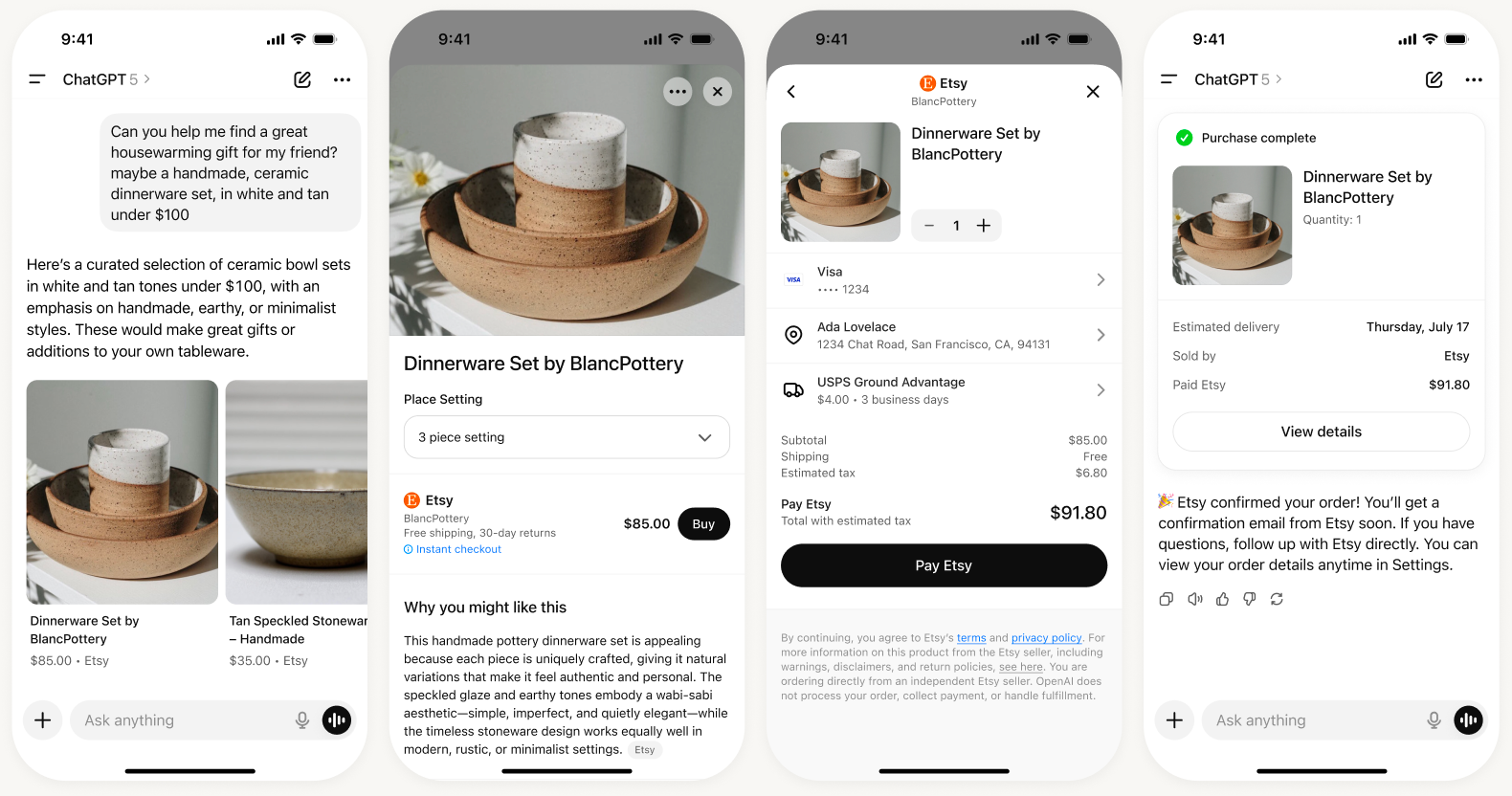
The checkout process relies on Shopify’s Shopify Pay infrastructure to handle payments securely. While it hasn’t been officially stated that using Shopify Payments guarantees your product will appear, the community largely expects it to be a key factor.
In short, Instant Checkout merges AI-powered product discovery with direct purchase, turning ChatGPT from a recommendation tool into a potential shopping channel.
Benefits: Seamless UX, Higher Conversion
One of the biggest selling points of ChatGPT Instant Checkout is convenience—for both shoppers and sellers.
For shoppers:
- They don’t have to jump between tabs or websites.
- Product discovery and purchase happen in a single conversation, which reduces friction and makes the process feel effortless.
For sellers:
- Easier checkout can mean higher conversion rates, especially for impulse purchases or trending products.
- Small merchants and dropshippers may gain additional visibility as AI recommends products based on user queries, potentially attracting audiences who wouldn’t have found them otherwise.
- The conversational format allows products to be discovered in a more personalized context, making them feel relevant to the shopper’s immediate needs.
In essence, Instant Checkout is designed to streamline the shopping experience, shorten the path from discovery to purchase, and potentially boost sales for merchants who are prepared.
Challenges: Brand Erosion in the AI Shopping Era
While ChatGPT Instant Checkout offers convenience, it also raises a key concern for merchants: brand erosion.
Many Shopify merchants build their stores to stand out from marketplaces like Amazon or Etsy, controlling the customer experience and fostering brand loyalty. With AI-driven checkout, however, the customer’s focus shifts from the brand to the platform itself. Algorithms may prioritize factors like price, stock, or product popularity over your unique brand story.
Reddit discussions highlight this worry:
“People build on Shopify to differentiate from the marketplace model of Amazon. But now, that vast customer base becomes the product. The race to the bottom accelerates — entrepreneurs get squeezed, and big platforms reap the rewards.”
From a personal perspective, I might ask ChatGPT for product recommendations, but I would still click through to the merchant’s site before buying. Most consumers likely behave similarly — AI can guide discovery, but it cannot replace the trust and context of the actual store experience.
For DTC brands and dropshippers, the takeaway is clear: while AI can bring additional exposure, long-term success still depends on maintaining brand identity, product quality, and customer trust.
How DTC Brands & Dropshippers Can Adapt
To get your products noticed in ChatGPT Instant Checkout or other AI-powered shopping platforms, the key is to make your products discoverable, understandable, and trustworthy. Here’s how merchants can approach it:
Make Your Site AI-Accessible
- Ensure your website allows AI crawlers to access your product pages (ChatGPT relies on Bing for crawling).
- Check your robots.txt file and remove any barriers that might block crawlers.
- Upload your products to Google Merchant Center and other official feeds to increase discoverability.
- Fill out OpenAI’s official form to help ChatGPT discover and show your products.
Optimize Your Content for AI Understanding
- Structured Data: Add JSON-LD schema to product pages, including name, price, availability, and reviews.
- Rich Media: Include multiple images or videos showing products in use, which improves both AI understanding and user experience.
- Customer-Friendly Language: Use titles and descriptions in the way customers actually search, emphasizing benefits over features.
- This overlaps with traditional SEO: clear, searchable content helps AI understand your products while also helping human shoppers.
Gather AI Feedback & Take Action
- Treat AI as a testing tool: see which stores it recommends for your product category.
- If your store isn’t recommended, investigate why — it could be related to page structure, clarity of titles/descriptions, or product presentation.
- This process helps identify areas of your site that may need adjustment to improve discoverability.
- Keep the evaluation objective — don’t tell AI it’s your store, so the feedback reflects its actual assessment.
Keep in Mind: AI Visibility Is Only Part of the Puzzle
- Even with perfect optimization, product quality, inventory management, and customer experience remain essential.
- A reliable fulfillment partner, like HyperSKU, ensures products are in stock, shipped quickly, and consistently presented — supporting both AI recommendation performance and real customer satisfaction.
Final Thoughts
ChatGPT Instant Checkout and similar AI shopping features make discovery faster and the checkout process more convenient. But for most brands, these tools are an addition, not a replacement, for your existing eCommerce strategy.
While AI can help potential customers find your products, your brand identity, product quality, and customer experience remain irreplaceable. A strong brand story, reliable fulfillment, and thoughtful post-purchase experience are what keep customers coming back — something AI alone cannot deliver.
For DTC brands and dropshippers, the key is balance: embrace AI as a discovery and conversion tool, but continue to invest in your website, content, and operations. Optimizing for AI should complement, not replace, the human elements that make your brand unique.
In practice, this means:
- Keep your site crawlable and product information clear.
- Monitor how AI interacts with your store and adjust where needed.
- Ensure fulfillment and customer experience are seamless — working with a partner like HyperSKU can help you scale without compromising reliability.
By combining AI-driven efficiency with human-driven brand care, your store can stay competitive in an evolving shopping landscape, without losing the qualities that set you apart.
[hurrytimer id=”8590″]
Black Friday and Cyber Monday are coming fast — and for online sellers, Q4 can make or break your year. Preparing now isn’t just about trending products; it’s about stable fulfillment, smart inventory management, and smooth operations during peak demand. This guide will show you how to navigate the 2025 holiday season with smart strategies—from planning your stock to optimizing your store and boosting conversions.
We’ll also share practical tips to streamline fulfillment and inventory management, and show how HyperSKU’s US warehouses and end-to-end services can help you keep orders moving smoothly, reduce shipping delays, and maintain a reliable experience for your customers.
Focus on selling — HyperSKU handles logistics, support, and operations, so you can scale confidently during the holiday rush.
When Is BFCM in 2025?
- Black Friday 2025 lands on November 28.
- Cyber Monday 2025 follows on December 1.
Yes, those are the anchor days. But here’s what many brands do now: extend the hype period. Think “Black Week,” “Cyber Week,” or early access deals for loyal customers. So while Nov 28–Dec 1 are the core, your campaign timeline should stretch beyond that.
Why BFCM Matters for Sellers
We can’t ignore what’s already been proven. Here’s what the 2024 holiday season taught us:
- Online retail spending from Nov 1 to Dec 31, 2024 hit $241.4 billion, up 8.7% over the previous year.
- During that season, mobile transactions accounted for 54.5% of online purchases. In other words, more than half of shoppers were on phones.
- Adobe’s report also flagged the growth in flexible payments (like BNPL), stronger discounts in major categories, and broader discounting earlier in the season.

Source: Adobe
These numbers show two big things:
- The holiday season is a goldmine — the bulk of online spending is concentrated in these 2 months.
- Mobile is no longer optional — if your mobile experience stinks, you lose more than half your potential sales.
What to Watch for 2025 (Forecasts & Trends)
Now, let’s peek into 2025: what are the analysts and reports saying might happen?
- Deloitte projects that U.S. holiday retail sales (Nov–Jan) will land between $1.61 to $1.62 trillion, with e-commerce expected to grow 7% to 9% to roughly $305 billion.
- On consumer behavior:
- Klaviyo predicts that 54% of consumers plan to use AI tools during the holiday season (price comparisons, product search, recommendations).
- MarketWake’s BFCM 2025 guide forecasts “over 53% of online purchases will come via smartphones” — so mobile dominance continues.
- Many brands are preparing for more early shopping behavior (shoppers jump in before Nov), and stretched discount periods.
What This Means for Your Online Business
So, putting the past + predictions together, here’s what you, as a store owner, should take away:
- The scale is still there. Even if growth moderates, online sales will remain huge — your competitors are going after the same pie.
- Mobile-first is mandatory. The fact that 54.5% of 2024 purchases came via mobile means you can’t skimp there. One slow-loading mobile page or clunky checkout, and you lose the sale.
- AI, personalization, and smart offers will be expected. As data tools become more accessible, customers will expect that your deals feel “for them,” not just “for everyone.”
- Margin pressure is real. With some forecasts being cautious, discounts will be more competitive. So you’ll need smarter bundling, upsells, and back-end efficiencies.
8 Smart BFCM Tips for 2025
1. Use AI to predict demand & plan inventory
Leverage AI tools to spot bestsellers and forecast Q4 spikes. Smart predictions help you avoid overstocking or running out of hot items.
2. Pre-stock inventory strategically
Keep key products close to your main markets so customers get their orders fast. Pre-stocking ensures you avoid last-minute shipping headaches.
3. Build high-converting, mobile-first product pages
Optimize your layout, include AI-powered search, and make product recommendations seamless. Fast-loading pages and clear CTAs turn browsers into buyers, especially on mobile.
4. Automate orders & store operations
Sync your store with Shopify, WooCommerce, Etsy, or other platforms to cut down on manual work. Automation keeps things running smoothly even during the busiest days.
5. Offer bundles & upsells pricing
Smart product bundles and dynamic pricing encourage shoppers to spend more without feeling pushed.
6. Strengthen customer support
Quick, helpful responses prevent abandoned carts. Make sure your team is ready to answer questions promptly, especially during peak hours.
7. Enhance brand image
Custom packaging, POD products, or a thoughtful thank-you note can make unboxing memorable and encourage positive reviews.
8. Retain customers with reviews & post-purchase engagement
Follow up after purchase, collect feedback, and share social proof. Small touches go a long way in turning first-time buyers into repeat customers.
How HyperSKU Supports You During Q4 Rush
1. Streamline Fulfillment with Strategic Warehousing
Q4 is all about speed and reliability. Efficient warehousing can be the difference between a satisfied customer and a missed sale. HyperSKU’s US warehouses bring inventory closer to your buyers, helping you shorten delivery times and reduce shipping headaches during peak season.
HyperSKU operates two strategically located US warehouses (Los Angeles & California), enabling US-to-US delivery in as fast as 2–5 days.
Pre-stocking your inventory locally helps:
- Avoid international shipping delays during peak congestion
- Reduce air freight costs by shipping in bulk ahead of time
- Secure stock for key dates like Black Friday & Christmas
- Maintain high on-time delivery during the busiest weeks
US warehouse access is limited and available upon request. Please speak with your dedicated agent for details.
Learn more about HyperSKU’s warehousing solutions here.
2. Dedicated Support Around the Clock
During the holiday rush, slow responses can mean lost sales. That’s why HyperSKU offers 24/7 live chat support. With real humans on rotating shifts, you get help exactly when you need it.
Our dedicated agents can assist with:
-
Real-time sourcing & price checks
-
Stock monitoring & replenishment suggestions
-
Quick resolution of fulfillment or logistics issues
-
Faster escalation during peak hours
This ensures your operations stay smooth even during the busiest days, so you can focus on selling.
3. Make Your Brand Stand Out with BrandLift Services
A strong brand experience can turn one-time buyers into loyal customers. HyperSKU’s BrandLift services help you deliver consistent quality while enhancing the unboxing experience.
-
Quality checks & reinforced packaging reduce the chance of damaged goods
-
Customized thank-you cards and brand wrap make unboxing feel special
-
POD & private label options allow you to stand out during holidays
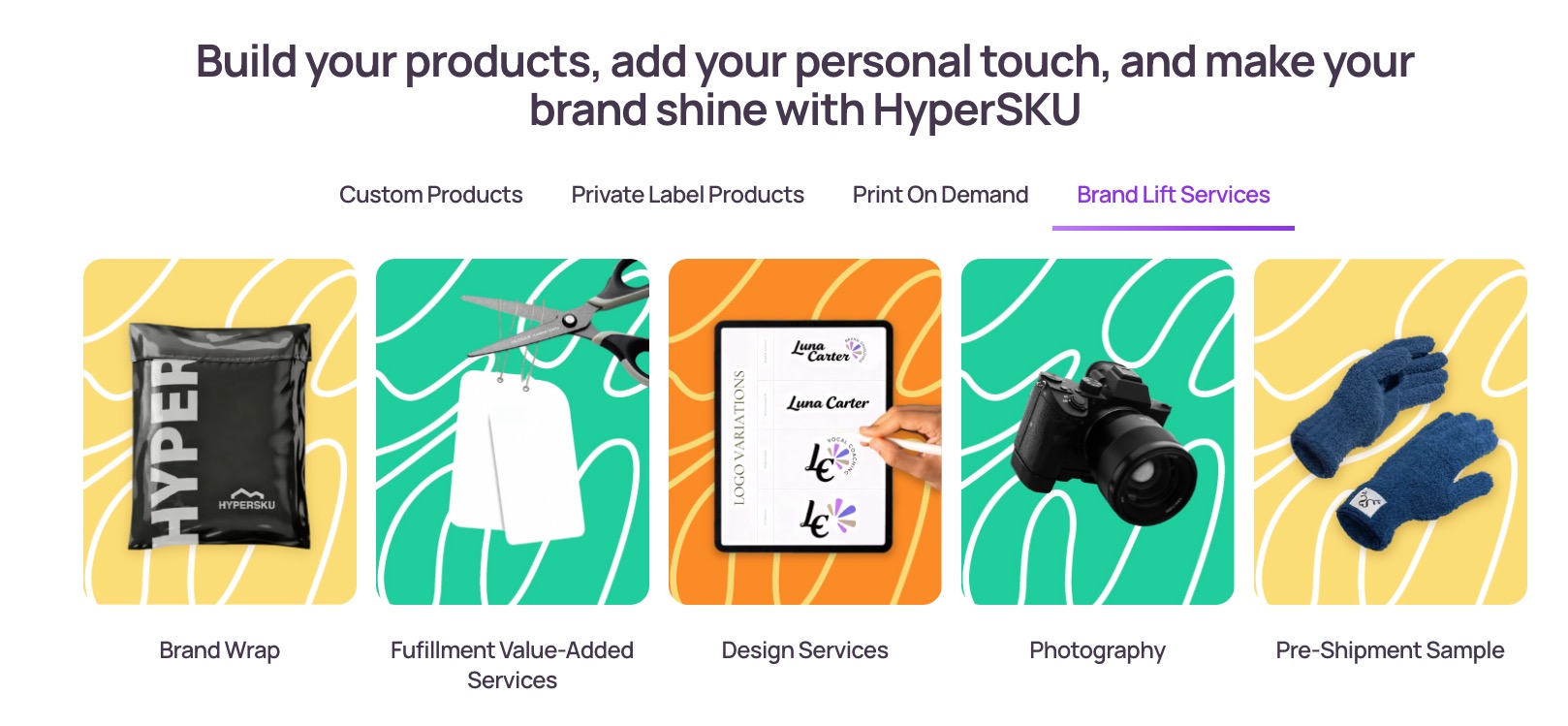
These services are designed to make your products and brand memorable, driving positive reviews and repeat sales.
4. Seamless System Integration & Order Automation
Q4 order spikes can be overwhelming—but with HyperSKU, syncing your store with Shopify, WooCommerce, BigCommerce, Etsy, TikTok Shop, and others is seamless, letting you focus on selling while your operations stay on track.
-
Orders sync automatically from your store
-
Fulfillment handled end-to-end (pick, pack, ship)
-
Tracking updates push back to your store
-
Manual workload is significantly reduced
This smooth integration ensures your store remains smooth and stable, even on the biggest sales days.
From warehousing to dedicated support, enhanced brand experiences, and automated order handling, HyperSKU helps sellers prepare early, ship faster, and scale confidently during Q4. Focus on selling — HyperSKU takes care of the rest.
5 Best Products to Dropship During BFCM 2025
If you’re thinking about starting an online business from scratch, BFCM is one of the best times to give it a try. Dropshipping makes it possible to test products without the headache of stocking inventory—your supplier takes care of the storage, packing, and shipping, and you only buy after a customer orders. In other words, you can move fast, ride the holiday shopping wave, and see which products actually sell.
Here are some categories that tend to shine during BFCM:
1. Print-on-Demand Products

Shoppers love giving gifts that feel personal. A custom mug with a name, a holiday hoodie with a funny slogan, or a phone case designed for a specific vibe—these little touches make products feel one-of-a-kind.
Great picks: custom T-shirts, mugs, phone cases, and tote bags.
People are on the hunt for thoughtful gifts, and personalized items hit the sweet spot between unique and affordable. HyperSKU POD helps sellers launch custom products without worrying about inventory or logistics.
- Curious about the possibilities? Check out Rachel’s success story, where she turned her online influence into a fast-growing fashion line.
- Or see how a charity leveraged POD to hit $60K in just 30 days with HyperSKU POD.
If T-shirts are on your list, you may also find our Shirt Printing Guide useful—it breaks down the most popular printing techniques.
2. Health & Beauty

The holiday season is when people want to look and feel their best—or gift self-care products to loved ones. Plus, the “new year, new me” mindset kicks in right after.
Great picks: Skincare kits, facial rollers, mini massage devices, blue-light glasses, essential oil diffusers.
These items make great gift sets, and they’re lightweight enough to ship quickly during peak season.
3. Home & Office Essentials

With remote and hybrid work still shaping lifestyles, home and office upgrades are in demand. BFCM shoppers also look for practical buys alongside splurge items.
Great picks: Air purifiers, ergonomic desk gear, smart home gadgets, organizers.
These are higher-ticket items that people often wait to buy until discounts hit.
4. Pet Products

Let’s be honest—many people spend as much on their pets as they do on family. And holiday-themed pet items? They sell fast.
Great picks: Festive pet outfits, interactive toys, grooming kits, feeding accessories.
Pet owners love spoiling their pets, and seasonal products bring out the impulse buyers. If you want more inspiration, check out our 2025 guide on dropshipping pet products for trending items and tips on selling them online.
5. Electronics Accessories
Electronics are BFCM bestsellers every year, but accessories are the hidden gems. They’re cheaper, giftable, and perfect as last-minute add-ons.
Great picks: Wireless earbuds, charging stations, phone stands, smartwatch bands, portable power banks.
Small tech gadgets are classic stocking stuffers, and everyone’s upgrading devices around this time.
💡 Quick tip: Look for products that are lightweight, durable, and gift-ready. Those are the items that ship smoothly, survive the holiday rush, and actually convert during the busiest shopping weekend of the year.
5 Common Mistakes to Avoid During BFCM
Black Friday and Cyber Monday are massive opportunities, but they come with their own set of challenges. Knowing what to avoid can save you a lot of headaches—and lost revenue.
1. Mismanaging Inventory
Underestimating demand can lead to stockouts, while overestimating can leave you with unsold inventory. One seller shared their experience of losing $15K in profit last BFCM due to overstocking and poor preparation (source:Reddit).
Tip: Base your inventory on realistic sales forecasts and keep a buffer for unexpected demand. For a deeper dive into best practices, check out our guide to dropshipping inventory management.
2. Ignoring Customer Support
More traffic usually means more questions. Ignoring customer inquiries can result in negative reviews and lost sales.
Tip: Make sure your support team is ready, or set up auto-responses for common questions.
3. Running Untested Promotions
Launching discounts or ads without testing can waste your budget.
Tip: Try small campaigns first, analyze results, then scale the ones that work.
4. Overcomplicating Checkout
Lengthy forms, forced account creation, or limited payment options can kill conversions.
Tip: Keep checkout simple with guest options and popular payment methods like PayPal or Apple Pay.
5. Neglecting Mobile Optimization
A large portion of shoppers will be on mobile. Poor mobile experience means lost sales.
Tip: Test your store on multiple devices, make buttons easy to tap, and avoid excessive pop-ups.
Final Thoughts
Black Friday and Cyber Monday are your chance to make the most of the busiest shopping days of the year—but preparation is everything. From optimizing your store for speed and mobile, to planning inventory, running tested promotions, and avoiding common pitfalls, every step counts. The stores that plan ahead not only boost sales during BFCM, but also build trust and loyalty that lasts well beyond the holidays.
If you’re ready to kick off your BFCM preparations, HyperSKU provides support to help sellers launch products quickly and streamline their operations. Register today to get started and access everything you need to sell confidently this holiday season.
Frequently Asked Questions
1. When is BFCM in 2025?
Black Friday 2025 falls on November 28, and Cyber Monday follows on December 1. Planning early is key to capturing the holiday rush.
2. Do I need to hold inventory for BFCM?
Not necessarily. Many sellers use dropshipping or print-on-demand to test products without upfront inventory costs.
3. How can I optimize my store for BFCM traffic?
Focus on site speed, mobile responsiveness, simplified checkout, and tested promotions. These factors help reduce cart abandonment and improve conversions.
4. Which products sell best during BFCM?
Trending categories include print-on-demand items, health & beauty, home & office essentials, pet products, and electronics accessories. Lightweight, giftable, and unique items often perform best.
5. How do I avoid common mistakes during BFCM?
Plan inventory carefully, test your promotions, provide strong customer support, and make sure your website can handle traffic surges. Also, optimize for mobile and simplify checkout.
By 2028, the global digital economy is projected to reach $16.5 trillion, accounting for 17% of worldwide GDP. This growth is primarily driven by e-commerce, online services, and digital content, offering unprecedented opportunities for individuals to earn money online.
Whether you want to turn a hobby into a source of income, launch an online brand, or explore new digital ventures, the online economy makes it possible. From e-commerce stores and content creation to online courses, there are countless ways to connect with a global audience and generate revenue.
This guide will explore a variety of online money-making methods, ranging from simple side hustles to scalable business models. By understanding market trends and selecting the right products and platforms, you can ride the wave of the digital economy and take steps toward financial freedom.
8 Best Ways to Make Money Online in 2025
1. Freelancing

Source: Upwork
Why it’s promising:
The global freelance platforms market is projected to grow from US$5.6 billion in 2024 to US$14.4 billion by 2030, at a CAGR of 16.1% . This growth reflects the sustained demand for flexible, specialized services online.
How to start:
- Build a profile on platforms like Upwork or Fiverr.
- Highlight your skills via a portfolio or samples.
- Take on smaller gigs first to build credibility.
2. Affiliate Marketing
Why it’s promising:
Affiliate marketing is booming—U.S. spending alone reached US$13.63 billion in 2024, demonstrating strong performance and potential.
How to start:
- Choose a niche you know well.
- Join affiliate networks like Amazon Associates or ShareASale.
- Create content that provides value—then weave in affiliate links.
3. Selling Digital Products (Courses, eBooks, Templates)
Why it’s promising:
The global e-learning market is set to expand from US$274 billion in 2022 to US$465 billion by 2028, growing at about 9.2% CAGR. Digital products tap directly into this trend with low overhead and scalable reach.
How to start:
- Identify knowledge you can teach.
- Package it as an ebook, course, or template.
- Sell via platforms like Gumroad, Teachable, or your own site.
4. Content Creation (YouTube, TikTok, Blogging, Patreon)
Why it’s promising:
The creator economy continues to thrive—Influencer marketing has grown to a $16+ billion industry . Monetization channels are broader than ever, spanning ads, sponsorships, and direct support.
How to start:
- Pick a medium that fits your style.
- Publish regularly and build your audience.
- Monetize through ads, affiliate links, or memberships via Patreon.
5. E-commerce (Online Stores)

Source: Unsplash
Why it’s promising:
The global retail e-commerce sales are expected to exceed US$6.3 trillion in 2024 —highlighting how online shopping continues to surge worldwide.
How to start:
- Choose between dropshipping, private label, POD, or holding inventory.
- Select a platform like Shopify, WooCommerce, or Amazon.
- Optimize for mobile shopping and run targeted ads.
6. Online Tutoring & Coaching
Why it’s promising:
The global online tutoring market is forecasted to reach US$23.73 billion by 2030, growing steadily. Learners increasingly prefer personalized virtual instruction.
How to start:
- Define your teaching specialty (language, business, fitness, etc.).
- Join platforms like Preply or italki—or offer coaching directly.
- Promote via content marketing or your professional network.
7. Audio Content & Audiobooks
Why it’s promising:
The audiobooks market is set to skyrocket—from US$8.70 billion in 2024 to US$35.47 billion by 2030 (CAGR ~26.2%) . Audio content investment is rapidly growing.
How to start:
- Record podcasts, storytelling sessions, or audiobooks.
- Distribute via platforms like Apple Podcasts, Spotify, or ACX.
- Monetize through ads, subscriptions, or direct sales.
8. Virtual Assistance & Remote Services
Why it’s promising:
Businesses worldwide increasingly outsource admin, customer support, and operations. The global virtual assistant market size is expected to reach $25.6 billion by 2025.
How to start:
- List services like email management, social media support, data entry, or scheduling.
- Niche down (e.g., VA for e-commerce sellers or coaches) to increase rates.
Why Running an Online Store Is a Smart Way to Make Money
After exploring all those ways to make money online—from freelancing and affiliate marketing to content creation—you might be wondering: which path can actually grow into a long-term business?
For many aspiring entrepreneurs, the answer is running an online store. Unlike gigs or one-off projects, an online store allows you to reach customers worldwide, scale your business, and build a recognizable brand. With e-commerce, you’re not just trading time for money—you’re creating an asset that can generate income for years.
Dropshipping: Low-Risk, High Potential

Dropshipping is one of the most popular ways to start an online store without holding inventory. You partner with suppliers who ship products directly to your customers. This eliminates the need for warehouses or upfront inventory costs, making it a low-risk entry point for beginners.
Why it works: You can test different products and markets quickly, adapt to trends, and scale your business without major financial risk. Many successful online entrepreneurs began with dropshipping before launching their own branded products.
Print-on-Demand: Monetize Your Creativity

If you’re an artist, designer, or influencer, print-on-demand (POD) is a great way to monetize your creative work. Similar to dropshipping, POD allows you to sell custom-designed products—like t-shirts, mugs, or notebooks—without investing in inventory.
With POD platforms integrated with popular e-commerce stores, you can focus on design and marketing while the platform handles production and shipping. This model is perfect for testing ideas, building a brand identity, and connecting with a niche audience.
Direct-to-Consumer (DTC) Brands: Build Your Own Empire

While dropshipping and POD are great starting points, building a DTC brand gives you full control over your products, pricing, and customer experience. A strong DTC brand allows you to:
- Create unique products that stand out in the market
- Build loyal customers through marketing and storytelling
- Increase profit margins by cutting out middlemen
Thanks to e-commerce platforms, tools for marketing, and global logistics networks, even solo entrepreneurs can now run DTC brands that reach customers worldwide.
Why It’s Promising?
- E-commerce growth is massive: by 2033, the market could be more than $67.05 trillion .
- Online stores allow scalability: unlike freelancing or content creation, a store can grow into a full-fledged business.
- Global reach: you can sell to customers anywhere in the world, 24/7.
- Flexibility: dropshipping and POD let you start small with low upfront costs, while DTC lets you build a brand with high-profit potential.
Whether you’re testing products with dropshipping, showcasing creativity with POD, or launching your own DTC brand, running an online store combines low entry barriers, flexibility, and long-term growth potential—making it one of the smartest ways to make money online in 2025.
Step-by-Step Guide to Starting Your Online Store
Starting an online store may sound overwhelming, but the process is more straightforward than it seems—especially with business models like dropshipping. Here’s a simplified roadmap to get you started:
Step 1: Choose Your Business Model
Decide whether you want to start with dropshipping, print-on-demand (POD), or managing your own inventory.
- Dropshipping is low-risk and beginner-friendly because you don’t need to handle stock.
- POD lets you sell custom designs without upfront costs.
- DTC works best if you already have an initial vision for building your own brand and product line.
Step 2: Find the Right Products
Research trending or evergreen products with proven demand. Tools like Google Trends, TikTok Made Me Buy It, or product research platforms can help.
- Look for products with a clear problem-solving angle.
- Avoid overly competitive niches unless you bring a unique twist.
Step 3: Pick Your Online Store Platform
Choose a platform that’s easy to set up and scale with.
- Shopify is the most popular choice for dropshipping.
- WooCommerce works well if you prefer WordPress.
- Marketplaces like Etsy or Amazon can also work, depending on your niche.
Step 4: Set Up Payments & Logistics
Make sure customers can pay you easily and securely.
- Integrate options like PayPal, Stripe, or local payment methods.
- If dropshipping, connect your store to suppliers so orders are automatically fulfilled.
Step 5: Build Your Storefront
Focus on a clean, conversion-friendly design.
- Use high-quality product images and videos.
- Write persuasive, benefit-driven product descriptions.
- Keep navigation simple—less friction means more sales.
Step 6: Drive Traffic with Marketing
Even the best product won’t sell without visibility.
- Start with paid ads (Meta, TikTok, Google) for fast testing.
- Use social media content to build organic reach.
- Consider influencer partnerships for niche targeting.
Step 7: Test, Optimize & Scale
Your first version doesn’t need to be perfect—it needs to be live.
- Track key metrics (CTR, conversion rate, ROAS).
- A/B test creatives, copy, and pricing.
- Once you find a winning product, scale ad spend and expand channels.
👉 Tip: As your store grows and you find consistent winners, that’s the right time to invest in building a long-term brand identity for customer loyalty.
How HyperSKU Helps You Build a Profitable Online Store
Running an online store is exciting, but it also comes with challenges: finding reliable suppliers, managing inventory, ensuring fast shipping, and keeping customers happy. This is where HyperSKU comes in.
1. Reliable Product Sourcing
HyperSKU connects you with a wide network of verified suppliers, giving you access to trending, high-quality products without worrying about unreliable sources.
2. Faster Shipping Times
Unlike traditional dropshipping platforms with long wait times, HyperSKU offers 5–12 day global shipping on average, helping you win customer trust and increase repeat purchases.
3. Automated Order Fulfillment
With HyperSKU, once a customer places an order in your store, everything from packaging to delivery is automated—saving you hours of manual work every week.
4. One Dashboard for Everything
Manage your products, orders, and shipping from one easy-to-use dashboard that integrates with Shopify and other platforms.
5. Scale with Confidence
As your store grows, HyperSKU supports you with dedicated account managers and tools to help you scale smoothly.
In short, HyperSKU makes it easier for anyone—whether you’re just testing the waters of dropshipping or building a full-fledged DTC brand—to run a profitable online store without the headaches.
Final Thoughts
While there are many ways to make money online, e-commerce stands out as one of the most rewarding paths. Yet, the road can be bumpy without the right tools and support. HyperSKU bridges that gap by taking care of the hardest parts of running an online store—so you can focus on what matters most: growing your business and delighting your customers.
Frequently Asked Questions About How to Make Money Online
1. What is the easiest way to start making money online?
Starting with freelancing, online stores, or affiliate marketing is often the simplest. These options require minimal upfront investment and allow you to test the waters before scaling.
2. How do I know which online business model is right for me?
Consider your skills, resources, and time. If you prefer selling physical products without holding inventory, dropshipping or print-on-demand is ideal. For creative work, content creation or selling digital products may be a better fit.
3. Can I start an online store without my own products?
Yes! Dropshipping allows you to sell products sourced from suppliers without having to manage inventory. HyperSKU, for example, connects you with verified suppliers and handles order fulfillment.
4. How do I find reliable suppliers for my online store?
Look for verified suppliers on platforms like HyperSKU, Alibaba, or Apliiq. Check their shipping times, minimum order quantities, and customer reviews to ensure they meet your standards.
5. Do I need a lot of money to start making money online?
Not necessarily. Many online business models, like freelancing, content creation, or dropshipping, have low upfront costs. The key is consistent effort and smart marketing.
6. Can I turn a side hustle into a full-time online business?
Absolutely! Many successful online entrepreneurs started with small side projects. By testing ideas, optimizing your strategy, and scaling wisely, you can grow your online business into a sustainable full-time venture.