
No brand packaging or unboxing experience
Sneaker silhouettes are shrinking. After several years of chunky, oversized soles dominating the market, 2026 has brought a clear shift toward flatter, slimmer, more understated designs. Fashion editors are calling it the “low-profile” moment, and it is showing up everywhere from spring runways to fall retail floors.
For sellers, this is more than a style headline. It is a signal worth testing, but also one that comes with real sourcing and fit risks if approached carelessly. This guide breaks down what is driving the trend, which product directions are worth a first test, and what to check before you commit inventory.
What are low-profile sneakers, and why are they trending in 2026
A low-profile sneaker is defined by a thin sole, a narrow toe box, and a slim, elongated silhouette, the opposite of the thick-soled “chunky” sneaker that dominated the past several years. The look favors flat proportions and minimal visual bulk over exaggerated cushioning. Style guides tracing the category note that the aesthetic has roots in early-2000s minimalism and is currently experiencing a revival driven by demand for versatile, wear-everywhere footwear.
The trend is not coming from a single brand or a single moment. It is being pushed from several directions at once. Who What Wear reports that low-profile silhouettes dominated the spring 2026 runways at Celine, Prada, and Dries Van Noten. Retailers are following the same signal: Foot Locker’s fall 2026 trend coverage places low-profile retro sneakers alongside basketball classics and performance runners as the season’s core styles, rather than replacing chunkier shoes outright. And industry trend coverage points to archive sneaker styles, from vintage running shoes to court and racing shoes, being reissued in flatter, narrower forms throughout the year.
The practical read for sellers: low-profile is not a replacement for chunky sneakers, it is a second, fast-growing lane running alongside them. Stylists interviewed by Business Insider point to low-profile retro sneakers as a major continuing trend into the new year, while also noting that mixed-material, bolder colorways are gaining ground as quiet luxury fades. This suggests the market is settling into a multi-silhouette phase rather than a full pivot away from bulkier styles.
Are sneakerinas still trending in 2026? Four directions worth testing
Within the low-profile category, four distinct product directions are gaining traction. Rather than betting on one silhouette, sellers get better signal by testing a small, focused range across all four and watching which one earns engagement.
1. Low-profile retro trainer

This is the broadest, most wearable direction: a 70s-style running shoe or retro trainer silhouette with a thin sole, a moderate toe box, and an elongated side profile. It works across genders and pairs easily with denim, tailoring, or casualwear, which makes it the safest first-test option for a wide audience.
- Materials: suede or nubuck paired with nylon or mesh panels
- Colors: off-white and gum sole as the anchor, with navy or black as stable options and small accent-color runs for testing
- Best for: broad, gender-neutral audiences aged roughly 20 to 38 who want one shoe that works for commuting, weekends, and travel
2. Sneakerina / ballet-hybrid

Stylists have flagged ballet-inspired sneakers, sometimes called “sneakerinas,” as one of the defining trends of the year, describing them as hybrids that combine the delicate look of a ballet flat with the structure of a sneaker sole. According to trend forecasting agency Trendalytics, cited by Fashionista, Google searches for “sneakerina” grew sharply year over year in early 2026, alongside a large jump in related TikTok views over the same period. This direction is currently the highest-growth segment within low-profile footwear, and it is worth testing even though it carries more fit risk than the retro trainer lane.

- Materials: satin is the strongest visual trend material but has durability and staining risks; suede or soft leather are safer for everyday versions, with satin reserved for limited or seasonal colorways
- Colors: dusty pink, burgundy, silver-gray, off-white, and black; darker tones help avoid an overly saccharine look
- Best for: women aged 18 to 34 interested in soft, feminine styling; this direction tends to test stronger in Europe, while a Mary Jane-style sneaker can be a good entry point for the US market
3. Racing / court hybrid

This direction borrows silhouette cues from racing shoes, football boots, and court trainers: an elongated toe, a lower heel, and a closely fitted upper. The goal is to translate athletic speed cues into an everyday casual shoe without copying any specific brand’s identifying details.
- Materials: suede, patent-finish leather, metallic-look textile, and lightweight nylon combined for contrast
- Colors: red-and-white or cobalt-and-white pairings test well in the US, while darker tonal combinations suit European audiences
- Best for: motorsport, retro sportswear, and streetwear-adjacent audiences; works well for expanding into male and gender-neutral segments
4. Quiet material sneaker

The fourth direction skips loud branding and bold color contrast altogether. Instead, the sneaker’s appeal comes entirely from proportion and material quality: a clean upper, minimal visible branding, and a slim side profile built from fewer panels.
- Materials: full suede, soft leather, and tonal nylon-and-leather combinations
- Colors: espresso brown, charcoal gray, off-white, black, and deep burgundy, tuned for fall and winter
- Best for: buyers who want a casual sneaker that can be worn with tailored pants or a coat without looking out of place; this direction tends to have a longer sales cycle but more consistent conversion than trend-driven colorways
Fashion sneakers vs. barefoot shoes: don’t mix up the claims
Are low-profile sneakers the same as barefoot shoes? No, and this distinction matters for both product sourcing and marketing compliance.
Both categories reduce the amount of material under the foot, but they are built for different purposes. A fashion-oriented low-profile sneaker can look thin while still keeping a small amount of cushioning, a soft insole, or a lightly structured midsole, so the shoe reads as sleek without becoming uncomfortable. A true barefoot shoe is a functional category, generally defined by industry guides around four criteria: zero heel-to-toe drop, a wide toe box that allows the toes to sit and splay naturally, a highly flexible sole, and minimal stack height, typically only a few millimeters. Market research on the category confirms this construction is engineered specifically to preserve natural foot movement and ground feedback, and the category is commonly marketed on health and natural-movement claims.
This is not just a design distinction, it is a marketing one. Unless a shoe has actually been built and tested to barefoot specifications, sellers should avoid language like “corrects gait,” “improves arch support,” “suitable for long-distance walking,” or “medical-grade comfort.” Using barefoot or natural-foot-health claims on a shoe that has not been engineered and tested for that purpose raises both credibility and compliance risk.
A safer messaging framework:
- Headline copy: lightweight silhouette, retro-inspired, everyday styling
- Product detail copy: soft upper materials, cushioned insole, flexible sole
- Health or natural-movement language: only if the shoe genuinely meets barefoot construction standards
What materials work best for low-profile sneakers
Because a low-profile silhouette has less visual bulk to work with, material and color choices carry more of the design’s identity than they would on a chunkier shoe. A useful starting ratio: roughly 70% neutral tones to build everyday wearability, 20% low-saturation tones to build out a cohesive color range, and 10% higher-impact accent colors to drive scroll-stopping content.
Keep the material palette tight. Mixing too many finishes on a single shoe undercuts the clean, minimal look that makes low-profile sneakers appealing in the first place.
US vs. Europe: same silhouette, different creative angle
The low-profile trend is showing up in both US and European markets, but the creative angle that resonates differs by region. This is a strategy hypothesis based on current editorial coverage and runway trends, not a confirmed regional sales split, so it is worth testing in both markets before committing budget at scale.
For a first-round test, a shared creative asset built around “3 outfits, 1 low-profile pair” works across both regions and helps confirm whether the silhouette itself is driving interest before localizing further.
Fit and return-risk checklist before you list
A low-profile shoe can look great in a product photo and still generate a high return rate if fit and comfort are not addressed up front. The thinner the sole and the more minimal the structure, the more these details matter.
- Toe box: Confirm the front of the shoe leaves enough room for the forefoot, even on a visually narrow silhouette. Provide clear sizing guidance for wider feet.
- Heel and collar: Check heel cup shape, collar padding, and lace or strap tension so the shoe stays secured during walking.
- Underfoot feel: A visually thin sole does not need to feel thin. Keep a low-profile insole cushion, cork layer, or partial rubber structure so the shoe does not feel hard underfoot.
- Strap and trim friction: Ballet-style straps and suede edges can rub against skin. Soften contact points, add binding, or recommend wearing with socks.
- Weather resistance: Satin and suede are vulnerable to rain and staining. Pair the product listing with clear care instructions, and consider a more weather-resistant material option for fall and winter markets.
- Sizing variance: Foot arch height and instep volume vary widely. Provide length, forefoot width, and instep guidance, and back product pages with genuine try-on video rather than static images alone.
Avoid unverified claims such as “corrects posture,” “improves arch support,” or “medically graded comfort” anywhere in product copy. These push a fashion product into a higher bar of evidence and regulatory scrutiny that most footwear listings are not built to meet.
What should sellers test before sourcing footwear? A 3-step approach
Rather than committing to full production on a single silhouette, a staged testing approach reduces risk and gives clearer signal on where to invest.
Step 1: Build a lightweight test set. For each of the four directions above, prepare a small set of reference images, one color palette, and two or three ad concepts, one built around the silhouette itself and one built around outfit pairing. Avoid expanding SKU count before you have signal.
Step 2: Run both hooks and compare. Test a “silhouette hook” (before-and-after style transformation, or a close-up on proportion) against an “outfit hook” (the same shoe styled three different ways). Track click-through rate, three-second video retention, and the language showing up in comments and saves.
Step 3: Narrow and go deeper. Keep the one or two directions with the strongest engagement, then test material and color variations within those directions. Pay close attention to negative feedback patterns, comments like “looks too thin,” “looks like a dance shoe,” “hard to style,” or “worried about foot pain” are early warning signs on fit or positioning, not just tone.
This staged approach lets you validate market interest before locking in supplier terms, minimum order quantities, or full production runs.
How HyperSKU supports sourcing and product development
Testing a trend like low-profile sneakers is not just a content exercise. Every direction covered in this guide, from a satin sneakerina to a full-suede quiet sneaker, comes with its own sourcing complexity: different materials, different fit tolerances, and different return risks. Moving from a validated ad concept to a sellable product means your supply chain needs to keep pace with what your testing data is telling you. HyperSKU supports that entire path with six connected services.
1. Product sourcing
Once you know which of the four directions is earning engagement, whether that is the broad-appeal retro trainer or the higher-risk sneakerina lane, HyperSKU’s product sourcing connects you to a vetted manufacturer network that can find suppliers who can actually produce it in the right materials and colorways. This matters especially for the more technical builds in this guide, like a racing/court hybrid with mixed suede and metallic-look textile panels, where not every factory can execute the material combination cleanly.
2. Private-label and customization
The “1-2 high-identifiable details” approach outlined earlier, changing a strap, a stitch line, or a colorway rather than reinventing the silhouette, depends on having a sourcing partner who can actually execute small, targeted customizations without forcing you into a full custom-mold minimum order. HyperSKU’s private-label and customization services let you apply logo placement, branded insoles, or a distinct strap detail to an already-proven silhouette, which keeps market education costs low while still giving your listing a distinct identity.
3. Product quality inspection

The fit and return-risk checklist in this guide, toe box room, heel security, insole cushioning, strap friction, is exactly the kind of detail that gets missed without a formal inspection step. This level of scrutiny is available through the BrandLift package, a value-added service for sellers who want enhanced quality checks before a product ships. For a category like low-profile sneakers, where a stiff heel counter or a misaligned strap can turn a promising test into a wave of return requests, that extra inspection step is often what separates a validated concept from a costly relaunch.
4. Custom packaging


For a low-profile sneaker, especially in the higher-price sneakerina or quiet-material lanes, the unboxing experience carries some of the same weight the shoe’s materials do. Branded mailers, tissue wrapping, or a care card explaining how to handle satin or suede can reinforce the “considered product” positioning this category depends on, rather than shipping a premium-looking shoe in generic packaging. Custom packaging is offered alongside quality inspection in the same BrandLift package, a value-added upgrade on top of standard fulfillment for sellers ready to invest in a more premium, brand-consistent unboxing experience.
5. Global warehousing and fulfillment
Once a direction moves from test to full listing, shipping speed becomes part of the product experience. HyperSKU’s global warehousing network across China, the US, and the EU keeps delivery windows tight for both the broad retro-trainer audience and the more regionally split sneakerina and quiet-sneaker segments discussed in the US-versus-Europe section above.
6. Shopify dropshipping integration
For sellers running this kind of test directly on Shopify, a direct Shopify store connection syncs products, automates order fulfillment, and keeps inventory and tracking updated in real time. This removes the manual order-entry work that slows teams down during a fast-moving trend test, when you may be running four silhouette directions and several colorways at once.
Final thoughts
Low-profile sneakers are not a single product bet, they are a proportion shift working its way through four distinct directions at once, each with its own audience, material logic, and level of sourcing difficulty. The safest starting point is the retro trainer lane, broad enough to test with a wide audience and forgiving on fit. The sneakerina and quiet-material directions carry more upside but also more execution risk, from satin durability to strap friction, and reward sellers who build fit and quality checks into the process from the start rather than after the first wave of returns.
The bigger opportunity for sellers is not picking the “right” silhouette on day one. It is running a small, structured test across a few directions, reading the engagement and return signals honestly, and only then committing to inventory, customization, and a supplier relationship built to scale. That sequencing, test first, source second, is what turns a trend headline into a product line that actually holds up past the first season.
Ready to test your next footwear trend?
HyperSKU connects you with vetted manufacturers, private-label options, and fast fulfillment so you can move from concept to product with confidence.
Get Started with HyperSKUFAQs
What are low-profile sneakers?
Low-profile sneakers are shoes built with a thin sole, a narrow toe box, and a slim, elongated silhouette. They are the visual opposite of chunky, thick-soled sneakers and are currently a leading trend across both runway and retail footwear in 2026.
Are sneakerinas still trending in 2026?
Yes. Ballet-inspired sneakers, often called sneakerinas, are one of the fastest-growing segments within the low-profile category, with stylists and fashion editors repeatedly flagging the style as a defining trend of the year.
What materials work best for low-profile sneakers?
Suede and nylon combinations offer the broadest appeal and are easiest to produce across multiple colorways. Full suede or soft leather suit a quieter, minimalist look, while satin delivers the strongest visual impact but carries more durability risk.
Are low-profile sneakers the same as barefoot shoes?
No. Low-profile sneakers are a style category focused on a slim, flat silhouette, while barefoot shoes are a functional category built around a wide toe box, zero heel-to-toe drop, and minimal soling. Sellers should avoid using barefoot or natural-foot-health claims unless a shoe is genuinely built and tested to that standard.
What should sellers test before sourcing footwear?
Start with a small set of reference images and ad concepts across a few silhouette directions rather than committing to full production. Compare engagement between silhouette-focused and outfit-focused content, then narrow to the one or two directions with the strongest signal before finalizing material, color, and supplier decisions.
Generic dropshipping has a ceiling. When your product page looks the same as fifty other stores selling the exact same item from the exact same supplier, price becomes the only lever you have left, and thin margins follow close behind. Private label changes that equation. It’s how a store stops looking like a reseller and starts looking like a brand.
Consumer behavior backs this up. Bazaarvoice’s 2025 Shopper Experience Index found that 86% of consumers had purchased a private label product in the past six months, up sharply from 64% the year before, and 73% had permanently switched some of their regular purchases to private label options. Shoppers aren’t just tolerating private label anymore. They’re actively choosing it.
But there’s a catch most guides gloss over: a lot of what gets marketed as “private label” is really just a logo slapped on a generic product. That’s a different thing, with a different cost and a different level of control. This article draws that line clearly, walks through how real private label actually works, where sellers get tripped up, and when it makes sense to bring in a dedicated partner instead of managing it all yourself.
Private Label vs. White Label vs. Generic Dropshipping
These three terms get used interchangeably online, and that’s part of why so many sellers end up disappointed with what they actually got.
- Generic dropshipping. You sell a supplier’s product exactly as it comes. No branding, no customization, and often the supplier’s own packaging shows up in your customer’s mailbox.
- White label. The product itself doesn’t change. What changes is the label, the logo, and sometimes the box it ships in. Other sellers can source the identical product and put their own name on it.
- Private label. The product itself is made or configured to your specifications, whether that’s a formula, a material choice, a design detail, or a functional tweak. No one else is selling that exact version.
| Model | Level of Customization | Tradeoff |
|---|---|---|
| Generic Dropshipping | None | No brand equity, competes on price alone |
| White Label | Logo, packaging, branding only | Product isn’t unique, easy for others to copy |
| Private Label | Product formula, materials, or design | Higher MOQ, longer lead time, more upfront coordination |
Here’s the honest part most articles skip: in dropshipping specifically, that line between white label and private label gets blurry fast. True product level customization, changing a formula, commissioning a mold, altering a material, is expensive and slow at low volume. A lot of what gets sold as “private label dropshipping” is really white label with better marketing. That’s not necessarily a problem, but you should know which one you’re actually buying before you commit budget to it.
How Private Label Actually Works
The process looks different from a standard dropshipping setup because you’re not just picking a product off a catalog page.
It typically runs in four stages. First, you settle on a product direction, informed by what’s already selling well in generic form, since private label works best on validated demand rather than a guess. Second, you work with a manufacturer or sourcing partner on the specific details you want changed, which could be a formula adjustment, a material upgrade, a design tweak, or a functional feature. Third, you review a sample, sometimes several rounds of them, until the product matches what you specified. Fourth, once the sample is approved, the supplier moves to production and you’re now selling something that didn’t exist in that exact form before you commissioned it.
The core difference from white label is accountability. With white label, you’re responsible for how the product looks on the outside. With private label, you’re responsible for the product itself, which means quality issues, formula problems, or design flaws are yours to own, not a shared catalog issue affecting every seller using that supplier.
Where Sellers Get Tripped Up
A few problems show up often enough that they’re worth planning around before you start, not after.
MOQ pressure. Product level customization almost always requires a higher minimum order than simply rebranding an existing item. A supplier willing to print your logo on a stock product for 50 units might require several hundred once you’re asking them to change the product itself. Budget for this gap rather than being surprised by it mid-negotiation.
Quality control risk. A defective batch of white label products is annoying. A defective batch of private label products is more expensive to fix, since you can’t just swap in an identical item from another seller’s stock. The product is specific to you, so returns and rework take longer and cost more.
Longer lead times. Product development, sample rounds, and adjusted production runs add weeks that a simple white label order doesn’t require. Sellers who don’t build this into their timeline often end up scrambling before a peak season they’d planned to launch into.
None of these are reasons to avoid private label. They’re reasons to plan for it with realistic timelines and a supplier relationship built for back and forth, not a one click import.
When to Source It Yourself vs. Bring in a Partner
If you’re still validating whether your audience even wants a branded version of a product, there’s little reason to commit to full private label yet. A basic white label run through a low MOQ supplier on Alibaba or a similar marketplace is enough to test the appetite without locking in a long development cycle.
Once you’ve decided to commit to private label as a real part of your business, the operational load changes. You’re now managing sample rounds and revisions with a factory, coordinating quality checks before every shipment, and handling logistics for a product that can’t simply be re-sourced from a different supplier if something goes wrong. Doing all of that yourself is possible, but it’s also where a lot of the hidden time cost of private label shows up, chasing sample approvals, catching quality issues before they reach customers, and managing shipping for a product line that’s uniquely yours. This is usually the point where working with a dedicated sourcing and fulfillment partner starts to pay for itself instead of adding another layer of complexity.
Private Label Dropshipping Suppliers to Consider
If you’ve reached the point where you need a partner rather than a marketplace connector, here’s where to start looking. Figures below are approximate and worth confirming directly, since MOQs and pricing shift.
| Supplier | MOQ | Turnaround | Product Range | Pricing |
|---|---|---|---|---|
| HyperSKU | From around 100 units | Roughly 10 to 20 days production, plus 5 to 12 day shipping | Broad catalog across apparel, home, beauty, accessories, and more | Free to install, no monthly fee |
| Trendsi | From around 60 units for private label runs | 7 to 10 days | Women’s apparel, shoes, accessories | Free up to 500 listings, paid plans from $29.99/mo |
| DR.HC Cosmetic Lab | None, starts at one unit | 1 to 3 business days | Clean, vegan, US made skincare and haircare | Private label membership around $2,150/yr |
| Makers Nutrition | Around 500 units | As little as 4 weeks with fulfillment included | Vitamins, powders, gummies, capsules | Quote based |
| Supliful | High, custom formulas typically require a $10,000 upfront commitment | 3 to 7 business days | Wellness, supplements, coffee, pet care | Business plan required, around $349/mo |
| SourcinBox | Around 1,000 units for custom packaging, higher for full customization | Roughly 8 to 14 days to the US after processing | Broad catalog across electronics, home, beauty, fashion | Free app, pay product and service fees |
| CJ Dropshipping | 500 to 1,000 units for OEM/ODM production | 30 to 60 days for manufacturing plus shipping | Massive catalog spanning most categories | Quote based |
| Printful | None, one unit at a time | 2 to 5 business days | 400+ SKUs, apparel, accessories, home decor | Free to install, optional $24.99/mo for discounts |
| Printify | None | 2 to 7 business days | 1,300+ SKUs across apparel, drinkware, pet products | Free to install, optional $29/mo for discounts |
HyperSKU

HyperSKU sits between the pure POD platforms and the high MOQ, high commitment options like Supliful or CJ’s OEM service. Sourcing agents handle factory negotiation and sample coordination directly, quality checks happen before a batch ships rather than after a customer complains, and multi region warehousing keeps delivery windows reasonable even with a customized product line. It’s built for sellers who’ve moved past testing and want a customization and private label partner managing the sourcing relationship rather than chasing it themselves order by order.
Trendsi
Trendsi is a fashion and accessories supplier built specifically for fashion sellers, with private label runs starting around 60 units and a 7 to 10 day turnaround. It’s a solid entry point if your brand is apparel focused and you want a low commitment way to test private label without a long development cycle.
DR.HC Comstic Lab
DR.HC Cosmetic Lab is a Silicon Valley based cosmetics manufacturer that accepts orders starting from a single unit, which makes it one of the lowest friction ways to get into private label skincare and haircare. The tradeoff is the annual membership fee, which is worth weighing against how many units you actually expect to move.
Makers Nutrition
Makers Nutrition is a GMP compliant, FDA registered supplement manufacturer based in New York, working with sellers on custom formulas, label design, and packaging. MOQ sits around 500 units, and pricing is quote based depending on the formula and packaging you choose.
Supliful
Supliful covers wellness, supplements, coffee, and pet care, but its custom formula option is built for sellers who’ve already validated strong demand. It requires enrollment in a paid Business plan plus a $10,000 upfront commitment for custom formulas, so it’s less of a starting point and more of a scale up option.
SourcingBox
SourcinBox is a China based sourcing agent that coordinates manufacturing, custom formulas, and branded packaging on your behalf, with MOQs starting around 1,000 units for custom packaging and higher for full product customization. It doesn’t charge a recurring subscription, but does add a private label service fee on top of product and shipping costs.
CJ Dropshipping
CJ Dropshipping offers ODM manufacturing through two tiers, Basic and Premium Advanced, alongside its regular dropshipping catalog. Pricing and MOQ are quote based and vary by product, since CJ doesn’t publish fixed numbers for custom runs. What is confirmed is response time: Basic ODM requests get reviewed within 3 to 5 business days, while Premium Advanced ODM requests, which include supplier comparison and deeper sourcing support, get a response within 24 hours. It’s worth requesting a quote directly before assuming a specific MOQ or timeline applies to your product.
Printful
Printful is a print on demand supplier with production hubs across North America, Europe, and APAC, and it requires no MOQ since you can sell a single unit at a time. It’s a fit for brands whose customization is closer to design and print work than deep product level changes.
Printify
Printify connects your store to more than 90 print providers worldwide, also with no MOQ, letting you mix and match providers by price, location, and print method for each SKU. Like Printful, it’s better suited to design-driven customization than formula or material level changes.
Final Thoughts
Private label isn’t a requirement for every dropshipping store, and it shouldn’t be the first move for a product you haven’t validated yet. But once you know something sells, the gap between a generic listing and a real brand comes down to how much control you’re willing to take over the product itself, not just the packaging around it.
The suppliers above cover a wide range of that spectrum, from single unit POD orders to five figure custom formula commitments. The right one depends less on which name is most recognizable and more on where your business actually is: still testing, or ready to build something no one else is selling.
Not sure what MOQ or timeline your product needs?
Submit your product idea and get a sourcing feasibility check from a dedicated HyperSKU agent, no guesswork before you commit budget.
Get StartedFAQs About Private Label Dropshipping
What’s the difference between private label and white label dropshipping?
White label means the product stays the same and only the branding changes, logo, packaging, labeling. Private label means the product itself is customized to your specifications, whether that’s a formula, material, or design change, so it’s not identical to what any other seller offers.
How much does it cost to start private label dropshipping?
It varies widely by product category and MOQ. Samples typically run $10 to $100 each before shipping, and most sellers budget somewhere between $500 and a few thousand dollars to cover samples, initial branding assets, and the first production run. Categories with higher MOQs or regulatory requirements, like supplements or cosmetics, tend to sit at the higher end of that range.
Can I do private label dropshipping with a low MOQ?
Yes, though options narrow the more customization you want. Some suppliers, particularly in cosmetics and print on demand, accept single unit or very low volume orders. True formula or design level customization usually requires a higher MOQ, often in the hundreds of units, since that’s where it becomes viable for a manufacturer to set up a custom production run.
Is private label dropshipping worth it for beginners?
It depends on where you are. If you haven’t validated demand for a product yet, starting with generic or white label dropshipping is lower risk. Private label makes more sense once you know a product sells and you’re ready to invest in differentiating it, since the upfront cost and lead time are harder to justify without that validation already in hand.
The EU €3 customs duty is now confirmed law. On February 11, 2026, the Council of the European Union gave final legislative approval to new customs duty rules for small parcels — this is no longer a proposal. It is legislation with a fixed enforcement date.
Starting July 1, 2026, all commercial parcels valued under €150 entering the EU will be subject to a fixed customs duty of €3 per item category (HS6 code). This reform was originally planned for 2028 but was accelerated in response to the rapid growth of low-value e-commerce imports and pressure from EU-based retailers facing an uneven playing field.
This regulation removes the previous low-value customs exemption and replaces it with a standardized duty structure across all EU member states. For cross-border sellers shipping from outside the EU, the window to adapt is short.
This guide explains what the €3 duty is, how it is calculated, who pays it, and how to protect your margins before July 1.
Key Takeaways
This is now law. The EU Council gave final legislative approval on February 11, 2026. July 1, 2026 is a hard deadline, not a proposal.
€3 is charged per HS6 code, not per parcel. A shipment with 3 product categories costs €9 — not €3. HS code accuracy is now a direct cost variable.
Two deadlines land in 2026, not one. July 1: €3 duty. November 1: +€2 handling fee. Combined total reaches €5 per HS6 code by Q4 2026.
The €3 is temporary. From 2028, the EU Customs Data Hub replaces the flat rate with standard tariff-based duties based on full HS classification.
Plan for €5, not €3. Build pricing, fulfillment, and DDP models around the November rate from the outset — repricing twice in one year is avoidable.
Effective
July 1, 2026
Phase 2
November 1, 2026
Cost from Nov 2026
€5 per HS6 code
Permanent regime
2028
What the EU €3 Customs Duty Means
The EU €3 customs duty is a fixed import charge applied to all commercial goods valued under €150 entering the European Union from non-EU origins. The duty is assessed per item category (HS6 code) per consignment — not as a flat fee per parcel.
Unlike VAT, this duty is not calculated as a percentage of product value. Instead, it is a fixed charge per item classification, replacing the previous duty-free exemption for low-value consignments.
Key facts
- Effective date: July 1, 2026
- Scope: All commercial goods under €150 entering the EU from non-EU origins
- Fee structure: Fixed €3 per item category (HS6 code) per consignment — a parcel containing 3 different product categories incurs €9, not €3
- Tax distinction: Separate from and additional to import VAT Geographic coverage: Applies across all EU member states
How the duty is applied
Duties are assessed based on Harmonized System (HS) codes, which classify goods for customs purposes. Critically, the €3 duty is charged per unique HS6 code present in a consignment — meaning the number of product categories in a single parcel directly determines your total customs cost.
For example:
- 3 units of the same product (1 HS6 code) = €3
- 3 different product types (3 HS6 codes) = €9
Accurate classification is critical. Incorrect or incomplete HS codes can result in:
- customs clearance delays
- additional charges or penalties
- increased operational costs
Official regulatory basis
The European Commission further states that this reform removes the €150 duty-free threshold as part of broader efforts to modernize EU customs processes and standardize e-commerce imports across member states.
How the €3 Customs Duty Is Applied
The €3 duty is applied based on customs declaration data submitted at the time of import. Each shipment is classified using Harmonized System (HS) codes, and the duty is charged per unique HS6 code present in the consignment — not as a single flat fee per parcel.
Mechanism overview
- Each product in a shipment is assigned an HS6 code based on its category
- Customs authorities validate HS classification at the point of entry
- A fixed €3 duty is applied for each unique HS6 code in the consignment
- A parcel containing multiple product categories is charged €3 per category
How costs multiply across categories
| Products in one parcel | HS6 codes | Customs duty |
|---|---|---|
| 3 units, same product type | 1 | €3 |
| 2 different product types | 2 | €6 |
| 3 different product types | 3 | €9 |
This means that mixed-category orders carry a higher customs cost per shipment. Where possible, grouping same-category items into a single order reduces total duty exposure.
Key implication
Accurate HS code assignment is critical. Classification errors can lead to:
- incorrect duty calculation
- customs clearance delays
- compliance risks and potential penalties
EU VAT vs €3 Customs Duty
The €3 customs duty is separate from VAT and does not replace it. Import VAT continues to apply to all goods entering the EU, regardless of value.
| Category | €3 Customs Duty | Import VAT |
|---|---|---|
| Type | Fixed import duty | Consumption tax |
| Calculation basis | €3 per HS6 code per consignment | Percentage of product value |
| Applies to | Parcels under €150 from non-EU origins | All goods imported into the EU |
| Charged on | Each unique item category in the shipment | Declared value of goods |
| Collection system | EU customs system | IOSS or import VAT system |
| Cost variability | Scales with number of product categories | Scales with product price |
| Operational impact | Adds a per-category cost per shipment | Requires VAT compliance and reporting |
A single shipment may be subject to both VAT and the €3 customs duty simultaneously. From November 1, 2026, an additional €2 handling fee per HS6 code will also apply, bringing the combined duty and fee total to €5 per item category. See the next section for a full breakdown.
Who Pays the EU €3 Duty
The €3 customs duty is legally imposed on the importer of record. In practice, the cost is almost always passed to the end customer unless the seller chooses to absorb it through prepaid (DDP) pricing.
The total amount owed per shipment depends on the number of distinct HS6 codes in the order. A single-category order incurs €3. A three-category order incurs €9. Sellers offering mixed-product bundles need to account for this when deciding how duties are handled at checkout.
Common Payment Models: DAP vs DDP
So which model fits your EU strategy?
| DAP | DDP | |
|---|---|---|
| Who pays duties | Customer, at delivery | Seller, built into checkout price |
| Duty amount (Jul 2026) | €3 per HS6 code | €3 per HS6 code |
| Duty amount (Nov 2026) | €5 per HS6 code | €5 per HS6 code |
| Customer experience | Surprise charge on arrival | Final price shown at checkout |
| Delivery refusal risk | Higher — especially on low-value orders | Lower |
| Dispute/chargeback risk | Higher | Lower |
| Seller complexity | Low upfront | Requires pricing adjustment |
| Best suited for | Higher-value orders where duty is a smaller % of product price | Most EU-facing e-commerce, especially low-to-mid price range |
Delivered At Place (DAP)
- The customer pays duties on arrival, after the parcel reaches the destination country
- Lower upfront cost and operational complexity for the seller
- Higher friction risk — unexpected charges at delivery are a leading cause of refusals, disputes, and negative reviews
- From November 2026, customers under DAP will face €5 per HS6 code rather than €3, increasing the likelihood of delivery refusals on low-value orders
Delivered Duty Paid (DDP)
- Seller includes all duties and fees in the checkout price
- Customer sees a final, all-inclusive price with no surprises at the door
- Higher upfront planning required, but significantly better post-purchase experience
- When building DDP pricing, factor in the full €5 per HS6 code that will apply from November 2026 — not just the initial €3 rate
Operational impact of DDP
DDP reduces:
- checkout abandonment caused by unexpected fees
- delivery disputes and parcel refusals
- post-purchase dissatisfaction and negative reviews
For sellers moving to DDP, the simplest approach is to calculate your worst-case duty exposure per order based on the number of HS6 codes you typically ship, then build that amount into your product pricing or add it as a transparent line item at checkout. Absorbing a known fixed cost is operationally simpler than managing customer disputes after delivery.
Why DDP Is Becoming the Only Safe Model
The €3 customs duty is legally imposed on the importer of record. In practice, the cost is almost always passed to the end customer unless the seller chooses to absorb it through prepaid (DDP) pricing.
Under the old €150 exemption, DAP (Delivered At Place) carried little risk, because most low-value parcels owed nothing on arrival. That protection is gone.
After July 1, 2026, every parcel under €150 carries duty, often a national surcharge, and VAT calculated on the combined total. Ship DAP into this environment and the carrier presents that full bill to your customer before release. The predictable outcomes are delivery refusals, carrier handling penalties on parcels held in customs limbo, and chargebacks from buyers who never agreed to a surprise charge at the door.
This is not a temporary friction that eases over time. As the €2 handling fee and national surcharges stack on top of the €3 duty through 2026, the gap between DAP and DDP outcomes will widen, not narrow. DDP, where every cost is calculated and collected at checkout, is becoming the only model that reliably clears customs without disrupting the customer experience.
Implementation Timeline
The EU is rolling out its customs reform in three distinct phases. Each phase adds a new layer of cost and compliance requirements — and two of the three deadlines land within 2026 alone.
EU Customs Reform: Phase Timeline
July 1, 2026
Phase 1 — €3 Flat Duty
€3 per HS6 code
- €150 customs duty exemption fully abolished
- €3 fixed duty per HS6 code per consignment
- Simplified customs declaration system in effect
- IOSS for VAT continues unchanged
Nov 1, 2026
Phase 2 — +€2 Handling Fee
€5 per HS6 code total
- Additional €2 handling fee per HS6 code introduced
- Combined total rises to €5 per item category
- A 3-category parcel now incurs €15 in duties and fees
- Sellers priced around €3 will face a second margin hit
2028
Phase 3 — Permanent Regime
Varies by product
- EU Customs Data Hub fully operational
- Flat-rate system replaced by standard tariff-based duties
- Full HS classification required for all low-value imports
- Duty rates will vary by product type — potentially higher or lower
Plan for €5, not €3.
The jump from €3 to €5 happens within the same calendar year — just four months apart.
Build your pricing and fulfillment model around the November rate from the outset.
Strategic implication
The jump from €3 to €5 happens within the same calendar year, just four months apart. Sellers who build pricing and fulfillment models around the July rate alone will need to revise them again before the year ends.
The practical window to prepare covers three areas:
- Pricing models — build around €5 per HS6 code from the outset, not €3
- Fulfillment structure — reduce mixed-category shipments where possible to limit HS6 code exposure per order
- Compliance workflows — ensure accurate HS6 classification across your full product catalog before July 1
The €2 Handling Fee: What Changes in November 2026
The €3 customs duty is not the only new cost cross-border sellers need to account for in 2026.
The EU has confirmed a separate €2 handling fee per HS6 code, to be implemented no later than November 1, 2026. This fee is designed to compensate customs authorities for the operational cost of processing the significantly higher volume of small parcels that will now require formal customs treatment.
The two charges are legally distinct, serve different purposes, and stack on top of each other:
€3 Customs Duty vs €2 Handling Fee
| €3 Customs Duty | €2 Handling Fee | |
|---|---|---|
| Effective date | July 1, 2026 | November 1, 2026 |
| Charged per | HS6 code | HS6 code |
| Purpose | Import duty on goods | Admin processing cost |
| Replaces | Previous €150 exemption | — |
| Combined total | — | €5 per HS6 code |
What this means in practice
€5
1 product category
per parcel
per parcel
€10
2 product categories
per parcel
per parcel
€15
3 product categories
per parcel
per parcel
Bundling same-category products reduces exposure.
Because both charges are assessed per HS6 code, shipping 3 units of the same
product type costs €5 total. Shipping 3 different product types costs €15.
Where your catalog allows it, grouping same-category items into single orders
is one of the most direct ways to reduce per-order customs cost.
The €3 flat rate — and the subsequent €5 combined rate — is a temporary measure bridging the gap until the EU Customs Data Hub is operational in 2028, at which point standard tariff rates based on full HS classification will replace the current flat-fee system.
Member States Are Adding Their Own National Fees
The EU’s €3 duty and €2 handling fee are not the only charges in play. Several countries have introduced national fees that stack on top, creating a more fragmented landscape for cross-border shippers.
| Country | Fee | Charged per | Effective |
|---|---|---|---|
| 🇷🇴 Romania | ~€5 (25 lei) | Package | Jan 1, 2026 |
| 🇫🇷 France | €2 | Item line | Mar 1, 2026 |
| 🇮🇹 Italy | €2 | Package | 2026 (TBD) |
| 🇳🇱 Netherlands | ~€2 | Declaration line | Feb 2026 (planned) |
| 🇧🇪 Belgium | No confirmed fee | — | Relying on EU €3 |
National fees may change as implementation details are finalized. Confirm current rates for each destination country before hard-coding them into your checkout.
HyperSKU’s 2026 Solutions for the EU €3 Customs Duty
As the EU €3 customs duty update approaches, many sellers are concerned about how it may affect shipping costs, product margins, and overall EU market strategy.
At HyperSKU, we are actively working with logistics partners to evaluate different fulfillment and declaration solutions. While final execution details are still being tested by major carriers, we want to share the main solution directions currently under review, so sellers can start preparing early.
Please note that the final cost impact may vary depending on your product category, HS code structure, order volume, shipping route, and the final policy execution by logistics providers.
Three Ways to Adapt Your Fulfillment Strategy
HyperSKU’s current solution directions
+10%
cost increase
EU Warehouse Fulfillment
+20%
cost increase
Customized Localized EU
+20-30%
cost increase
Standard Declaration
+10%cost
1. EU Warehouse Fulfillment
Ship inventory ahead to EU warehouses (Germany, Poland, Italy); fulfill orders locally.
✓ Stronger compliance, faster delivery✗ Not ideal for many SKUs/HS codes
Best for: simple product lines, stable volume
+20%cost
2. Customized Localized EU Solution
Custom routing built around your volume and product mix, for qualified larger sellers.
✓ Reduces repeated fixed-duty impact✗ Longer delivery, still being tested
Best for: stable volume, flexible delivery window
+20-30%cost
3. Standard Accurate Declaration
Default option: declare orders accurately based on actual shipped items and HS codes.
✓ Most compliant, predictable execution✗ Higher cost for multi-category sellers
Best for: compliance-first, predictable sellers
Customer Cost Impact by Order Value
Cost Impact by Order Value
Above $30
Manageable impact
The €3 duty is relatively easier to absorb at this price level. Include the additional tax and duty cost in your retail price calculation while protecting your margin.
$15 to $30
Moderate impact
Monitor conversion rate changes closely. Test price adjustments in advance and review whether your SKU structure needs optimization.
Below $15
Significant impact
The fixed duty may directly affect the business model. Consider reducing supply chain costs, increasing average order value, shifting to higher-margin categories, or narrowing your EU market focus. Review your data before fully giving up the EU market.
Cost calculation reference: Sellers with multiple HS codes can expect overall shipping costs to increase by around 20% to 30%, including declaration handling, compliance costs, and operational adjustments. Sellers with a single HS code may access more optimized solutions, evaluated case by case.
Taken together, the right fulfillment direction and your product’s price point will largely determine how much the €3 duty actually affects your bottom line. Sellers who match their solution choice to their order value and SKU structure now will be far better positioned than those who wait until July to react.
What HyperSKU Customers Should Know
Is the execution plan final?
Detailed execution plans for the EU customs change are still being finalized and tested by major logistics providers, with more concrete operational updates expected before the end of June 2026. At this stage, the three directions above represent the main paths under evaluation: EU warehouse fulfillment for simpler product structures, customized localized solutions for qualified volume-based sellers, and standard accurate declaration as the default stable option. HyperSKU will continue working closely with logistics partners and will share updates as soon as new information becomes available.
Which solution direction fits my store?
This depends mainly on your SKU structure and order volume, not just your price point. Sellers with a single HS6 code and steady volume tend to fit EU warehouse fulfillment best. Sellers with higher volume but flexible delivery expectations may benefit from a customized localized solution. Multi-category sellers with frequently changing product lines will likely stay on standard accurate declaration, at least during the transition period. Your HyperSKU agent can review your SKU structure and recommend the best starting point.
Should I pause my EU business?
We do not recommend pausing your EU business without a detailed review first. Europe remains a high-purchasing-power market, and the key is adjusting your strategy before the new cost structure takes effect, not withdrawing from it. Higher-order-value products are likely to be less affected, as shown in the cost impact table above. For lower-priced products, consider increasing average order value, bundling, shifting toward higher-margin categories, or narrowing your EU focus during the transition. HyperSKU can work with you to review your product data, estimate the cost impact, and build a practical transition plan.
How to protect my margin?
Whichever fulfillment direction you choose, these execution details determine wether you actually protect your margins.
Pricing & Product
Run a landed cost audit (product + shipping + VAT + duty) across your EU-facing SKUs
Reprice, bundle, or phase out SKUs where the €5 total makes unit economics unworkable
Compliance & Operations
Confirm your IOSS registration is active and correctly linked to your EU sales channel
Standardize customs documentation across your supply chain to avoid declaration errors
Market Strategy
Increase average order value through bundling or multi-item offers to dilute the per-category cost
Prioritize higher-purchasing-power markets like Germany and the Netherlands, where price increases are absorbed more easily
How HyperSKU Charges
We will continue to monitor EU and national-level updates and revise our guidance accordingly. For the latest version of this guide, click here.
Please contact your dedicated HyperSKU agent for a personalized assessment of how these changes affect your specific product mix and order volume.
Not sure which solution fits your store?
Talk to your HyperSKU agent to review your SKU structure, order volume, and EU shipping routes, then get a customized logistics solution built for your business.
Get a Customized Logistics SolutionCommon Seller Mistakes Under the New Regulation
Most sellers won’t struggle because of the €3 duty itself, but because of how they respond to it. The four patterns below cause the most damage, and all four are avoidable with early action.
4 mistakes to avoid before July 2026
1Treating HS code classification as optional
2Not declaring the duty method at checkout
3Continuing to sell low-margin SKUs without adjustments
4Planning around €3 and ignoring the November €5 total
Conclusion
The EU €3 customs duty introduces a structural shift in cross-border e-commerce by replacing the previous low-value duty exemption with a fixed per-parcel import fee.
This change increases cost pressure on low-value imports and strengthens the importance of fulfillment optimization, pricing strategy, and compliance accuracy.
Sellers who adapt early by restructuring fulfillment, optimizing SKU selection, and implementing transparent pricing models will be better positioned for long-term stability in EU markets.
As EU customs systems continue evolving toward full automation by 2028, operational efficiency and system-level logistics design will become core competitive advantages in cross-border commerce.
FAQs About EU €3 Customs Duty
What is the EU €3 customs duty?
A fixed customs duty applies to all commercial parcels valued under €150 entering the EU from non-EU origins, starting July 1, 2026. The duty is charged at €3 per item category (HS6 code) per consignment — not as a flat €3 per parcel. A shipment containing multiple product categories is charged €3 per category.
Does the €3 duty replace VAT?
No. The €3 customs duty and import VAT are entirely separate charges. VAT continues to apply to all goods entering the EU regardless of value, and is calculated as a percentage of the declared product price. A single shipment may be subject to both simultaneously.
Who pays the €3 duty?
The duty is legally imposed on the importer of record. In practice, the cost is almost always passed to the end customer unless the seller uses DDP (Delivered Duty Paid) pricing, where duties are included in the checkout price upfront. DDP reduces the risk of surprise charges at delivery, which are a leading cause of refusals and chargebacks.
Can fulfillment optimization reduce customs impact?
Yes, in two ways. First, positioning inventory closer to the EU through regional warehousing reduces the number of cross-border shipments subject to customs processing. Second, structuring orders to minimize the number of distinct HS6 codes per consignment directly reduces the total duty owed per shipment — since the €3 charge applies per item category, not per parcel.
Is the €3 duty charged per parcel or per product type?
Per product type (HS6 code). A single parcel containing three different item categories is charged €9 (3 × €3), not a flat €3. This makes accurate HS6 code classification and same-category bundling especially important for sellers shipping mixed-product orders.
What is the €2 handling fee, and is it separate from the €3 duty?
Yes, they are entirely separate charges. The €3 customs duty applies from July 1, 2026. An additional €2 handling fee per HS6 code will be introduced by November 1, 2026, bringing the combined charge to €5 per item category. Sellers should build their pricing models around the €5 total rather than the initial €3 rate.
At some point in building an ecommerce brand, the operational model that got you here stops being good enough to get you to the next stage.
Pick and pack works fine when your catalog is simple and your orders are straightforward. But when you are running a multi-SKU product line, selling collectibles or limited-edition drops, managing custom bundling requirements, or shipping high-margin items internationally, standard warehousing starts creating problems instead of solving them. Packaging arrives damaged. Shipping costs erode the margins you worked hard to build. Complex fulfillment rules get executed inconsistently, or not at all.
This is the point where value-added warehousing and fulfillment becomes a strategic decision rather than a nice-to-have.
For DTC brand owners and POD sellers at the scaling stage, the warehouse is not a storage facility. It is the last point in your supply chain where you can actively protect your margins, enforce your brand standards, and execute the kind of order complexity that standard fulfillment operations simply are not built for.
This guide covers what value-added warehousing actually means in operational terms, which services matter most for brands at the scaling stage, and what real execution looks like, with documented case studies and measurable results.
What Is Value-Added Warehousing and Fulfillment?
Value-added warehousing and fulfillment (VAWF) refers to any warehousing operation that goes beyond standard receive-store-ship logistics to provide customized, brand-specific handling at the individual order or SKU level.
In a standard fulfillment model, the warehouse receives inventory, stores it, and ships it when an order comes in. The product leaves in roughly the same condition it arrived: same packaging, same configuration, same presentation. That model is efficient for simple catalogs. It is not designed for complexity.
Value-added warehousing operates differently. The warehouse becomes an active part of your supply chain, executing operational tasks that standard facilities do not support: repackaging inventory to reduce freight costs, building multi-SKU kits to custom specifications, enforcing order-level fulfillment rules, inserting branded materials, performing pre-shipment quality checks, and adapting packaging to meet regional compliance requirements.
The distinction matters because the business impact operates on multiple levels simultaneously.
Margin protection. Packaging decisions made at the factory are optimized for storage and display, not freight. Repackaging inventory at the warehouse level before it ships is often the single most direct lever available for reducing per-unit shipping costs, without requiring supplier changes or product modifications.
Brand consistency at scale. As order volume grows, manual brand execution becomes harder to maintain. Value-added fulfillment replaces ad hoc handling with documented SOPs, ensuring every order reflects the same standards regardless of volume.
Operational complexity, executed reliably. Multi-SKU kitting, conditional fulfillment rules, randomized distribution protocols, region-specific labeling. These are the requirements that cause standard warehouses to fail and brands to lose customers. VAWF infrastructure is built to absorb that complexity and execute it consistently.
The core principle is straightforward. The warehouse is the last point in your supply chain before the product reaches your customer. What happens there directly determines the cost of delivery, the condition of arrival, and the quality of the unboxing experience. Treating it as passive storage is a missed opportunity. Treating it as an operational asset is what scaling brands do.
Value-Added Services That Scale Ecommerce Brands
A. Custom Kitting & Precision Fulfillment Protocols
For brands selling products with operational complexity baked into the concept, the fulfillment challenge is not just about getting orders out the door. It is about executing a specific set of rules, consistently, across every single order.
Multi-SKU kitting and custom fulfillment protocols move that operational complexity from the factory floor to the warehouse level. Instead of relying on suppliers to assemble, sort, or configure orders correctly before shipping, the warehouse takes ownership of those steps. This matters especially for brands managing bundle logic, limited-edition drops, or product lines where the fulfillment method is part of the product experience itself.
The challenge is not conceptual. It is executional. Getting kitting right at scale requires documented protocols, trained warehouse staff, and a system that does not degrade under volume.
Case Study: Blind Box Merch Brand
A fashion brand introduced a limited blind box merch line with six collectible styles. The outer box was part of what the customer was buying. Before working with HyperSKU, roughly 50% of boxes were arriving damaged. Randomized fulfillment across six styles, including a controlled hidden variant, had no system behind it.
HyperSKU built a documented warehouse protocol covering style rotation rules, pre-labeled variant identification, multi-box duplicate prevention, and secured inventory management for the hidden S variant. Outbound packaging was redesigned with pearl cotton, bubble film, and reinforced corner taping to eliminate transit damage without increasing freight costs.

Custom Kitting & Precision Fulfillment
From 50% Packaging Damage to Zero
A fashion brand’s blind box merch line required randomized fulfillment across 6 collectible styles and zero tolerance for packaging damage. HyperSKU built a documented warehouse protocol from scratch and redesigned the outbound packaging around the product’s collectible nature.
0%
Damage rate after
488
Orders fulfilled, zero protocol violations
B. Dimensional Weight Optimization & Repackaging
Factories pack for display and protection. That is a reasonable priority when inventory is sitting on a shelf or traveling by bulk freight. It becomes a cost problem the moment those same packages enter international parcel shipping, where carriers charge by dimensional weight rather than actual weight.
Dimensional weight pricing means a large, lightly stuffed package is billed at a rate reflecting its physical volume, not how much the contents actually weigh. For soft goods, bags, apparel, and similar categories, the gap between actual weight and dimensional weight can be significant. Brands often absorb this cost without identifying it as a solvable problem, treating inflated shipping fees as a fixed variable rather than something that can be engineered down.
The fix does not always require changing suppliers or renegotiating freight contracts. In many cases, it happens at the warehouse level during inbound processing, before the order ships.
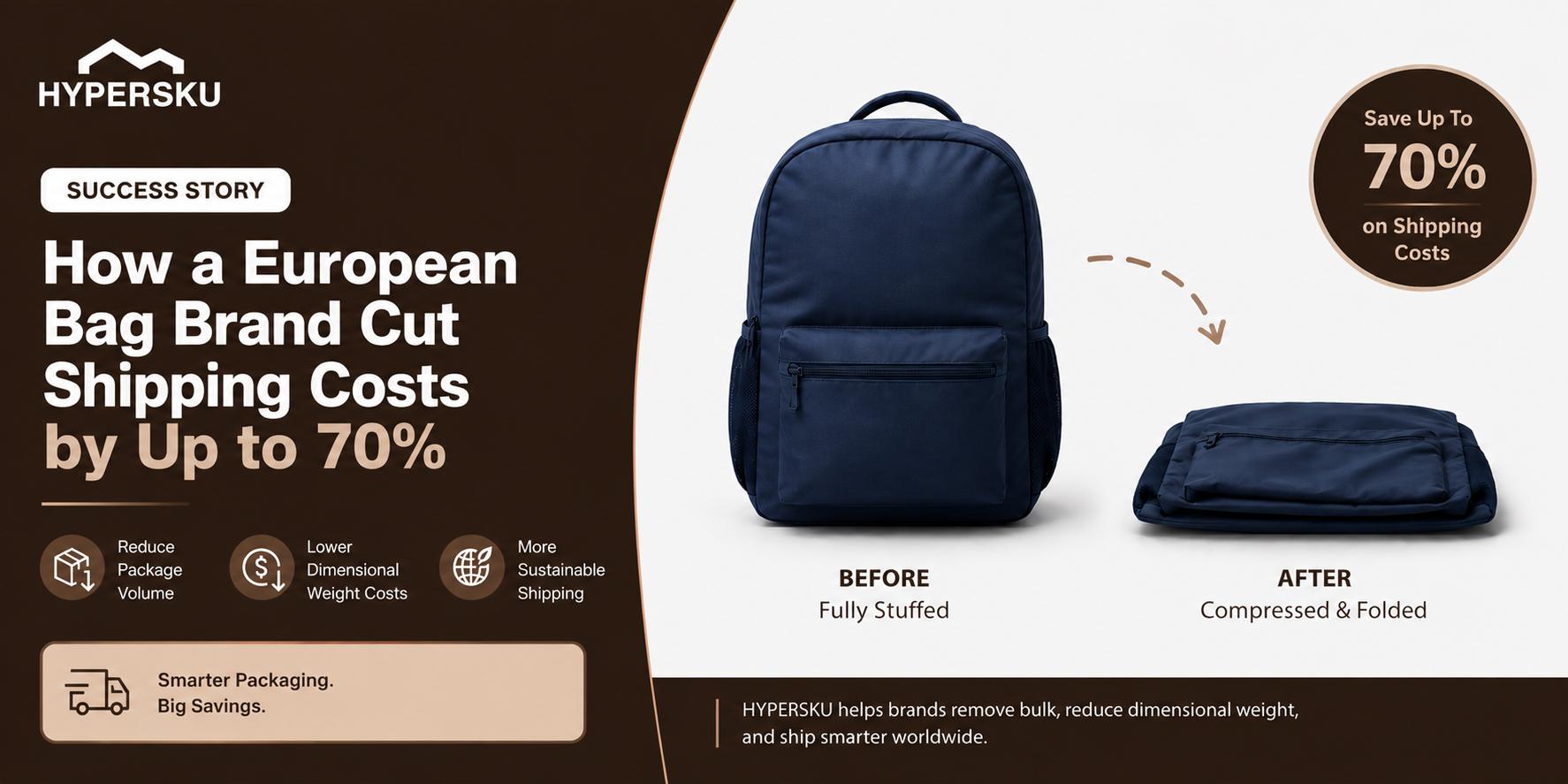
Case Study: European Bag Brand
An EU-based accessories brand was paying $52.00 per backpack and $99.71 per tote bag in shipping fees. The root cause was factory filler material inflating the dimensional weight of every unit. The product quality was not in question. The supplier relationship was intact. The entire margin problem traced back to one operational detail: how the bags were packed when they left the factory.
HyperSKU’s inbound repackaging workflow removed the filler, folded the bags flat, and repacked them at their true dimensional size before each outbound shipment. The team also flagged the potential for light crease marks upfront, giving the brand the information needed to make an informed decision before proceeding. Thank you cards and custom packaging were added to maintain the unboxing experience alongside the leaner pack size.
Dimensional Weight Optimization
Shipping Costs Cut by Up to 70% — Without Changing Suppliers
A European bag brand was paying $99.71 per tote bag in shipping fees because factory filler material inflated dimensional weight on every unit. HyperSKU’s inbound repackaging workflow removed the filler, compressed the bags to their true size, and transformed the freight profile of every outbound shipment.
70%
Reduction in tote bag shipping cost
46%
Reduction in backpack shipping cost
C.Pre-Shipment Quality Control & Market Compliance
Sourcing from overseas manufacturers introduces a layer of quality and compliance risk that does not resolve itself. Products that pass factory inspection can still arrive at the warehouse with defects, mislabeling, or packaging that does not meet the regulatory requirements of your target market. By the time those issues surface at the customer level, the cost is not just the product. It is the return, the refund, the review, and the trust.
Pre-shipment quality control at the warehouse level intercepts those problems before they ship. This is not a replacement for factory QC. It is a second checkpoint, closer to the customer, covering the specific standards that matter for your market and your product category.
For brands selling into North America, Europe, or Australia, compliance requirements go beyond generic quality checks. Labeling must meet region-specific standards. Barcodes must be placed correctly for retailer or platform acceptance. Packaging may need to be adapted to meet import regulations or market-specific presentation requirements. These are details that cause shipments to be rejected, held at customs, or returned by end customers.
HyperSKU’s warehousing services include inbound inspection workflows covering product defect screening, compliant relabeling, barcode verification, and repackaging tailored to target market requirements. Inventory that does not meet the agreed standard is flagged and resolved at the warehouse, before it enters the fulfillment pipeline.
For scaling brands managing multiple SKUs across multiple markets, having that checkpoint built into the warehousing operation removes a category of risk that is otherwise very difficult to manage at volume.
Value-Added Fulfillment Services
What HyperSKU’s Fulfillment VAS Includes
From per-item quality inspection to brand label sewing and vacuum compression for freight efficiency, HyperSKU’s value-added fulfillment services are designed around the operational needs of scaling ecommerce brands.
Download BrandLift PackageHow to Evaluate a Value-Added Fulfillment Partner
Not every fulfillment provider that offers value-added services has the infrastructure to execute them reliably as your brand scales. The gap between what a partner lists as a capability and what they can actually deliver consistently at volume is where most brands run into problems.
Three criteria are worth applying when evaluating a VAWF partner at the scaling stage.
Documentation & SOP Capability
Cost Transparency & Proactive Optimization
Execution Consistency at Scale
Documentation and SOP capability. Can the partner take your operational requirements and translate them into written, executable warehouse protocols? A fulfillment provider that handles complexity through verbal instructions or informal arrangements will not maintain consistency across high order volumes or staff changes. The blind box case in this article is a useful benchmark: six fulfillment rules, written down, executed across 488 orders with zero violations. That is what documented execution looks like.
Cost transparency and proactive optimization. Does the partner identify cost inefficiencies on your behalf, or do they wait for you to raise them? The dimensional weight case in this article involved HyperSKU identifying a repackaging opportunity that reduced per-unit shipping costs by up to 70%. That kind of intervention requires a partner who understands your margin structure and treats cost optimization as part of the service, not an extra conversation.
Execution consistency at scale. A value-added service that works at 50 orders per month needs to work at 500 and 5,000. Ask for documented results. Ask how SOPs are maintained during volume spikes. Ask what happens when inbound inventory arrives damaged or noncompliant. The answers will tell you whether a partner’s capabilities are real or aspirational.
HyperSKU is built for brands at exactly this stage. With warehousing and fulfillment infrastructure spanning China, the US, and the EU, a native Shopify integration, and a track record of executing complex fulfillment requirements at scale, HyperSKU functions as a supply chain infrastructure partner rather than a logistics vendor.
Final Thoughts
Value-added warehousing and fulfillment is not a premium add-on for enterprise brands with complex logistics budgets. It is the operational infrastructure that scaling DTC and POD brands need when standard fulfillment starts creating problems that hurt margins, damage brand reputation, and slow growth.
The two cases in this article illustrate the range of what that looks like in practice. A blind box brand eliminated a 50% packaging damage rate and built a randomized fulfillment system that executed without a single protocol violation across 488 orders. A European bag brand reduced per-unit shipping costs by up to 70% through an inbound repackaging workflow that required no supplier changes. Both outcomes came from the same source: a fulfillment partner that treated operational complexity as a solvable problem rather than a fixed constraint.
For brands at the scaling stage, the warehouse is where margins are protected or lost, where brand standards are upheld or compromised, and where operational complexity either gets absorbed cleanly or starts generating customer complaints. Choosing the right fulfillment infrastructure is not a back-office decision. It is a growth decision.
Ready to Turn Your Fulfillment Into a Growth Advantage?
HyperSKU handles the operational complexity so you can focus on scaling. From precision kitting to shipping cost optimization, your fulfillment infrastructure starts here.
Get Started FreeFAQs About Value-Added Warehousing & Fulfillment
What are examples of value-added services in a warehouse?
Value-added warehousing services include custom kitting and assembly, dimensional weight optimization and repackaging, pre-shipment quality control and inspection, compliant relabeling for target markets, branded packaging and insert insertion, and returns processing. These services go beyond standard pick-and-pack to provide order-level customization and brand-specific handling.
What is the difference between standard fulfillment and value-added fulfillment?
Standard fulfillment covers receiving, storing, and shipping inventory in the condition it arrives. Value-added fulfillment adds a layer of customized handling at the SKU or order level, including repackaging, kitting, quality checks, and compliance-related relabeling. The practical difference is that value-added fulfillment treats the warehouse as an active part of your supply chain rather than a passive storage and dispatch facility.
How does value-added warehousing reduce shipping costs?
The most direct lever is dimensional weight optimization. Carriers charge international parcel shipping rates based on volumetric weight, not actual weight. Products packed with factory filler material or in oversized boxes are billed at a rate that reflects their volume rather than their contents. Repackaging inventory at the warehouse level, before it ships, reduces the dimensional weight of each unit and lowers the per-unit freight cost without requiring supplier changes or product modifications.
What are some examples of value-added services in ecommerce fulfillment?
In an ecommerce context, value-added fulfillment services typically include multi-SKU kitting and bundle assembly, custom packaging and branded unboxing materials, inbound quality inspection and defect screening, regional compliance relabeling for markets such as North America, Europe, and Australia, dimensional weight optimization through repackaging, and specialized handling protocols for product categories like collectibles, apparel, or fragile goods.
Is value-added warehousing suitable for small ecommerce brands?
Value-added warehousing becomes most relevant when a brand’s product complexity or shipping volume starts creating problems that standard fulfillment cannot absorb. This does not require enterprise scale. A brand managing multi-SKU bundles, selling into multiple regional markets with different compliance requirements, or losing margin to inflated shipping costs is already at the stage where value-added services deliver measurable returns. The key is finding a partner whose service model is built for brands at the scaling stage, not just for high-volume enterprise accounts.
A shopper opens ChatGPT and types: “Find me a lightweight running jacket, under $80, delivered by Thursday.” No Google search. No ad click. No browsing. Thirty seconds later, a product recommendation appears with a price, a delivery estimate, and a checkout link. The shopper buys.
The brand that got recommended didn’t win that sale because of its ad spend. It won because when the AI agent looked at its store data, everything was there: accurate inventory, a real shipping window, clean product attributes, and a fulfillment track record the model had learned to trust.
This is how a growing number of purchases are being made in 2026. And Shopify has built the infrastructure to put your store right in the middle of it. This guide covers what that infrastructure looks like, how to activate it, and what’s required beyond activation to actually get chosen.
The AI Commerce Shift Is Already Affecting Your Store
Before getting into features, it helps to understand the scale of what’s happening, because the numbers make the urgency concrete.
7×
Increase in AI-driven traffic to Shopify stores since January 2025
11×
Increase in purchases attributed to AI-powered search since January 2025
20%
of all transactions predicted to be executed through AI platforms by 2030
The traffic volumes are still smaller than organic search. But the quality is already outperforming on a per-session basis. Shopify’s own analysts have compared this moment to how merchants treated mobile traffic in 2012: a small number that was easy to dismiss, right before it stopped being small.
AI-referred shoppers arrive directly on product pages, having already been pre-qualified by the agent’s evaluation. They’re not browsing. They’ve already decided they’re interested. That’s why conversion rates are higher. Once these shoppers reach the store, the page experience still needs to convert that intent into action. A Shopify landing page builder like GemPages can help merchants improve product pages, sales pages, and campaign-specific landing pages with clearer structure, conversion-focused sections, and faster page creation workflows. And it’s why getting your store chosen by an agent matters more than just getting it found.
Shopify’s AI Ecosystem :Three Layers That Work Together
Shopify’s Winter ’26 Edition shipped over 150 updates. The AI-related changes aren’t a scattered list of features. They form a three-layer system, each addressing a different part of how you run and grow your store.
Shopify AI Ecosystem — Winter ’26 Edition
| Layer | Tool | What It Does | Plan Required |
|---|---|---|---|
| Discovery | Agentic Storefronts | Syndicates your product catalog into ChatGPT, Google AI Mode, and Microsoft Copilot. Customers discover and buy from you inside AI conversations. | All plans (US buyers required for most channels) |
| Intelligence | Sidekick + Pulse | AI assistant built into your admin. Sidekick answers questions and executes tasks. Pulse proactively monitors your store and surfaces recommendations before you ask. | All plans, free |
| Automation | Shopify Flow + AI | Workflow automation across your entire operation. In 2026, Sidekick builds Flow automations from plain-language instructions. No coding required. | All plans, free |
Each layer addresses a different challenge. Agentic Storefronts solves the discovery problem. Sidekick solves the intelligence problem. Flow solves the operational problem. The sections below break each one down.
Agentic Storefronts: Getting Your Products Into AI Conversations
Agentic Storefronts is a sales channel that syndicates your product catalog to AI shopping platforms. When a user asks ChatGPT, Google AI Mode, or Microsoft Copilot for a product recommendation, eligible Shopify merchants can appear in the results — and in some cases, allow the purchase to complete directly inside the AI interface, without the buyer ever visiting your store.
Think of it as a distribution layer sitting behind your storefront. Your products don’t need to be redesigned or reformatted for each platform. Shopify Catalog handles the data syndication automatically. You manage everything from one place in your admin.
The three channels work differently, and knowing the distinction matters before you decide where to focus first:
ChatGPT (OpenAI)
EnrollmentDefault ON
CheckoutRedirects to your store
FeeNo additional fee
EligibilitySell to US buyers
Reach800M+ weekly users
Microsoft Copilot
EnrollmentManual toggle
CheckoutDirect in Copilot
FeeNo additional fee
EligibilitySell to US buyers
WhereSettings → Sales Channels
Google AI Mode
EnrollmentManual toggle
CheckoutDirect in Google AI Mode
FeeNo additional fee
EligibilityUS-based stores only
WhereSettings → Sales Channels
A note on fees worth clarifying: when ChatGPT launched its Instant Checkout feature in January 2026, opt-in Shopify merchants paid OpenAI a 4% fee on in-chat purchases. That feature was quietly shut down in March 2026, with OpenAI stating it “did not offer the level of flexibility that we aspire to provide.” The current Agentic Storefronts model, which launched by default for all Shopify stores in late March 2026, redirects buyers to your own storefront to complete checkout. There is no additional transaction fee under this model. If you read earlier reporting about the 4% fee, that applied to a feature that no longer exists.
Being enrolled is the entry requirement. Whether your products actually appear depends almost entirely on data quality: complete attributes, accurate inventory, specific titles, and pricing consistency across channels. Incomplete product data is the most common reason products don’t show up in AI recommendations — and it’s entirely within your control to fix.
Sidekick + Pulse: From Reactive Tool to Proactive Monitor
Shopify Sidekick is an AI assistant built directly into your admin. You can ask it questions, request store summaries, draft content, or use it to build automations — all in plain language, without leaving your dashboard.
The meaningful upgrade in Winter ’26 is Sidekick Pulse: a proactive monitoring layer that surfaces recommendations on your admin home without you having to ask. Instead of waiting for you to notice a problem, Pulse flags things like inventory heading toward stockout, conversion anomalies, and unusual traffic changes as “Pulse Cards” on your dashboard. The shift is from reactive tool to proactive business monitor.
Sidekick: Before and After Winter ’26
| Capability | Before Winter ’26 | Winter ’26 + Pulse |
|---|---|---|
| Mode | Reactive — answers when asked | Proactive — surfaces insights automatically |
| Inventory alerts | Manual query required | Pulse Card appears when stock drops below threshold |
| Conversion issues | Visible only in Analytics | Pulse flags anomalies on admin home |
| Flow automation | Build manually in Flow editor | Describe in plain language, Sidekick builds it |
| Mobile access | Text only | Voice mode on Shopify mobile app |
One clarification worth noting: some guides describe Pulse as sending daily email briefings to your inbox. That’s not accurate in the current release. Pulse surfaces recommendations inside your Shopify admin dashboard as Pulse Cards. If you want daily visibility into key metrics, check your admin home each morning, or ask Sidekick directly for a summary.
Sidekick is free on all Shopify plans, with no per-query limits.
Shopify Flow: Automating the Operations That Slow You Down
Shopify Flow is Shopify’s built-in automation tool. It lets you set up logic-based workflows across your store: trigger an action when a condition is met, without writing code. The Winter ’26 upgrade connects Flow directly to Sidekick — you can now describe a workflow in plain language and have Sidekick build the automation logic for your review before anything goes live.
For independent store operators managing cross-border fulfillment, three workflow categories deliver the most immediate return:
Scenario 01
Abandoned Checkout Recovery
Automatically send a recovery email with a time-limited discount when a customer abandons checkout. Runs natively in Flow — no third-party app subscription required.
Marketing automation
Scenario 02
Low-Stock Alerts for Bestsellers
Trigger an internal alert when inventory for a top-selling SKU drops below a defined threshold. For sellers sourcing from China, catching this 10–14 days early is the difference between a smooth restock and a stockout.
Inventory management
Scenario 03
VIP Customer Tagging
Automatically tag customers whose lifetime spend crosses a defined threshold. Use the tag to trigger separate email flows, exclusive discounts, or priority service routing — without manual segmentation.
Customer segmentation
Flow is free on all Shopify plans. For a step-by-step setup guide, see our detailed Shopify Flow automation guide.
Being Discoverable Is Not Enough: What AI Agents Actually Use to Choose
Getting enrolled in Agentic Storefronts is the entry requirement. It is not the finish line.
Here is the part most Shopify AI guides skip: the agent’s recommendation decision doesn’t happen on your storefront. It happens when the agent looks behind your storefront and evaluates whether what it finds there is reliable enough to stake a recommendation on.
Two stores selling nearly identical products. Both enrolled in Agentic Storefronts. Both with complete product titles and clean descriptions. One gets recommended consistently. One doesn’t. The difference comes down to four signals — and none of them live on your storefront.
Signal 01
Real-Time Inventory Accuracy
An agent verifies stock before recommending. If your inventory count is based on a delayed sync — or reflects warehouse totals rather than per-SKU availability — the agent is working with data that may already be wrong. Stores with unreliable inventory data get deprioritized as the model learns from failed outcomes over time.
Lives in your supply chain
Signal 02
Dynamic Shipping Commitments
A static policy page saying “ships in 5–7 days” cannot answer “will this arrive by Thursday?” A real shipping estimate requires knowing the origin warehouse, the buyer’s destination, and current carrier performance. Agents that can’t verify a delivery commitment won’t make one on your behalf.
Lives in your logistics layer
Signal 03
Structured Product Attributes
Agents run structured queries against product data. If a shopper needs “a merino wool mid-layer, 180gsm, available in medium,” the agent needs those as parseable attributes — not embedded in marketing copy. Incomplete attributes mean your product doesn’t match the query, even when it should.
Lives in your product data
Signal 04
Fulfillment Consistency Over Time
AI systems learn from outcomes. A pattern of late deliveries, wrong variants shipped, or slow returns handling degrades your standing in the agent ecosystem — not through a manual penalty, but through the model’s learned association between your store and failed purchase experiences. This effect is cumulative and slow to recover from.
Lives in your fulfillment ops
Notice what all four signals have in common. They all require operational infrastructure that sits behind your store, connecting the product listing to the physical reality of getting an order from a supplier’s warehouse to a customer’s door, reliably, every time.
This is where supply chain infrastructure becomes a direct input to AI discoverability. Not as a backend consideration — as a front-end competitive advantage. Shopify’s own data shows that merchants with complete, structured, real-time product data consistently outperform those with similar products but weaker backend infrastructure.
For Shopify sellers working with a fulfillment partner, the partner you choose has a direct impact on how often your products get recommended. Real-time inventory feeds, per-warehouse stock visibility, dynamic shipping estimates by destination, and a consistent fulfillment track record are the infrastructure requirements that convert AI discoverability into AI selection.
Recommendation Is Not a Ranking System. It’s a Learning System.
Most merchants approach AI discoverability the way they approached SEO: optimize the inputs, improve the ranking. Fill in the product attributes. Write better titles. Enable the right channels. These steps matter — but they address only the entry layer. They determine whether you’re eligible to be recommended. They don’t determine whether you’re chosen.
The distinction matters because AI recommendation systems don’t work like search rankings. A search engine scores your page against a set of signals at a point in time. An AI recommendation system is continuously learning from outcomes. Every transaction it facilitates — completed or failed, delivered on time or late, returned or kept — feeds back into its model of which stores are reliable enough to recommend for which types of queries.
This means your fulfillment history is not just a customer satisfaction metric. It is an input into how frequently the model recommends you next week, next month, and next quarter. The feedback loop is asymmetric: trust accumulates slowly, through a consistent pattern of positive outcomes. It degrades quickly, through a smaller number of negative ones.
For merchants who have been operating on Shopify for years with a stable customer base, this is a structural shift in what “performance” means. Your conversion rate, your return rate, your shipping consistency — these were always important. In AI commerce, they directly determine your visibility.
The Data Freshness Problem
AI agents don’t just evaluate what your product data says. They evaluate how much they can trust it.
When an agent receives a query — “find me a merino wool base layer, available in large, that ships to Toronto by Thursday” — it needs to make a real-time assessment across multiple variables: does this product actually exist in the right variant? Is it in stock right now? Can it realistically reach Toronto by Thursday given current carrier performance?
A store with real-time inventory sync can answer all three questions with data the agent can verify. A store with batch inventory updates — where Shopify stock counts refresh every 12 or 24 hours — cannot. The agent knows the difference, because it has access to signals about data recency. In ambiguous situations, agents are conservative: they would rather not recommend than recommend and be wrong.
This is the data freshness problem, and it disproportionately affects cross-border sellers. For merchants sourcing from suppliers in China, inventory data often exists in fragments: the supplier’s actual stock in one system, the 3PL warehouse count in another, the in-transit quantity somewhere else. None of these naturally sync to Shopify in real time. What the agent sees is a number that may be accurate, or may reflect conditions from yesterday. Without a reliable data pipeline connecting the physical supply chain to the storefront, the agent’s confidence in your listings is structurally lower than a competitor shipping from a domestic warehouse with live inventory feeds.
The Shipping Commitment Gap
Static shipping policies are one of the most common and most costly gaps in AI readiness for independent store operators.
Most Shopify stores publish a shipping policy that was written at setup and states something like “standard shipping 7–14 business days.” That policy cannot answer the question an AI agent actually needs to answer: will this specific product, shipped from its current warehouse location, reach this specific buyer’s address by a specific date?
The reason this matters more in AI commerce than in search commerce is accountability. When a buyer finds your store through Google and reads your shipping policy, the responsibility for interpreting it belongs to them. When an AI agent recommends your product and implicitly vouches for its delivery timeline, the agent is taking on a layer of accountability for the outcome. Agents that have been associated with stores with unreliable or unverifiable shipping commitments learn to route around them. They recommend stores whose logistics infrastructure gives them enough signal to make a confident commitment.
For cross-border sellers, closing this gap requires more than updating a policy page. It requires knowing, at the time of an agent query, which warehouse holds the inventory, what the current transit time is from that warehouse to the buyer’s region, and whether that transit time is based on real carrier data or a historical average. This is a logistics infrastructure question, not a content optimization question.
Fulfillment Consistency: The Compounding Signal
Of the four signals that influence AI recommendation frequency, fulfillment consistency is both the most impactful and the slowest to recover once damaged.
Shopify’s data points to a clear pattern: merchants whose stores consistently deliver what the agent promised — correct variant, on time, with a low return rate — see recommendation frequency increase over time as the model learns to associate their store with positive purchase outcomes. Merchants whose fulfillment is inconsistent see the opposite, even if their product data is clean and their storefronts are well-optimized.
The mechanism is worth understanding. An AI recommendation system isn’t penalizing you manually for a late shipment. It’s updating its probabilistic model of what happens when it sends a buyer to your store. A pattern of late deliveries, wrong variants, or unresolved returns shifts that probability distribution. The model becomes more conservative about recommending you for time-sensitive or high-consideration purchases — exactly the queries where margin and volume tend to be highest.
What makes this particularly consequential for cross-border sellers is that fulfillment inconsistency is often structural rather than operational. It doesn’t stem from individual errors. It stems from the inherent complexity of a supply chain that spans supplier lead times, international freight, customs clearance, and last-mile delivery across multiple markets. Each handoff is a point where data can break, timelines can slip, and the signal the agent receives can diverge from what actually happens.
The Four Moats: Why Supply Chain Is Now a Brand Question
A useful framework for thinking about long-term competitiveness in AI commerce comes down to four moats — each one representing a dimension of advantage that is genuinely hard to replicate quickly, and that compounds in value over time.
Moat 01
Regulatory Compliance
Moving faster than competitors on certifications like CE, GPSR, and MDR creates a barrier that takes significant time and investment to clear. Most sellers never do.
Compliance Infrastructure
Moat 02
Price-Value Positioning
Making a meaningful price premium feel justified through product quality, industrial design, and brand experience. Customers don’t pay for materials — they pay for the feeling of owning something considered.
Brand & Product
Moat 03
Physical Infrastructure
Sourcing networks, warehouse positioning, and logistics infrastructure that take years to build. Dual-node fulfillment, reliable supplier relationships, and operational depth competitors can’t replicate overnight.
Supply Chain Depth
Moat 04
Brand Trust — The AI Moat
Building a brand that AI systems recommend by default, not a generic alternative. In agent-driven commerce, this trust is built through clean data, reliable fulfillment, and a track record of positive purchase outcomes — not ad spend.
Most Relevant to AI Visibility
Key Takeaway
Win one moat, win an order. Win all four, win a category. In the AI era, Moat 04 is the multiplier — it determines whether the other three ever get seen.
The first three are relatively familiar. Regulatory compliance: moving faster than competitors on certifications like CE, GPSR, and MDR creates a barrier that takes time and investment to clear. Price-value positioning: making a meaningful price premium feel justified through product quality, industrial design, and brand experience. Physical moats: sourcing infrastructure, warehouse positioning, and logistics networks that take years to build and can’t be copied overnight.
The fourth moat is brand — and in an AI commerce environment, it takes on a meaning that goes beyond marketing. Building a brand that AI systems recommend by default, rather than a generic alternative, is not an outcome of better creative or higher ad spend. It is an outcome of operational trust: clean data, reliable fulfillment, structured product information, and a track record of positive purchase outcomes consistently associated with your store.
Brand trust and supply chain quality are no longer separate conversations. They are the same conversation, viewed from different angles. The store that wins the AI recommendation isn’t always the one with the best product. It’s the one the model has learned to trust.
What This Means in Practice
The choice of fulfillment partner is one of the most underweighted decisions in this context. What’s visible — cost per shipment, catalog size, integration options — is easy to compare. What’s harder to evaluate, but more consequential for AI visibility, is the data infrastructure behind the operation: how inventory counts are synced, how shipping estimates are generated, and what the order reliability track record actually looks like at scale.
In an agent-driven commerce environment, your supply chain data quality is part of your marketing stack. It needs to be evaluated accordingly.
7-Day Implementation Snapshot
The checklist below covers one high-priority action per day across all three layers of the Shopify AI ecosystem. The goal isn’t a full technical overhaul in a week. It’s to make sure the most important switches are flipped, the most common data gaps are closed, and you have a baseline to measure from going forward.
D1
Activate Agentic Storefronts
Discovery Layer — Settings → Sales Channels
Go to Settings → Sales Channels → Agentic Storefronts. Confirm your ChatGPT channel is active — eligible stores are enrolled by default. Toggle on Microsoft Copilot and Google AI Mode if you sell to US buyers. Unpublish any products you don’t want appearing in AI channels: gift cards, subscription items, or region-restricted SKUs.
Not eligible yet? Shopify is rolling access out in waves through 2026. Check your admin dashboard for a notification, or watch for an email from Shopify confirming your store’s enrollment status.
D2
Check your Pulse Cards and set a monitoring baseline
Intelligence Layer — Shopify Admin Home
Open your Shopify admin home and look for Pulse Cards. Shopify may already be surfacing recommendations based on your store data. Open Sidekick and ask for a baseline summary: your top products by revenue, your highest cart abandonment rate, and any inventory currently below a safe threshold. Note what comes back. This is your starting point.
D3
Audit your top 20 products for AI readiness
Product Data Layer — Highest-leverage fix
Ask Sidekick to identify your top 20 products by traffic and flag which ones have incomplete attributes, missing meta descriptions, or titles that lack specific product specs. For each flagged product, update titles to include material, size, use case, and key spec. Agents match on attributes, not brand positioning. Export a backup before making bulk edits.
Sidekick review step: Sidekick shows suggested changes before applying anything. Review AI-generated copy against your brand voice before approving, especially for hero products.
D4
Set up abandoned checkout recovery via Flow
Automation Layer — First workflow
Open Sidekick and describe the workflow: abandoned checkout trigger, 2-hour delay, recovery email with a discount code, customer tagged for tracking. Sidekick builds the flow for your review. Adjust the discount to fit your margins, then activate. Check the Flow log after 48 hours to catch edge cases — customers with no email on file, variants with tracking disabled, and so on.
D5
Set up low-stock alerts for your top 5 SKUs
Automation Layer — Inventory management
Use Sidekick to build a Flow automation that triggers an internal alert when inventory for each of your top 5 bestsellers drops below a defined threshold. For most sellers sourcing from China, 10–14 days of stock buffer is the minimum. Set your trigger to give you that window before you run out, not after.
D6
Cross-check your inventory and shipping data
Backend Readiness — The step most guides skip
Compare your Shopify inventory counts against your actual warehouse or supplier stock levels. Flag any discrepancies — these are the listings most at risk of failed AI recommendations. Then review your published shipping policy: for each main destination market, confirm the delivery windows reflect real current carrier performance, not copy written months ago.
Why this matters: Shopify’s tooling connects you to AI channels. What happens when an agent queries your stock and shipping data depends entirely on your supply chain infrastructure. This is the highest-leverage fix for long-term AI visibility.
D7
Review performance and build your optimization cycle
Analytics Layer — Ongoing
Ask Sidekick for a week-over-week summary including any AI channel attribution visible in your reports. In Shopify Analytics, look for sessions attributed to AI referral sources and compare conversion rate against organic search. Identify 2–3 products that received AI traffic but didn’t convert — these are your optimization priorities for next week.
This is a cycle, not a one-time setup: AI channel performance compounds as models learn from outcomes. Stores that review and optimize consistently build a growing advantage over those that activate once and leave it.
Final Thoughts
Shopify’s AI ecosystem in 2026 is genuinely well-built. Agentic Storefronts, Sidekick Pulse, and Flow give independent store operators access to distribution, intelligence, and automation infrastructure that didn’t exist two years ago — and at no additional cost on any plan.
But the merchants who will build durable advantages in this environment are not the ones who activate the fastest. They are the ones who understand what the AI layer is actually evaluating, and who invest accordingly in the operational infrastructure behind their storefronts.
Getting found by an AI agent is a front-end problem. Getting chosen — consistently, over time, across the queries that drive real revenue — is a supply chain problem. The stores that win in agent-driven commerce will be the ones where the product listing and the physical reality behind it are in tight, real-time alignment.
Want to Win in the Shopify AI Era?
AI agents choose stores with reliable fulfillment data. Partner with HyperSKU for real-time inventory, dynamic shipping estimates, and cross-border fulfillment infrastructure built for Shopify sellers.
Get Started FreeFAQs
What is Shopify Agentic Storefronts?
Agentic Storefronts is a Shopify sales channel that syndicates your product catalog to AI shopping platforms including ChatGPT, Google AI Mode, and Microsoft Copilot. Products become discoverable inside AI conversations, with buyers clicking through to complete checkout on your own storefront. As of March 2026, eligible merchants selling to US buyers are enrolled in the ChatGPT channel by default. Google AI Mode and Microsoft Copilot require a manual toggle in Settings → Sales Channels → Agentic Storefronts.
Does Shopify charge extra fees for AI channel sales?
No. As of March 2026, there are no additional transaction fees for sales through any of the three Agentic Storefronts channels. The original ChatGPT Instant Checkout model, which charged a 4% fee on in-chat purchases, was discontinued by OpenAI in March 2026. The current model redirects buyers to your storefront, and standard Shopify payment processing rates apply.
What is Shopify Sidekick Pulse?
Sidekick Pulse is a feature introduced in Shopify’s Winter ’26 Edition that shifts Sidekick from a reactive chatbot to a proactive store monitor. Rather than waiting for you to ask questions, Pulse analyzes your store data in the background and surfaces actionable recommendations on your admin home dashboard as “Pulse Cards” — flagging things like inventory heading toward stockout, conversion anomalies, and unusual traffic patterns. It is available free on all Shopify plans.
Why isn’t my store appearing in ChatGPT or Google AI recommendations?
There are typically three reasons. First, your store may not yet be enrolled or eligible for the specific channel — check Settings → Sales Channels → Agentic Storefronts for your current status. Second, your product data may be incomplete: missing attributes, vague titles, or stale inventory counts are the most common blockers. Third, your fulfillment reliability signals may be weak — AI systems learn from purchase outcomes over time, and stores with inconsistent fulfillment histories get deprioritized on higher-consideration queries. Start with a product data audit on your top 20 SKUs.
Do I need Shopify Plus to access these AI features?
No. Agentic Storefronts, Sidekick (including Pulse), and Shopify Flow are all available on every Shopify plan at no additional cost. The main Plus-exclusive features relevant to this article are the full B2B Wholesale Storefront and certain advanced Flow configurations. For AI channel access and the Sidekick intelligence layer, your current plan is sufficient.
How does supply chain quality affect AI product recommendations?
AI recommendation systems learn from purchase outcomes — meaning your fulfillment track record directly influences how frequently the model recommends your store over time. Four signals matter most: real-time inventory accuracy, dynamic shipping commitments, structured product attributes, and fulfillment consistency. All four originate in your supply chain infrastructure, not your storefront. Merchants with real-time inventory feeds, live shipping estimates by destination, and consistent order reliability consistently outperform those with similar products but weaker backend data. For a deeper look at this, see our guide on agentic eCommerce for DTC brands.
If you sell products to customers in Europe, a new regulation is changing the rules around how your orders are packaged.
The EU’s Packaging and Packaging Waste Regulation, known as PPWR, sets binding standards for packaging design, materials, recyclability, and labeling across all 27 EU member states. It applies to any packaging that enters the EU market, regardless of where it was produced or shipped from.
Most of its core requirements take effect from August 12, 2026. Sellers who ship to Europe need to understand what PPWR requires, who it applies to, and what changes are necessary before that date.
This guide explains the regulation, breaks down the key obligations, and outlines practical steps for e-commerce sellers to prepare.
What Is PPWR?
PPWR stands for the Packaging and Packaging Waste Regulation. Its full legal name is Regulation (EU) 2025/40. It entered into force on February 11, 2025, replacing the previous Packaging and Packaging Waste Directive (94/62/EC), which had been in place since 1994.
The core difference between the old directive and the new regulation is how they apply. The previous directive required each EU member state to pass its own national legislation to implement the rules, which resulted in different standards, different enforcement approaches, and different timelines across the bloc. PPWR is a regulation, which means it applies directly and uniformly across all 27 member states without national transposition. There is one set of rules, one set of deadlines.
The regulation is part of the EU’s broader Circular Economy Action Plan and its 2050 climate neutrality goals. Its primary objectives are to reduce the total volume of packaging waste generated in Europe, increase the recyclability of packaging placed on the EU market, limit the use of unnecessary or oversized packaging, and introduce new producer responsibility requirements.
PPWR covers all packaging categories: primary packaging (the packaging in direct contact with the product), secondary packaging (grouped or retail packaging), and tertiary packaging (transport and logistics packaging). For e-commerce sellers, this means the regulation applies not just to product boxes and labels, but also to shipping cartons, mailer bags, void fill, protective inserts, and any other packaging used to fulfill an order.
Who Does PPWR Apply To?
PPWR applies to any business that places packaging on the EU market, regardless of where that business is based.
The regulation defines this broadly. If your packaged products are sold to customers in EU member states, whether through your own website, a marketplace, or a fulfillment partner, your packaging falls within its scope.
Specifically, PPWR applies to the following types of sellers and operators:
E-commerce sellers and DTC brands shipping directly to EU consumers are within scope. This includes Shopify store owners, independent brand websites, and any seller fulfilling orders to EU addresses. The packaging used to ship those orders, including outer cartons, mailer bags, tissue paper, and branded inserts, is covered.
Amazon and marketplace sellers listing products for EU customers are also covered. PPWR explicitly addresses online marketplaces as responsible actors. Under Article 45 of the regulation, marketplaces are expected to verify that sellers have completed EPR registration as a condition of market access. Non-EU sellers who have not appointed an EU authorized representative may find the marketplace itself treated as the responsible economic operator.
Dropshipping businesses are not exempt. If you are dropshipping products to EU customers, the packaging those products arrive in must comply with PPWR. The regulation does not have a volume threshold below which it stops applying. There is no minimum order quantity that makes compliance optional.
Importers and fulfillment operators placing packaged goods into the EU market take on compliance obligations at the point of import. If you use a third-party fulfillment center in Europe, you will need to ensure that the packaging coming into that facility already meets PPWR requirements.
One important note on company size: PPWR does include limited exemptions for micro-enterprises (defined as businesses with fewer than 10 employees and an annual turnover or balance sheet below €2 million). However, the core requirements, including recyclability standards, packaging minimization rules, labeling obligations, and EPR registration, apply regardless of business size, as long as you are placing packaging on the EU market.
In short, if your products reach EU customers, PPWR applies to you.
PPWR Timeline: Key Deadlines from 2025 to 2030
PPWR does not introduce all of its requirements at once. The regulation rolls out in stages, with different obligations taking effect at different points between 2025 and 2030. Understanding the sequence helps sellers prioritize what to address first.
PPWR compliance timeline
Click each milestone to see what’s required
Feb 2025
PPWR enters into force
⌄
Regulation (EU) 2025/40 becomes law, replacing the old Packaging Directive.
Aug 12, 2026
Core obligations begin
⌄
The main compliance date. Most e-commerce packaging obligations become enforceable.
Feb 2027
Digital labeling begins
⌄
EU member states may require QR codes on packaging covered by EPR schemes.
Aug 2028
Harmonized labels mandatory
⌄
Uniform EU-wide recyclability pictograms become compulsory on all new packaging.
Jan 2030
Recyclability grades + empty space rules
⌄
All packaging must achieve grade C minimum. E-commerce boxes capped at 50% empty space.
Already in effect
Act now — Aug 2026
Coming up
February 11, 2025: PPWR enters into force
Regulation (EU) 2025/40 became law on this date. From this point forward, PPWR is the governing legal framework for packaging on the EU market, replacing the previous Packaging and Packaging Waste Directive.
August 12, 2026: Core obligations begin
This is the main compliance date. From August 12, 2026, the following requirements become enforceable:
- Packaging minimization: Packaging must be designed to minimize its volume and weight. Unnecessary packaging layers, excessive void fill, and oversized boxes that serve no functional purpose are no longer permitted.
- Substance restrictions: PFAS (per- and polyfluoroalkyl substances) in food-contact packaging are prohibited above defined concentration thresholds. Heavy metal limits for lead, cadmium, mercury, and hexavalent chromium also apply.
- Declaration of Conformity: Every packaging item placed on the EU market requires a Declaration of Conformity confirming it meets PPWR requirements, along with a supporting technical file.
- EPR registration: Producers must register under Extended Producer Responsibility schemes in each EU member state where they place packaging on the market. Non-EU sellers without an EU-established entity must appoint an EU Authorized Representative to fulfill this obligation.
- Marketplace verification: Under Article 45(4) of the regulation, online marketplaces are required to verify that third-party sellers have valid EPR registration in each country of sale before activating their listings.
February 12, 2027: Digital labeling begins (optional at national level)
EU member states may begin requiring packaging covered by EPR schemes to carry a digital label, in the form of a QR code or equivalent open technology. Once a member state introduces this requirement, the format becomes mandatory within that country. Separate national symbols that could mislead consumers about recyclability or reusability are no longer permitted.
August 2028: Harmonized labeling becomes mandatory
Uniform EU-wide packaging labels with recyclability pictograms become compulsory for all new packaging. The specific pictogram designs will be defined by the European Commission in delegated acts published by August 2026.
January 1, 2030: Recyclability grades and empty space rules
Two significant requirements come into full effect:
- Recyclability grades: All packaging placed on the EU market must achieve a minimum recyclability grade of C, meaning at least 70% of the packaging unit (by weight) must be recyclable. Packaging that falls below this threshold is prohibited from the market. Grade D and E packaging will not be permitted.
- Empty space limit: E-commerce packaging must not contain more than 40% empty space relative to total package volume, unless technically unavoidable. This applies specifically to grouped, transport, and e-commerce packaging.
For sellers who fulfill orders to EU customers, the 2026 deadline is the immediate priority. The 2030 requirements are further away, but packaging decisions made in 2025 and 2026 will determine whether a redesign is needed later.
What PPWR Actually Requires: 6 Key Obligations for Online Sellers
PPWR introduces obligations across the entire packaging lifecycle. For e-commerce sellers, six areas are directly relevant: what your packaging can contain, how recyclable it must be, what recycled material it must include, how it must be labeled, what producer responsibility fees you owe, and what documentation you must hold.
Key points at a glance:
- PFAS banned in food-contact packaging from August 2026
- All packaging must achieve recyclability grade C or above by 2030
- Plastic packaging must contain minimum recycled content from 2030
- Harmonized EU labels mandatory from August 2028, QR codes rolling out from 2027
- EPR registration required per country — non-EU sellers need an EU Authorized Representative
- Declaration of Conformity required for every packaging format from August 2026
1. Restricted substances
From August 12, 2026, food-contact packaging may not contain PFAS (per- and polyfluoroalkyl substances) above defined concentration thresholds. The limits are 25 parts per billion for any single PFAS identified through targeted analysis, 250 parts per billion as the combined total, and 50 parts per million for total organic fluorine as an overall marker. In practice, food packaging must test essentially free of PFAS to be legally placed on the EU market.
Heavy metal limits for lead, cadmium, mercury, and hexavalent chromium continue to apply at the existing 100 mg/kg cumulative limit.
For most e-commerce sellers in non-food categories, substance restrictions will have limited direct impact. If your products are classified as food-adjacent, or if your packaging uses specialist coatings or treatments, verify material compliance with your supplier before August 2026.
2. Recyclability standards
PPWR introduces a performance-based grading system for recyclability, with grades from A (highest) to D (lowest). From January 1, 2030, only packaging that achieves grade C or above may be placed on the EU market. Grade C means at least 70% of the packaging unit by weight can be recycled. From 2038, only grades A and B will be permitted.
The practical implication is that packaging made from complex laminated materials, mixed-material combinations that are difficult to separate, or non-recyclable coatings will become non-compliant from 2030. Simple mono-material structures in paper, cardboard, or recyclable plastics perform better under the grading criteria.
EPR fees will also be eco-modulated from 2028 onward, meaning better recyclability grades attract lower fees. There is a direct financial incentive to invest in packaging design ahead of that date.
3. Recycled content requirements
From January 1, 2030, plastic packaging placed on the EU market must contain a minimum percentage of post-consumer recycled (PCR) content, meaning material recovered from actual consumer waste streams rather than manufacturing offcuts.
The targets vary by packaging format:
- PET beverage bottles and contact-sensitive PET packaging: minimum 30% PCR by 2030, rising to 50–65% by 2040
- Other contact-sensitive plastic packaging (non-PET): minimum 10% PCR by 2030, rising to 25% by 2040
- All other plastic packaging: minimum 35% PCR by 2030, rising to 65% by 2040
For sellers using plastic mailer bags, polybags, or plastic protective inserts in e-commerce fulfillment, this means sourcing packaging materials from suppliers who can demonstrate and document PCR content percentages. This is a separate requirement from recyclability grades — a package can be recyclable but still fail the recycled content requirement if it is made entirely from virgin plastic.
4. Packaging minimization
PPWR requires that all packaging be reduced to the minimum volume and weight needed to fulfill its protective and functional purpose. Packaging containing unnecessary layers, excessive void fill, or space that serves no functional role is non-compliant.
From January 1, 2030, under Article 24 of Regulation (EU) 2025/40, e-commerce, grouped, and transport packaging must not exceed a 50% empty space ratio. Empty space is calculated as the difference between the internal volume of the packaging and the volume of the products inside. Filler materials such as paper cuttings, air cushions, bubble wrap, and foam all count toward the empty space ratio — switching to a different filler material does not solve the problem. The box itself must be right-sized.
The minimization principle applies from August 2026 even before the hard 50% cap takes effect in 2030. Packaging that is clearly and unnecessarily oversized creates compliance exposure from the main application date.
5. Labeling and digital identifiers
From August 2028, all new packaging placed on the EU market must carry harmonized EU-wide recyclability pictograms. These replace the current patchwork of national recycling symbols. The specific pictogram designs will be defined by the European Commission in implementing acts published by August 2026.
From February 2027, individual EU member states may require packaging covered by EPR schemes to carry a digital label in the form of a QR code. The QR code must link to structured information including material composition, recyclability classification, and disposal instructions. Once a member state activates this requirement, it becomes mandatory within that country.
For sellers managing packaging across multiple EU markets, tracking which countries have activated digital labeling requirements will become part of ongoing compliance management from 2027 onward.
6. EPR registration and documentation
Extended Producer Responsibility (EPR) requires producers to register with national packaging EPR schemes in each EU member state where they place packaging on the market, and to pay fees that fund the collection and recycling of that packaging.
Registration still operates at the national level. A seller distributing to customers in Germany, France, and the Netherlands must register separately in each country. Germany operates the LUCID register, France operates through CITEO, and the Netherlands uses PackTool. Each has its own portal, reporting format, and fee schedule.
For sellers based outside the EU, appointing an EU Authorized Representative is required to manage EPR registration and reporting on your behalf, unless an EU-established importer contractually assumes those obligations. Sellers without valid EPR registration risk having listings suspended on major marketplaces, as platforms are required under Article 45(4) to verify registration status before activating seller accounts.
Beyond registration, PPWR requires a Declaration of Conformity for every packaging format placed on the EU market from August 2026. Manufacturers and importers must also compile and retain technical documentation — including mass-balance proof for recycled content and chemical safety test results — for between five and ten years.
How to Make Your Packaging PPWR-Compliant: Practical Steps
Knowing what PPWR requires is the first step. The second is translating those requirements into actions your business can take before August 2026 and in the years that follow.
Key points at a glance:
- Audit your current packaging against PPWR’s minimization and material requirements
- Switch to mono-material, recyclable structures wherever possible
- Start EPR registration early — the process takes time, especially across multiple countries
- Ask suppliers for material certifications and PCR content documentation now
- Right-size your packaging before the 50% empty space cap takes effect in 2030
Step 1: Audit your current packaging
Before making changes, map what you are currently using. List every packaging format involved in your fulfillment process: outer shipping cartons, mailer bags, inner product boxes, void fill, tissue paper, branded inserts, labels, and tags. For each format, note the material, supplier, and whether recyclability or PCR content documentation exists.
This audit gives you a clear picture of where your packaging already meets PPWR standards and where it does not. Common problem areas include mixed-material structures such as plastic-laminated paper mailers, non-recyclable foam inserts, and oversized cartons with high void fill ratios.
Step 2: Simplify materials
The clearest path to PPWR compliance is reducing material complexity. Packaging made from a single material — paper, cardboard, or a single polymer — is significantly easier to recycle and more likely to achieve a higher recyclability grade than packaging combining multiple materials.
Practical switches to consider:
- Replace plastic-laminated mailer bags with recyclable paper mailers or certified compostable poly mailers (PLA+PBAT)
- Replace mixed-material void fill with paper-based alternatives or eliminate it by right-sizing the box
- Replace foam inserts with molded pulp or corrugated cardboard inserts
- Use kraft cardboard boxes rather than coated or printed board where possible
- Replace plastic tags and labels with recycled card or Oeko-Tex certified alternatives
When evaluating alternatives, ask your supplier for recyclability certifications such as EN 13432 (industrial compostability), and confirm whether the material qualifies for a recyclability grade under PPWR criteria.
Step 3: Right-size your packaging
The 50% empty space cap under Article 24 applies from 2030, but the general minimization principle is enforceable from August 2026. Packaging that is clearly oversized relative to its contents creates compliance risk from the main application date.
Review your current carton mix against actual product dimensions. Most fulfillment operations run from a limited range of box sizes, which means small products routinely ship in boxes significantly larger than necessary. Expanding your carton range — typically from 5 to 10 sizes to 12 to 20 — is one of the most effective ways to reduce empty space ratios across your order mix.
Right-sizing also reduces shipping costs directly, since dimensional weight pricing penalizes oversized packaging. This is one of the few PPWR compliance steps that pays for itself.
Step 4: Get your EPR registrations in order
EPR registration is the compliance step with the longest lead time. The process varies by country, requires local-language documentation in some cases, and involves ongoing reporting obligations once registered.
If you sell to customers in multiple EU countries, prioritize registration in your highest-volume markets first. Germany (LUCID), France (CITEO), and the Netherlands (PackTool) are the three largest e-commerce markets and the most likely to enforce marketplace verification from August 2026.
If your business is based outside the EU, appointing an EU Authorized Representative is a prerequisite for EPR registration. This is a legal entity established in the EU that takes on compliance obligations on your behalf. Several specialist compliance firms offer this service across multiple EU member states.
Step 5: Prepare your Declaration of Conformity
Every packaging format placed on the EU market from August 2026 requires a Declaration of Conformity confirming it meets PPWR requirements. This document is your responsibility as the seller or importer, not your packaging supplier’s.
To prepare it, you need material composition data, weight and volume specifications, and recyclability information for each packaging format. Request this documentation from your suppliers now, before August 2026. Suppliers who cannot provide it are a compliance risk.
Keep the Declaration of Conformity and supporting technical documentation on file for at least five years. Market surveillance authorities can request it at any time.
Step 6: Build ongoing compliance into your sourcing process
PPWR compliance is not a one-time exercise. Requirements become stricter in 2028, 2030, and 2038, and new implementing acts from the European Commission will add detail to existing obligations throughout that period.
The most effective approach is to build compliance criteria into your standard supplier evaluation process. When sourcing new packaging, ask for recyclability grade estimates, PCR content percentages, and relevant certifications as a baseline requirement. This makes compliance a consistent input to sourcing decisions rather than a reactive audit.
Selling to Europe? PPWR Is Just One Piece of the Puzzle
PPWR governs how your packaging must be designed and documented. But for sellers shipping into the EU market, packaging compliance sits alongside a second significant regulatory change that affects import costs directly.
From July 1, 2026, the EU is removing the previous duty-free exemption for low-value parcels and introducing a fixed €3 customs duty on all commercial goods valued under €150 entering the EU. Like PPWR, this change applies to all sellers shipping into the EU regardless of where they are based, and it affects the unit economics of every cross-border order.
The two regulations operate independently but affect the same shipments. A parcel entering the EU from outside the bloc is now subject to both packaging compliance requirements under PPWR and the new per-parcel customs duty. Sellers who address only one without the other are likely to face either compliance gaps or unexpected cost increases on their EU orders.
For a full breakdown of how the €3 customs duty works, who pays it, and how to adapt your pricing and fulfillment strategy, see our guide: EU €3 Customs Duty (2026): Complete Guide for Cross-Border E-Commerce Sellers.
How HyperSKU Helps You Ship to Europe with Confidence
Meeting PPWR requirements means making real changes to the packaging your products ship in. The challenge for most e-commerce sellers is that sourcing compliant packaging, verifying certifications, and maintaining documentation across multiple SKUs and markets is time-consuming — especially when packaging decisions are handled separately from fulfillment.
HyperSKU’s eco-friendly packaging line is built for sellers who need packaging that works for the European market. The materials and formats below are aligned with PPWR’s requirements on recyclability, compostability, and material simplicity.
Compostable shipping bags
Made from PLA+PBAT, a biodegradable material that meets EN 13432 and ASTM D 6400 industrial composting standards. Available in standard mailer and bubble-lined formats, these replace conventional plastic poly mailers with a material that holds up under PPWR’s substance and recyclability criteria.

Compostable apparel bags
Same PLA+PBAT base material in a matte semi-transparent finish, with tape-seal, reclosable, and zip closure options. Suitable for fashion and apparel sellers who need lightweight, low-volume packaging that meets compostability standards.

Recycled card, tags, and labels
Hang tags and inserts made from plantable seed paper, with label options in Oeko-Tex Standard 100 certified yarn. These cover the packaging inserts and labels that PPWR’s minimization and material requirements also apply to — not just the outer box.

Certifications
The packaging supplier behind this range holds the following third-party certifications, providing the verified documentation that PPWR’s Declaration of Conformity process requires:
OK HOME TUV
Home compostable
EN 13432
Industrial compostability
ASTM D 6400
Industrial compostability
AS 5810
Australian home composting
BPI
Biodegradable Products Institute
RCS 2.0
Recycled Claim Standard
SMETA
Ethical trade audit
ISO 9001
Quality management
For DTC brands building packaging standards for the long term, the goal is not just passing a compliance checklist. It is building a packaging system that holds up as PPWR requirements tighten in 2028 and 2030 — and that signals to European customers that your brand takes sustainability seriously.
Final Thoughts
PPWR is one of the most significant packaging regulations the EU has introduced in three decades. For e-commerce sellers shipping to Europe, it introduces real obligations: EPR registration in each country of sale, a Declaration of Conformity for every packaging format, material changes to meet recyclability standards, and documented recycled content in plastic packaging from 2030.
The regulation does not distinguish between EU-based businesses and those based elsewhere. If your packaging enters the EU market, the rules apply to you.
August 12, 2026 is the nearest deadline, and the lead time for EPR registration, supplier documentation, and packaging changes is longer than most sellers expect. Starting now means addressing one requirement at a time rather than several at once in the months before enforcement begins.
The sellers who will find PPWR least disruptive are those who treat it not as a compliance exercise but as a prompt to build packaging standards that hold up long term — simpler materials, right-sized boxes, verified suppliers, and documentation in order. Those changes reduce compliance risk in 2026, lower costs through right-sizing, and reduce EPR fees when eco-modulation takes effect in 2028.
Ready to Ship to Europe the Right Way?
HyperSKU helps you source PPWR-aligned packaging and fulfill orders to Europe — all from one platform.
Get Started FreeFrequently Asked Questions About PPWR
What is PPWR?
PPWR (Packaging and Packaging Waste Regulation), formally Regulation (EU) 2025/40, is an EU law setting binding standards for packaging design, recyclability, labeling, and producer responsibility across all 27 member states. It entered into force in February 2025, with core obligations applying from August 12, 2026.
What is the PPWR regulation for 2030?
From January 1, 2030, all packaging on the EU market must achieve a minimum recyclability grade of C (at least 70% recyclable by weight), e-commerce packaging must not exceed 50% empty space, and plastic packaging must meet minimum post-consumer recycled content targets.
Who does PPWR apply to?
PPWR applies to any business placing packaged goods on the EU market, regardless of where it is based — including Shopify sellers, Amazon sellers, dropshipping businesses, and importers. There is no volume threshold below which compliance is optional.
What are the 6 requirements of packaging under PPWR?
Restricted substances, recyclability standards, recycled content in plastic packaging, packaging minimization, harmonized labeling and QR codes, and EPR registration with Declaration of Conformity documentation.
How to comply with PPWR?
Audit your current packaging, switch to mono-material recyclable structures, right-size your boxes, register under EPR schemes in each EU country where you sell, and prepare a Declaration of Conformity supported by supplier certifications for every packaging format you use.
TikTok Shop has moved well past its “trend or fad” phase. In 2026, it’s a full-scale retail engine: global GMV reached $64.3 billion in 2025, up from $33.2 billion the year before, and is projected to climb significantly higher by the end of 2026. The platform’s algorithm keeps surfacing new must-haves daily, but the products that actually convert in 2026 look different from the viral hits of a year ago. Shoppers are leaning into what creators are calling “Reali-TEA” content: less polished advertising, more authentic before-and-after demos and “companion content” that shows a product actually being used.
In this article, we cover:
- Why TikTok Shop is still worth selling on in 2026
- 20 TikTok trending products across 5 high-performing categories, with hashtags you can use to research demand
- Tips for selling more effectively on TikTok Shop
Why TikTok Shop? Is social commerce still worth it in 2026?
TikTok Shop’s momentum hasn’t slowed down. If anything, the platform has matured into one of the most reliable product discovery channels in eCommerce.
Here’s what the numbers say:
- TikTok Shop’s global GMV reached $64.3 billion in 2025, up 94% from $33.2 billion in 2024, and continues to climb into 2026
- Beauty and personal care alone accounted for $2.49 billion in GMV in H1 2025, making it the single strongest category on the platform
- TikTok Shop now has over 15 million active sellers globally, with the U.S. seller base growing from roughly 4,450 shops in mid-2023 to over 475,000 today
What’s changed since last year is the type of content that wins. Heavily produced ads are losing ground to raw, demonstration-first videos. Sellers who can show a product working in real time, with real reactions, are the ones breaking through the algorithm in 2026.
20 Trending TikTok Products to Sell in 2026 (5 Top Performing Categories)
Category 1: Beauty & Skincare
Beauty remains the single biggest revenue driver on TikTok Shop, and 2026 has only deepened that lead.
1. Collagen Skincare Sets
- Multi-step collagen kits (serum, cream, mask) are dominating TikTok Shop’s best-seller charts, with one flagship collagen set generating over $11 million in Q1 2026 revenue alone.
- Creators build entire “skin transformation” series around these sets, tracking visible results over weeks, which keeps viewers coming back for the next update.
- Search tip: #collagenskincare, #skintransformation
2. Hyaluronic Acid & Brightening Serums
- Lightweight serums promising hydration and an instant glow remain a TikTok Shop staple, especially when paired with AM/PM routine content.
- Before-and-after lighting transitions make these products easy to demonstrate convincingly in under 15 seconds.
- Search tip: #hyaluronicacid, #brighteningserum
3. Lip Gloss & Lip Stain
- Wonderskin-style lip stains and high-shine glosses continue to sell at extraordinary volume, with one viral lip stain reportedly selling once every five seconds in the UK alone.
- Gloss reflects studio lighting beautifully on camera, and “dupe culture” content (affordable alternatives to luxury shades) keeps driving repeat purchases.
- Search tip: #lipstain, #glossy lips, #viral lip products
4. Perfume
- Long-lasting, gourmand, and vanilla-forward scents are still a TikTok favorite, carrying over strong momentum from previous years.
- “Scent of the season” and unboxing content continues to perform well, especially when tied to a specific aesthetic (clean girl, old money, etc.).
- Search tip: #perfumetok, #signaturescent
Why These Work So Well on TikTok
Visible transformation
Collagen sets and serums lend themselves to multi-week “results” series that build long-term audience trust.
High repeat purchase rate
Lip products and perfume are low-cost, habitual buys that fit impulse-friendly price points.
Strong creator trust signals
Beauty content relies heavily on creator credibility, which favors sellers who build ongoing creator relationships.
Studio-quality visuals
Glosses, serums, and packaging photograph well even in low-budget, phone-shot videos.
Category 2: Health & Wellness
Wellness has grown into one of TikTok Shop’s fastest-rising categories in 2026, as shoppers shift from pure impulse buys toward what creators call “Emotional ROI,” meaning purchases that feel intentional and self-care driven.
5. Magnesium & Sleep Supplements
- Magnesium supplements have crossed over a million units sold in a single month on TikTok Shop, driven by “nighttime routine” and sleep-hack content.
- Creators frame these as part of a broader self-care narrative rather than a one-off product push, which builds longer customer lifetime value.
- Search tip: #magnesiumglycinate, #sleephacks
6. Neck & Shoulder Massagers
- Wearable massagers with heat and pulse modes remain a top wellness seller, fitting neatly into “desk reset” and work-from-home content.
- The visual and audible feedback (pulsing, heat indicators) makes for genuinely satisfying short-form demos.
- Search tip: #neckmassager, #deskreset
7. Red Light Therapy Devices
- Compact red light panels and masks have moved from niche skincare tool to mainstream wellness must-have, fueled by dermatology-adjacent creator content.
- “10-minute routine” videos showing the device in use during a skincare or recovery session perform especially well.
- Search tip: #redlighttherapy, #skincareroutine
8. Resistance Band & Mini Fitness Bundles
- Compact, travel-friendly fitness sets continue to do well with creators who film quick home or hotel-room workouts.
- Bundling bands with a simple guide or app code increases perceived value without adding real fulfillment cost.
- Search tip: #homeworkout, #resistancebands
Why These Work So Well on TikTok
Routine-driven content
Wellness products fit naturally into recurring “my morning/night routine” formats that build habitual viewing.
Authenticity over polish
Audiences respond to creators showing real, sometimes imperfect routines rather than studio-perfect demos.
Higher perceived value
Wellness framing supports higher price points than pure novelty gadgets.
Gifting crossover
Many wellness items double as easy self-care gifts, extending their sales window beyond impulse buyers.
Category 3: Smart & Lifestyle Gadgets
Tech-forward gadgets that simplify everyday routines remain a reliable category, especially when the product has an obvious “satisfying” visual hook.
9. 3-in-1 Wireless Charging Station
- Multi-device charging docks that let a phone, watch, and earbuds charge simultaneously remain a desk-setup favorite.
- The magnetic “snap” of a device locking into place is exactly the kind of small, satisfying moment that performs well in short-form video.
- Search tip: #desksetup, #chargingstation
10. Portable Mini Projector
- Palm-sized, rechargeable projectors that turn a bedroom wall or campsite sheet into a movie screen continue to generate strong “cozy night in” content.
- The dramatic before-and-after of a dark room suddenly lit up with a big-screen picture is highly shareable.
- Search tip: #miniprojector, #cozynight
11. Privacy Screen Protectors
- Phone screens that darken sharply at an angle, keeping nearby eyes out, tap into a growing interest in everyday digital privacy.
- Demo videos showing the screen turn black from a side angle are simple, fast, and convincing.
- Search tip: #privacyscreen, #phoneprivacy
12. Wireless Earbuds
- Mid-range wireless earbuds remain a high-volume seller, with creator comparison content (battery life, comfort, sound quality) driving informed purchase decisions.
- Detailed “is it worth it” review formats continue to outperform simple unboxings for this category.
- Search tip: #wirelessearbuds, #techreview
Why These Work So Well on TikTok
Satisfying interaction
Magnetic snaps, screen-darkening demos, and unboxings all create the small payoff moments that keep viewers watching.
Everyday relevance
These gadgets solve recognizable daily friction points, making them easy to contextualize without heavy storytelling.
Comparison-friendly
Tech products support longer-form review and comparison content, which builds trust ahead of purchase.
Broad audience
Unlike niche aesthetic products, gadgets appeal across age groups and use cases.
Category 4: Home Aesthetic
2026’s home content leans into what creators call “Quiet Flex,” soft, atmospheric upgrades that feel calm and elevated rather than loud or maximalist.
13. Wax Melting Lamps
- Flameless candle warmer lamps that melt scented wax have become one of the year’s standout home gadgets, prized for being both a light source and an aroma diffuser.
- “Set the mood” timelapse videos showing the lamp transition from off to glowing are a reliable content format.
- Search tip: #waxmeltlamp, #cozyhome
14. LED Crystal Vase Lamps
- Rechargeable, sculptural lamps that double as decor pieces are popular in “room glow-up” and soft-luxury aesthetic content.
- Their dual function as both light source and standalone decor object gives them strong shelf appeal in video thumbnails.
- Search tip: #ledlamp, #roomglow
15. Peel-and-Stick Textured Wall Panels
- Renter-friendly 3D wall panels that require no tools or nails remain a budget-decor staple, especially for small apartments.
- DIYers continue to post full room makeovers using these panels as the centerpiece transformation.
- Search tip: #wallmakeover, #renterfriendly
16. Renter-Friendly Decor Bundles
- Curated decor sets (string lights, removable hooks, small shelving) sold as a bundle let renters upgrade a space without commitment.
- Bundling increases average order value while matching how creators already present these products, as a complete “room reset” rather than single items.
- Search tip: #apartmentdecor, #roomreset
Why These Work So Well on TikTok
Atmospheric appeal
Soft lighting and texture-driven decor photograph and film exceptionally well, even on a phone camera.
Low commitment
Peel-and-stick and rechargeable products remove the biggest objection for renters: permanence.
Bundling potential
Decor lends itself naturally to multi-item bundles, which lifts order value without adding new SKUs.
Aesthetic identity
Products tied to a named aesthetic (Quiet Flex, cozycore) tap into existing, searchable communities.
Category 5: Fashion & Accessories
Fashion content on TikTok in 2026 favors items with an immediate visual or tactile hook, the kind of product a viewer can picture before they finish watching the clip.
17. Cowhide Sandals
- Genuine cowhide flip-flops and sandals have exploded into one of the year’s biggest fashion crossovers, with monthly sales volume reportedly reaching into the hundreds of millions of units globally.
- Material authenticity matters here: creators who verify genuine cowhide versus printed imitations build outsized trust with followers.
- Search tip: #cowhidesandals, #summerfashion2026
18. Statement Jewelry
- Chunky earrings and oversized, sculptural pieces continue to perform well in close-up “details that matter” outfit breakdowns.
- Niche styles, like flower-shaped threader earrings, have driven individual creator videos to tens of millions of views.
- Search tip: #statementjewelry, #earringtok
19. Oversized Graphic Tees & POD Apparel
- Relaxed-fit shirts featuring bold visuals or niche references remain a strong print-on-demand category, letting small sellers compete without holding inventory.
- Niche humor and pop-culture-adjacent (but original) designs consistently outperform generic graphics.
- Search tip: #oversizedtee, #poddesign
20. Seal Plush & Emotional Gifting Items
- Soft, oddly specific plush toys like the viral seal plush have become a surprise breakout category, tied to 2026’s broader shift toward “Emotional ROI” purchases.
- Gifting-focused unboxing and “comfort item” content drives sales well beyond the typical kids’ toy audience.
- Search tip: #emotionalsupportplush, #giftideas2026
Why These Work So Well on TikTok
Tactile appeal
Materials like cowhide or plush textures translate into rich, sensory-feeling video content.
Transformation-friendly
Jewelry and apparel support quick before-and-after styling reveals that are easy to film.
POD scalability
Print-on-demand fashion lets sellers test trends fast without inventory risk.
Emotional resonance
Giftable, comfort-driven items extend beyond impulse buyers into intentional, repeat gift purchases.
Tips for Selling Successfully on TikTok Shop in 2026
Going viral still doesn’t guarantee conversions or smooth fulfillment. Here’s what actually moves GMV for sellers running TikTok Shop in 2026, beyond the generic “post more videos” advice.
Build Your Affiliate Program Before You Build Your Ad Budget
Affiliate creators, not paid ads, are the backbone of most TikTok Shop success stories. Tarte Cosmetics generated over $40 million in TikTok Shop revenue in a recent year, with 88% of it coming from affiliate creators rather than the brand’s own account or paid spend. That ratio is the norm, not the exception, for sellers who treat affiliates as a core channel rather than an afterthought.
- Set commission rates by category, not a flat number. Beauty and skincare typically command 15-20%, while electronics sit closer to 5-10%.
- Start higher than you plan to stay. A 20-25% launch commission gets a new SKU noticed, then taper down once it proves it converts.
- Filter creators by GMV and engagement, not follower count alone. Many top performers register as individual sellers specifically to access affiliate tools.
- Choose an Open Plan (any approved creator can promote) for speed, or a Targeted Plan (you invite specific creators) for more control over brand fit.
- None of this works if creators can’t get their hands on a product worth promoting. HyperSKU gives you access to a vetted supplier network and personalized product recommendations, so you’re recruiting affiliates around SKUs that are actually positioned to convert.
Let Organic Content Tell You What to Amplify, Then Pay to Scale It
The sellers winning on TikTok Shop in 2026 don’t guess which content to boost. They watch what’s already converting organically, then layer paid spend on top of it.
- Get real affiliate or UGC videos live first. Don’t put ad budget behind anything until you can see what’s actually driving checkouts on its own.
- Once a video shows traction, amplify it with Spark Ads or GMV Max, TikTok’s automated system that finds and scales whichever creator content is already performing.
- A workable GMV Max starting point: a 2x to 3x target ROI for the first 1-2 weeks, stepping up to 3x to 4x once it stabilizes. Feed it 8-15 distinct pieces of creator content; variety is what lets it optimize.
- Once paid amplification kicks in, demand can spike faster than a typical supply chain can react. This is where a fulfillment partner like HyperSKU matters: fast restocking and real-time inventory visibility mean a sudden surge in orders doesn’t stall out into backorders right when the algorithm is rewarding you with reach.
Track Profit Per Creator, Not Just Top-Line GMV
The “chase GMV at any cost” era is fading. With thousands of sellers competing for the same affiliate pool, the sellers staying profitable are the ones who know their real margin per partnership, not just their headline revenue number.
- Factor commission rate, cost of goods sold, and any ad spend tied to a creator’s content into a per-creator profit view, not just a sales total.
- Review this regularly enough to double down on the creator relationships that are actually profitable and quietly wind down the ones that drive volume without margin.
- TikTok Shop affiliate commissions are typically paid biweekly after the return window closes, which gives you a natural checkpoint to reassess which partnerships are worth renewing.
- Your fulfillment cost is half the margin equation. Working with a cost-efficient fulfillment partner like HyperSKU gives you more room in your per-creator profit math, since lower landed costs mean a given commission rate eats less into your actual margin.
Treat Fulfillment Speed as Part of Your Conversion Rate, Not a Separate Problem
A viral video means nothing if the product behind it can’t ship fast or stays out of stock. On TikTok Shop, delivery speed and seller ratings directly affect how much organic reach the algorithm gives you afterward.
That’s where HyperSKU helps you stay ahead:
5–10 day shipping with built-in address validation, so a sudden spike in orders doesn’t turn into a wave of delivery complaints.
HyperSKU simplifies sourcing with a vetted supplier network, personalized product recommendations, and cost-efficient fulfillment solutions.
Deliver a memorable unboxing experience with custom packaging that matches your brand, the kind of moment that often becomes its own piece of UGC.
Smooth integration with TikTok Shop
Sync products, orders, and tracking seamlessly so a viral spike doesn’t outrun your back-end operations.
Set a Clear After-Sales Policy and Keep Customers Coming Back
Retention matters just as much as acquisition, especially with average TikTok Shop conversion rates already running higher than traditional eCommerce (around 4.7% versus 2-4% elsewhere). Losing repeat buyers to a confusing return process is a self-inflicted wound.
- Clearly communicate your return, exchange, and refund policies upfront to reduce disputes and chargebacks.
- Consider follow-up messages, loyalty perks, or personalized thank-you notes to build long-term trust beyond the first purchase.
- Encourage happy customers to share UGC. Real testimonials feed directly back into your organic-to-paid pipeline described above, so retention and acquisition end up reinforcing each other.
Final Thoughts
TikTok Shop in 2026 isn’t an experiment anymore, it’s a core channel for sellers who know how to read the platform’s shift toward authenticity and intentional buying. From skincare and wellness to home aesthetic and fashion, this year’s trending products reward sellers who can show a product working in a believable, everyday moment.
Ready to Sell Smarter on TikTok Shop?
Join thousands of sellers using HyperSKU for fast global fulfillment, vetted sourcing, and seamless TikTok Shop integration.
Start with HyperSKU NowFAQs: Selling on TikTok in 2026
Can I start selling on TikTok Shop even if I don’t have a big following?
Yes. TikTok’s algorithm promotes engaging content, not just accounts with a large follower base. Many new sellers go viral with the right product and creative video strategy.
How do I know which products are trending in 2026?
Use hashtags like #TikTokMadeMeBuyIt or explore the “Shop” tab within TikTok. In this guide, we’ve provided tailored hashtag tips under each product category to help you research effectively.
Do I need to keep inventory in the US (or my target market)?
Not necessarily, at least for now. TikTok did propose a mandate earlier in 2026 requiring many U.S. sellers to route orders through TikTok’s own fulfillment program or approved logistics partners, which would have meant pre-positioning inventory locally. After pushback from sellers over cost and flexibility concerns, TikTok paused that requirement, so cross-border dropshipping and overseas warehousing remain workable for now. That said, platform fulfillment policies can shift again, so it’s worth checking TikTok Shop’s current seller requirements before committing to a model. With HyperSKU, you can operate a dropshipping or stock-on-demand setup with overseas or local warehousing depending on what fits your strategy, and we’ll help you adapt if TikTok’s fulfillment rules change.
What’s the average delivery time with HyperSKU?
Most global orders are delivered in 5–12 days, thanks to our optimized logistics network and address validation system.
Is HyperSKU only for TikTok sellers?
No. HyperSKU also integrates with Shopify, WooCommerce, and other eCommerce platforms. However, we’re especially optimized for TikTok Shop, making us a strong partner for creators and social commerce sellers.
Running an online store means constantly balancing two things: paid traffic that works now, and organic traffic that builds over time. As AI search tools reshape how people discover products, a new wave of terms like AEO and GEO has made organic strategy feel more complicated than ever. Before you overhaul your approach, here’s what Google’s own guidance says about what actually matters.
AI Search Didn’t Reinvent SEO
If you’ve been wondering whether AEO or GEO requires a completely different approach to how you get your store found online, the short answer is no. Google’s own guidance is clear that AI features like AI Overviews are built on the same foundation as traditional search. The way Google discovers, evaluates, and ranks your pages hasn’t fundamentally changed.
What this means for store owners: if your product pages aren’t showing up in regular search results today, they won’t show up in AI-generated answers either. The entry point is the same. A well-structured store with clear, useful content is still the baseline, whether the result appears as a traditional link or inside an AI summary.
You don’t need a new playbook. You need to make sure the one you have is actually working.
Technical Performance Is a Hidden Blocker
Before thinking about publishing more content or chasing AI visibility, it’s worth checking something more basic: is your store actually easy for Google to read and load?
Page speed, broken links, and server errors might feel like backend issues, but they directly affect whether your pages show up in search at all. Google’s requirements are straightforward: a page has to be accessible and functional before it can rank anywhere, including in AI-generated results. A page that loads slowly or returns errors is a page Google may simply skip.
For stores with large product catalogs, seasonal landing pages, or frequent promotions, these problems add up fast. Every product page that doesn’t load properly, every broken link from an expired sale, is a missed opportunity. And if your collections span multiple pages, each paginated page competes for Google’s attention separately. Pointing all those pages back to a single “view all” page helps Google understand your catalog as a whole, rather than treating each page in isolation.

Before investing more time in new content, it’s worth making sure the pages you already have are actually being seen.
Write for Intent, Not Keyword Volume
The way people search has changed. Shoppers no longer just type keywords into a search bar. They take a photo of a product they saw on the street and search by image. They watch a video review before they buy. They ask a question in natural language and expect a direct answer. Google has been expanding these search entry points deliberately, moving users away from single-keyword searches toward more intuitive, intent-driven discovery.
For store owners, this opens up real opportunities, but it also makes keyword-stuffing even less effective than it used to be. A product page built around repeating the same search term in slightly different ways won’t perform across these new surfaces. A product page with strong images, clear descriptions, and genuinely useful information has a chance to show up in visual search, AI summaries, and traditional results alike.
Google is also explicit that publishing large volumes of pages primarily to cover more search terms, rather than to genuinely help visitors, works against you. More pages don’t equal more visibility. The stores that build lasting organic traffic are the ones creating content that couldn’t come from just anyone: real product context, honest comparisons, specific use cases, and visuals that actually show what you’re selling.
Think less about what keywords you want to rank for, and more about what your customers are actually trying to figure out before they buy.
AI Content Isn’t the Problem. Low-Value Content Is.
A lot of store owners are worried that using AI to write product descriptions or blog posts will hurt their rankings. According to Google’s guidelines, it won’t, as long as the content is actually useful. The problem isn’t how the content was written. It’s what the content does for the person reading it.
A product description that’s vague, inaccurate, or could apply to any store selling the same item is the real risk, whether a human or an AI wrote it. On the other hand, a description that explains exactly what the product is, who it’s for, what makes it different, and what customers should expect when it arrives, that’s the kind of content that builds trust with both shoppers and search engines.
AI tools can help you move faster and structure your pages more consistently. But the details that make your store worth visiting, your product knowledge, your supplier relationships, your understanding of what your customers actually care about, those still have to come from you. That’s what turns generic content into something a shopper would actually find useful, and something Google would actually want to surface.
Think Beyond Text: Images, Video, and Structured Data Matter Too
Getting your product pages found is one thing. Getting shoppers to actually click on them is another.
Structured data is one of the most underleveraged tools for e-commerce stores. Adding product schema, review markup, and pricing information to your pages doesn’t directly boost your rankings, but it changes how your listings appear in search. Star ratings, price displays, availability status, and product previews all make your result stand out from a page of plain blue links. For stores in competitive niches, that visual difference in the search results can matter as much as ranking position itself.
For sellers with a product catalog, connecting your store to Google Merchant Center is worth prioritizing. Product data submitted through Merchant Center can surface in both Shopping results and AI-generated responses, giving your inventory visibility beyond standard web search. The more accurate and complete your product data, the better Google can match it to the right shoppers at the right moment.
The underlying point is simple: your product pages are doing more SEO work than any blog post you’ll ever write. Treating them as a serious visibility asset, with clean data, accurate information, and proper markup, is one of the highest-return investments a store owner can make.
What Does It Mean for Your Brand
The broader takeaway from Google’s guidance isn’t just a checklist. It’s a reminder that SEO works best when it’s connected to how your business actually grows.
Start with foundational SEO, but tie it to business priorities. Technical health, content quality, and traffic data are three separate lenses, and it’s easy to optimize one while ignoring the others. A page can load perfectly but target the wrong audience entirely. A blog can rank well but bring in visitors who will never buy. The more useful question is: which pages actually drive sales or conversions for your business, and are those the ones getting the most attention? Prioritizing your SEO efforts around your bestselling products, high-intent queries, and core category pages will consistently outperform a broad, unfocused approach.
For international growth, localization goes deeper than language. Expanding into markets like Australia, the UK, or Europe isn’t just a translation exercise. It means creating dedicated pages for each target market with clear, consistent URLs, telling Google which version of your page is meant for which country, and making sure your content reflects how shoppers in that market actually think and buy. Swapping US English for Australian spelling on an otherwise identical page isn’t localization. Local pricing context, regionally relevant products, and market-specific trust signals all factor in.
SEO is one part of a larger growth picture. Paid ads and supply chain operations sit alongside SEO as separate but equally important levers. Ads can drive immediate visibility while organic rankings build over time. A reliable supply chain, with consistent lead times, multi-region fulfillment, and transparent sourcing, supports the kind of customer experience that leads to reviews, repeat purchases, and the word-of-mouth that makes long-term organic growth more sustainable. None of these works as well in isolation as they do when they’re aligned around the same business goals.
FAQ
Do I need a separate AEO or GEO strategy on top of my existing SEO work?
Not within Google Search. Google’s position is that optimizing for AI features like AI Overviews is still fundamentally SEO. The same foundations apply: a well-structured store, useful content, and a good experience for visitors. You don’t need a separate strategic layer on top of that. That said, other AI platforms like ChatGPT, Perplexity, or Gemini operate independently, and Google’s guidance doesn’t speak for how those systems work.
Will using AI tools to write my content hurt my Google rankings?
Not by itself. Google’s guidance is that AI-assisted content is fine as long as it’s actually useful and accurate. The risk is using AI to produce large volumes of generic, thin content that doesn’t tell shoppers anything they couldn’t find anywhere else. The tool isn’t the problem. What you do with it is.
Do I need to add an llms.txt file or special AI markup to my site?
No. Google is clear that you don’t need any new files, special markup, or technical additions to appear in AI-generated search results. This is one of the more common misconceptions circulating right now, and it’s not supported by how Google Search actually works. If you’re seeing tools or services selling this as a requirement, it’s not something Google asks for.
Does my site’s technical performance affect AI search results, not just traditional rankings?
Yes. Because Google’s AI features are built on the same foundation as regular search, a page has to be functioning and accessible before it can appear anywhere in Google’s results, including AI summaries. If your pages are slow to load, returning errors, or otherwise hard for Google to process, that affects your visibility across the board, not just in traditional search.
Should I rewrite my existing content specifically for AI systems?
Within Google Search, no. Google’s systems are designed to understand what your content means, not just the exact words you use, so writing clearly for your human audience is the right approach. That said, this reflects Google’s guidance specifically. Other AI platforms may handle and surface content differently, so it’s worth keeping an eye on how those systems evolve separately.
Picture this: it’s mid-October, you’ve been running a clothing store on Shopify for six months, and sales are finally picking up ahead of the Christmas rush. You double down on ads — and then your AliExpress supplier tells you a popular athleisure set is backordered until December. Your customers are waiting. Your refund rate climbs. Your store rating takes a hit it won’t recover from before Boxing Day.
This scenario plays out for thousands of Australian dropshippers every Q4 — and it’s entirely avoidable. The difference between a store that survives peak season and one that doesn’t usually comes down to a single decision: which supplier you choose.
In this guide, we break down the best clothing dropshipping suppliers available to Australian eCommerce sellers in 2025 — covering both China-direct platforms and local Australian warehouse options. We compare shipping speed, category depth, branding capability, cost structure, and Q4 fulfillment reliability, so you can match the right supplier to where your store actually is right now.
Why Australia’s Fashion eCommerce Market Demands a Better Supplier
Australia’s fashion eCommerce market generated an estimated USD 9.4 billion in 2024 (Statista, 2024) — and it’s growing. Monthly online shoppers in fashion have surged 45% since 2020, reaching 17 million active users (IMARC Group, 2024). With approximately 33,000 Shopify stores in the clothing and accessories category, the opportunity is real — and so is the competition.
But Australia presents a specific set of challenges that most dropshipping suppliers aren’t built for:
Geographic isolation
Australia is one of the furthest major markets from Chinese supply chains — making logistics both expensive and time-sensitive.
Inverted seasonal calendar
Q4 is summer in Australia — athleisure, swimwear, and accessories dominate, not knitwear. Most dropshippers get this wrong.
Low tolerance for slow delivery
Australian buyers have been conditioned by The Iconic and Amazon AU — they expect 3–5 day delivery as a baseline.
High fashion return rates
Fashion return rates exceed 30% in Australia (Mordor Intelligence, 2025). A slow refund or replacement cycle amplifies customer frustration rapidly.
The Real Cost of Slow Shipping to Australian Buyers
AliExpress standard shipping to Australia typically runs 15 to 30 business days — and during peak season (Singles’ Day through Christmas), delays of 45 to 60+ days are widely reported by Australian sellers. That timeline is structurally incompatible with a market where same-week delivery is now an expectation, not a premium.
What does a single slow delivery event actually cost a clothing store?
- A 1-star Shopify review that suppresses future conversions for months
- A PayPal or Stripe dispute — which can lead to account flags at scale
- A lost repeat customer in a niche where lifetime value is the real margin driver
- Negative word-of-mouth in Australia’s tight-knit dropshipping communities on Facebook and Reddit
Speed isn’t a differentiator for Australian fashion stores — it’s table stakes. The question is which supplier actually delivers on it, consistently, when it counts most.
How the Top Clothing/Fashion Dropshipping Suppliers Compare for Australia
The comparison below covers both global suppliers shipping directly to Australia and Australia-based suppliers with local warehouses. These are fundamentally different supply models with different cost and speed trade-offs — and the right choice depends on your store’s stage and margin structure.
Global Suppliers vs. Australian Local Suppliers
Australian local suppliers like Dropshipzone and Simply Wholesale offer a genuine speed advantage — domestic shipping means 1–5 day delivery without the complexity of international freight. For stores that need immediate turnaround on a narrow SKU set, a local warehouse can be a legitimate first-mover advantage, especially outside Q4 peak windows.
The trade-off is structural. Local AU suppliers are priced at Australian wholesale rates, which compresses fashion margins to typically 15–25%. Global suppliers with fast shipping to Australia — like HyperSKU — can deliver 35–55% margins on the same categories, a difference that directly widens your advertising budget and profitability at scale. Beyond cost, global suppliers offer significantly broader catalogue depth: trending categories like athleisure, swimwear, and seasonal accessories that move fastest in Q4 are not reliably stocked at local level. And for sellers looking to build a brand, global suppliers offer relabeling, custom hangtags, and branded packaging — with no monthly subscription fees. None of the AU-local options provide equivalent customisation capability.
Australian local suppliers
Speed first- 1–5 day domestic delivery
- No international freight complexity
- Margins 15–25% — AU wholesale pricing
- Narrow catalogue, Q4 trending SKUs unreliable
- No branding or customisation services
Global suppliers
Scale & brand- Fashion margins of 35–55%
- Full category depth — athleisure, swimwear, seasonal
- Branding: relabeling, hangtags, branded packaging
- Q4 pre-stocking, no monthly subscription fees
- 5–9 days to AU — 2–3× faster than standard AliExpress
The pattern that emerges for scaling Australian clothing stores: local suppliers make sense when you need to test quickly with minimal margin risk. But as volume grows and Q4 approaches, migrating your core SKUs to a global supplier unlocks the margin, the category depth, and the branding capability that turns a generic store into a defensible one — with branding as the next lever to pull.
How Each Supplier Stacks Up
Here’s a quick-scan overview of each platform — full breakdowns follow below.
⚡ HyperSKU
Global supplier
5–9 days
$0 / mo
Branding
Q4 stable
Dropshipzone
AU local warehouse
1–5 days
$0 / mo
Narrow SKUs
Simply Wholesale
AU local warehouse (Perth)
2–5 days
$0 / mo
Low margin
CJ Dropshipping
Global + AU local
7–17 days
$0 / mo
Limited branding
AliExpress / DSers
Global supplier
15–30+ days
$0 / mo
Q4 risk
Spocket
Supplier marketplace
Varies
$39.99+ / mo
Few AU SKUs
Gelato
Local POD — Brisbane & Melbourne
3–5 days
POD only
HyperSKU delivers to Australia in 5–9 days via dedicated shipping lines — 2–3× faster than standard AliExpress and built to hold through Q4 peak volume. The full fashion category covers athleisure, swimwear, printed tees, and summer accessories. Branding services include relabeling, custom hangtags, and branded packaging, helping sellers build a store that stands apart from commodity competitors. Q4 pre-stocking is available through a dedicated account manager, and there are no monthly subscription fees — you pay per order fulfilled.
An Australia-based supplier with domestic warehouse fulfillment delivering nationwide in 1–5 days. The fashion catalogue covers accessories and some general apparel, but trending Q4 categories like athleisure and swimwear are limited in depth. No branding or customisation capability is available. Best suited as a low-commitment entry point for testing product-market fit before migrating to a supplier with full category coverage and higher margins.
Operating out of Perth with a broader clothing range than most AU local platforms — men’s, women’s, and kids’ apparel included, with free domestic shipping across Australia. The key limitation is cost: products are priced at Australian wholesale rates, which significantly compresses fashion margins compared to what’s achievable through global sourcing. No branding or relabeling services are available.
CJ’s CJPacket service reaches Australia in 7–17 days, and their AU local warehouse can achieve 2–3 days on stocked items — though the local fashion SKU range is narrow. POD capability is solid, making CJ a reasonable option for print-based stores. However, private label and branding depth is considerably weaker than HyperSKU, which makes it a limited option for sellers focused on building brand identity beyond print-on-demand.
The default entry point for most new dropshippers — widest SKU range, zero cost, familiar interface. But standard shipping to Australia runs 15–30 days and routinely extends to 45–60+ days during Q4 peak, making it structurally incompatible with a market that now expects delivery within a week. The absence of any branding capability means stores built on AliExpress are permanently locked into price competition with no path to differentiation.
Built primarily for US and EU markets, where it has a genuine network of local suppliers. For Australia, the supplier pool is thin, delivery times are inconsistent, and the entry-level subscription at $39.99/month adds fixed cost pressure that compounds quickly when fashion margins are already under pressure. For Australian clothing dropshippers, the cost-to-value ratio rarely justifies the platform.
Best-in-class for print-on-demand with local Australian production out of Brisbane and Melbourne — 3–5 day delivery on custom-printed tees and accessories. Fast, reliable, and purpose-built for POD. If your store is built entirely around custom-branded print products, Gelato’s local model is hard to beat on speed. Outside print-on-demand, it has no supply chain relevance for general clothing dropshippers.
If your store also runs print-on-demand alongside dropshipping, see our full guide: Print on Demand in Australia: A Practical Guide for Sellers (2026).
Where HyperSKU Has a Structural Advantage for Australian Fashion Sellers
HyperSKU’s edge for Australia isn’t a single feature — it’s a combination of factors that compound across the entire fulfilment lifecycle.
5–9 Day Shipping to Australia
HyperSKU’s dedicated fulfilment infrastructure delivers 2–3× faster than standard AliExpress — consistently, not just when logistics conditions happen to be optimal.
Q4 Pre-Stocking Support
Your account manager can help you lock inventory through HyperSKU’s warehousing programme ahead of peak season, so when demand spikes in November, you’re not competing with every other store for the same stock.
Branding & Relabeling Services
Switch out supplier labels for your own, remove original manufacturer tags, and add custom hangtags through HyperSKU’s customisation and private label services — sell products under your brand identity without building from scratch.
Full Summer Fashion Category Depth
Athleisure, swimwear, printed tees, summer accessories — browse the complete Australia Q4 fashion stack on HyperSKU’s fashion products catalogue, via a fashion-dedicated supply chain.
HyperSKU charges zero monthly subscription fees. You pay per order fulfilled, not for platform access. For a store scaling from $5k to $20k GMV per month, that cost structure is materially different from Spocket’s tiered model — and the margin you retain on China-direct pricing significantly widens your advertising budget.
The Shopify integration is a one-click setup. Orders auto-sync, tracking pushes to your customers automatically, and a dedicated account manager is reachable when something unusual happens — especially during the high-pressure weeks leading into Q4.
Q4 Fulfillment Stability — The Hidden Metric That Kills Australian eCommerce Stores
Q4 in Australia is a double peak: Black Friday / Cyber Monday (November) immediately followed by Christmas and Boxing Day (late December). Unlike Northern Hemisphere markets where Q4 overlaps with winter, Australian consumers are heading into summer — and their purchasing behaviour shifts accordingly.
Most Chinese suppliers experience their single biggest logistics bottleneck during exactly this window. The combination of Singles’ Day pre-orders (November 11), cross-border freight congestion, and global holiday shipping volume creates a system-wide slowdown that can add weeks to any delivery estimate.
For AliExpress-dependent stores, this isn’t a risk to manage — it’s a near-certainty. Suppliers deprioritise smaller dropshipping orders when their factories are running at capacity for large wholesale clients. The result: your “7–15 day” estimated shipping becomes 30+ days, and your Q4 store performance goes backwards precisely when it should be accelerating.
HyperSKU’s approach to Q4 stability involves two mechanisms: dedicated logistics channels that aren’t subject to the same volume spikes as consumer-facing carriers, and a pre-stocking programme where your account manager can help you move inventory closer to fulfilment ahead of peak season. For a clothing store running athleisure and summer accessories into November and December, this is the difference between capturing the Boxing Day wave and watching it pass.
Top Clothing Categories That Perform in Australia (2026 Q4 Focus)
Australian Q4 is summer — and if you’re planning your peak season inventory now, these are the categories worth building around heading into the 2026 peak season:
Athleisure & activewear
Swimwear & beach accessories
Lightweight printed tees
Summer dresses & playsuits
Caps, sunglasses & sun accessories
Festival & occasion accessories
Sustainable casual wear
Matching lounge sets
HyperSKU’s supplier network covers all of these categories with no minimum order quantity for dropshipping, which means you can test product-market fit across several SKUs before committing to branded inventory — a critical advantage when you’re calibrating for the Australian summer market from outside it.
One strategic note: athleisure is the most consistent year-round performer for Australian fashion dropshippers. Australia’s gym and outdoor culture creates sustained demand well beyond summer. It’s also the category where branding uplift — relabeling, custom hangtags, branded packaging — delivers the fastest return, because repeat purchasing in activewear is driven by identity, not just price.
How to Switch Clothing Suppliers Without Disrupting Your Store
One of the biggest hesitations dropshippers have when considering a supplier switch is momentum risk — what happens to live orders, existing customer expectations, and your product catalogue during the transition? Here’s a practical migration path that minimises disruption:
-
1
Run a parallel test on 2–3 SKUs first
Don’t migrate your entire catalogue at once. Select your best-performing 2–3 products, source them via HyperSKU, and run them alongside your existing supplier for 2–3 weeks. Compare actual delivery times and product quality against your current baseline.
-
2
Update delivery windows on your product pages
When migrating, update your product pages and checkout messaging to reflect the new delivery window (5–9 days). This alone improves conversion — Australian buyers self-select out of a purchase when they see 15–30 days listed at checkout.
-
3
Connect HyperSKU to Shopify in one click
Install the HyperSKU Shopify app, sync your product catalogue, and map existing variants. Your account manager can help you match current SKUs to HyperSKU equivalents without a catalogue rebuild from scratch.
-
4
Plan your Q4 inventory now — don’t wait until October
If you’re reading this in Q2 or Q3, now is the right moment to discuss pre-stocking options for your top-performing categories. Your HyperSKU account manager can build a Q4 inventory plan based on your current GMV and growth projections.
-
5
Activate branding on your first order batch
Use the supplier switch as the moment to add your brand — relabel products, remove supplier tags, add custom hangtags. Even a small initial batch going out under your store’s brand immediately differentiates your customer experience from competitors still shipping in plain manufacturer packaging.
Final Thoughts: Build a Supply Chain That Grows With You
Finding the right clothing dropshipping supplier for your Australian store isn’t a one-time decision — it’s a decision you’ll revisit as your store scales. Start where your risk tolerance allows: if local AU warehouse speed gives you the confidence to test, use it. But don’t let convenience become a ceiling.
The stores that consistently outperform in Australia’s fashion eCommerce market share one trait: they’ve stopped competing on price and started competing on experience — faster delivery, recognisable branding, and a supply chain that doesn’t collapse when Q4 hits. That shift starts with the supplier you choose today.
If you’re running a Shopify clothing store targeting Australian buyers and you’re still sourcing from AliExpress, the gap between where you are and where your competitors are heading is widening every month. The good news: closing that gap is a single supplier switch away.
Switch to a Supplier Built for Australia — Start Free Today
5–9 day delivery. Full fashion category depth. Branding services. Zero monthly fees. Join thousands of eCommerce sellers already using HyperSKU to scale their Australian stores.
Get Started for FreeAliExpress dropshipping made eCommerce accessible to millions of sellers — low barrier to entry, no upfront inventory, endless product options. For many DTC entrepreneurs, it was the obvious starting point.
But here’s the reality most sellers don’t talk about: as your store grows, the model that helped you launch starts working against you.
Return rates creep up. Ad performance plateaus. Customers don’t come back. And no matter how hard you optimize your ads or tweak your product pages, the underlying problem stays the same — because it lives upstream, in your supply chain.
In this guide, we’ll break down the three structural costs that AliExpress dropshipping builds into your business by default: the hidden costs that quietly drain your margins, the quality control gap that’s killing your ROAS, and the shipping unpredictability that’s costing you repeat customers. More importantly, we’ll show you how switching to a private label model addresses all three — and what that shift actually looks like in practice.
The Hidden Costs of AliExpress Dropshipping Nobody Talks About
When sellers calculate their dropshipping margins, the math feels simple: product cost + shipping, subtracted from sale price. What’s left looks like profit.
The problem is that equation ignores a whole category of costs that don’t appear on any invoice. Before we break each one down, here’s the short version:
- Returns are far more expensive than they look — processing a single return can cost up to 65% of the item’s original value (NRF × Shopify, 2024), once you factor in all the touchpoints
- Uncontrolled product quality creates a compounding problem — poor QC doesn’t just cause returns; it triggers bad reviews that hurt conversion rate and make every ad dollar work harder
- The numbers add up fast — at a 15% return rate on $50K/month in GMV, you’re looking at $7,500+ in monthly revenue leakage before processing costs
Now let’s look at each one in detail.
It’s Not Just Cheap Products — It’s Expensive Problems
“Cheap to source” doesn’t mean “cheap to operate.”
Processing a single return can cost anywhere from 20% to 65% of the item’s original price (NRF × Shopify, 2024) — and that’s just the direct cost. Layer on customer service time, the acquisition spend already paid, and chargeback risk, and the true cost per return is almost always higher than sellers expect.
Return shipping alone averages $8–$12 per item, with processing and inspection adding another $5–$8 on top (Opensend, 2025). None of this shows up on your AliExpress order receipt — but it’s very much part of your real unit economics.
The Real Price of Uncontrolled Product Quality
With AliExpress dropshipping, you have no visibility into what leaves the supplier’s warehouse. You’re trusting a third party — one with no stake in your brand reputation — to ship products that meet your customers’ expectations.
60% of all ecommerce returns are driven by quality or product description issues (ReadyCloud × NRF, 2024) — a risk structurally built into any model where the seller can’t inspect outgoing goods.
The downstream effect follows a familiar pattern: negative reviews drive down conversion rate, which means the same ad spend generates fewer sales, pushing up cost per acquisition. Poor product control doesn’t just create returns — it degrades the ROI of everything else you’re investing in.
Research also shows that roughly 20% of returns are caused by shipping damage alone, and that pre-shipment inspection can reduce damage-related returns by 40–60% (Red Stag Fulfillment, 2025). For sellers with no QC layer, that’s a margin leak running quietly in the background.
How the Costs Add Up
U.S. consumers returned $890 billion worth of merchandise in 2024 (NRF × Shopify, 2024), and online stores consistently sit above the industry average. Online return rates run roughly three times higher than brick-and-mortar — around 15%+ digitally versus just 5% in-store (Opensend, 2025). For dropshipping operations with no QC, these figures tend to be a floor, not a ceiling.
Run the numbers on your own store: every 1% increase in return rate on $50K/month GMV is $500 in direct revenue gone — before processing costs or lost repeat purchases. At 15%, that’s $7,500 per month, typically 1.5–2x higher once you account for every downstream touchpoint.
Key takeaway: The real cost of AliExpress dropshipping isn’t the product price — it’s the returns, ad waste, and reputational damage that stack up when you have no control over what leaves the warehouse. Private label gives you that control back.
How Product Quality Directly Affects Your ROAS
Most dropshippers treat ROAS as an advertising problem. If the numbers dip, the instinct is to test new creatives, adjust targeting, or shift budget between platforms. But for sellers running uncontrolled supply chains, poor ROAS is often a product problem wearing an ad problem’s clothes.
Here’s the short version before we dig in:
- Bad reviews kill conversion rate — and a lower CVR means your ad spend produces fewer sales at the same cost, pushing ROAS down without anything changing in your campaigns
- The feedback loop compounds fast — quality issues → returns → negative reviews → lower CVR → higher CAC → less budget to scale
- QC breaks the cycle upstream — catching defects before they ship is the only intervention that stops the spiral at its source
The Link Between Return Rates and Ad Performance
When a customer receives a poor-quality product, two things happen. They ask for a refund — and they often leave a review.
99.9% of consumers consult reviews before making an online purchase (Thrive Agency,2024), which means every negative review your product accumulates is actively working against every ad you run. The traffic keeps coming, but fewer of those visitors convert.
Businesses with 4+ star ratings generate 32% more revenue than those with lower ratings (WiserReview,2025) — and on the downside, a single negative review can deter up to 30 potential buyers (Thrive Agency,2024).
This is where the ROAS damage becomes structural. Average ecommerce ROAS has already been declining — down 4.3% year over year as rising media costs compress returns (ProfitMetrics via Billo,2025). For sellers also dealing with a product quality problem, that pressure hits twice: ad costs go up while conversion rates go down.
QC as a Revenue Protection Strategy
The standard response to falling ROAS is to optimize the ad. The smarter response is to ask what’s happening after the click.
If your product page conversion rate is declining, the most likely culprits aren’t your headlines or your creative — they’re your reviews. And reviews reflect product experience. A pre-shipment QC process doesn’t just reduce returns; it protects the review profile that your conversion rate depends on.
Simply seeing reviews lifts conversion by 20%, while actively interacting with review content lifts it by 128% (PowerReviews, 2022). The inverse is also true: a deteriorating review profile quietly suppresses conversion across every campaign you run, regardless of how well the ads themselves are optimized.
For dropshippers sourcing from AliExpress with no inspection layer, this is an invisible tax on every marketing dollar spent. QC isn’t a logistics expense — it’s a ROAS protection mechanism.
That’s exactly what Benjamin’s experience demonstrated. Dropshipping across multiple categories without a stable supply chain or QC layer, his team’s return rate sat at 10% — a constant drag on customer satisfaction and ad efficiency. After partnering with HyperSKU, the team introduced customized packaging and tightened shipping accuracy across their winning products. The return rate fell to under 2%. Revenue scaled from four figures to six figures.
The math is straightforward: fewer returns mean fewer negative reviews, a healthier conversion rate, and ad spend that actually works as hard as it should.
Private Label’s QC Advantage vs AliExpress Sourcing
The fundamental difference between AliExpress dropshipping and private label isn’t just branding — it’s control over the feedback loop.
With AliExpress sourcing, you have no visibility into outgoing product condition. Defects ship, reviews accumulate, and by the time your data shows a problem, the damage to your conversion rate is already done.
With private label, pre-shipment inspection becomes a standard part of the fulfillment process. Problems are caught before they reach customers — meaning fewer returns, fewer negative reviews, and a product page that converts at the rate your ad spend deserves.
| AliExpress dropshipping | Private label with QC | |
|---|---|---|
| Product inspection | ✕ None — ships direct from supplier | ✓ Pre-shipment QC on every batch |
| Defect visibility | ✕ After customer complaints | ✓ Before goods leave the warehouse |
| Review profile control | ✕ Negative reviews accumulate unchecked | ✓ Consistent quality protects CVR |
| ROAS impact | ✕ Eroded by declining CVR and rising CAC | ✓ Sustained by stable quality and lower CAC |
Supply Chain Reliability — The Silent Driver of Retention and Repeat Purchases
Sellers spend heavily to acquire customers. Most spend almost nothing to keep them. And yet 65% of company revenue comes from repeat buyers — who make up only 21% of a typical customer base (Rivo, 2026). For AliExpress dropshippers, the delivery experience — the single most powerful driver of whether a first-time buyer becomes a second — is the one thing they have the least control over.
- A bad delivery ends the relationship — most customers don’t complain after a shipping failure; they simply don’t come back
- Shipping uncertainty compounds into customer service cost — untrackable deliveries generate refund requests and disputes that drain margin
- Lost repeat buyers are expensive to replace — acquiring a new customer costs 5 to 25x more than keeping an existing one
Why Delivery Experience Shapes Brand Perception
For most DTC customers, the delivery is the product. It’s the only physical touchpoint your brand has — and it shapes everything that comes after.
79% of consumers say they may not purchase again after a poor post-purchase experience (Radial, 2024) — and that experience is defined largely by shipping. The flip side is equally clear: 76% of shoppers say a positive delivery experience directly influenced their decision to repurchase (Sifted, 2025).
Supply chain reliability isn’t a logistics metric. It’s a retention metric.
AliExpress Shipping Uncertainty and Its Retention Cost
AliExpress-sourced orders typically ship via ePacket or similar economy routes — 15 to 30+ days in transit, with tracking that goes dark for stretches. For customers expecting visibility, that uncertainty reads as unreliability, even when the order eventually arrives.
The retention damage is direct. 70% of shoppers are unlikely to purchase from a retailer again after a failed delivery (Opensend, 2025), and 35% permanently abandon a brand after just one late delivery (Bringg via Portless, 2025). For any store running paid acquisition, this is a structural leak — every dollar spent bringing in a new customer is worth less when a meaningful share won’t return because of a fulfillment experience you never controlled.
How Private Label Gives You Supply Chain Control
The shift to private label changes the fulfillment equation entirely. With a dedicated supply chain partner, you set consistent shipping windows, offer real tracking, and build a post-purchase experience that matches the brand you’re creating. That predictability is what converts first-time buyers into repeat customers.
Case in point: Jessica’s fashion jewelry store.
Before switching, Jessica relied on AliExpress ePacket for all her orders. Delivery averaged nearly 20 days. Her order failure rate sat at 20%. Customers demanded refunds, and because AliExpress sellers were uncooperative in issuing reimbursements, Jessica absorbed the losses herself — every failed shipment a customer permanently lost, every chargeback eating directly into margin.
After moving to HyperSKU’s fulfillment, the picture changed completely. Delivery times shrank to around one week. Her delivery success rate reached 98.5%. In the rare cases where a delivery did fail, HyperSKU reshipped at no extra cost — eliminating chargebacks and rebuilding her store’s reputation. Her ratings improved dramatically. Her profits followed.
The underlying shift wasn’t just speed. It was control — over quality, over tracking, over what happens when something goes wrong. That’s what a reliable supply chain actually gives you.
Supply chain reliability is the foundation that makes retention possible. You can’t build a repeat purchase cycle on a fulfillment model where delivery outcomes are unpredictable.
What Else Changes When You Move Away From AliExpress
Shipping is the most visible problem — but sellers making this transition typically face several challenges at once. Here’s how they map to what a private label model actually solves:
Challenge
What it costs you
HyperSKU solution
Branding
Generic presentation undermines perceived value and weakens repeat purchase intent
Custom packaging +
BrandLift services
— flexible MOQ, from logo printing to full packaging design
Operations
Unclear where to start with private label
Time wasted on wrong products or blocked by high MOQ minimums
Product sourcing from 2,000+ vetted suppliers — quotes in 48h, samples available before committing
Quality
Inconsistent product quality across batches
Unpredictable defect rates damage review profiles and suppress conversion rate
Pre-shipment QC — defects identified before goods leave the warehouse
Logistics
Slow, untrackable international shipping
Customer complaints, chargebacks, and permanent churn from buyers who won’t wait
Faster global delivery via warehouses in China, the U.S., and EU — cutting shipping times with full-mile tracking
Operations
Supplier communication gaps and order errors
Operational drag and time spent chasing suppliers instead of scaling
Dedicated Account Manager handling supplier liaison, inventory planning, and after-sales end-to-end
If you’re at the research stage of making this shift, these are worth reading next:
- The best AliExpress alternatives for scaling DTC brands
- How to find private label manufacturers in 2026
Key takeaway: Supply chain reliability is where customer loyalty is won or lost. AliExpress uncertainty quietly erodes repeat purchase rates in ways that don’t surface until you look at your LTV data. A private label model with dedicated fulfillment — real tracking, pre-shipment QC, and branded delivery — converts first-time buyers into the repeat customers your business depends on
Final Thoughts
Moving from AliExpress dropshipping to private label isn’t a single decision — it’s a series of small ones. Choosing a supplier you can actually hold accountable. Adding a QC step before goods ship. Building a fulfillment process that gives customers a tracking number that works.
None of it is complicated. But together, these shifts change the structural economics of your business: fewer returns, stronger reviews, better ROAS, and a customer base that actually comes back.
The sellers who scale past six figures aren’t running a fundamentally different business model. They’re running the same model with one key difference — they own their supply chain instead of renting someone else’s.
Ready to Move Beyond AliExpress Dropshipping?
From private label sourcing to branded fulfillment — HyperSKU gives you the supply chain infrastructure to reduce returns, protect your ROAS, and build a brand customers come back to.
Get Started for Free
FAQs
What is the average return rate for AliExpress dropshipping?
There’s no official figure, but ecommerce averages around 20% for online stores, and uncontrolled dropshipping typically runs higher. Industry data shows 60% of returns stem from product quality or description issues, both of which are structural risks when you have no visibility over what leaves the warehouse.
Does product quality really affect Facebook ad ROAS?
Yes. Quality issues trigger returns, returns generate bad reviews, and bad reviews suppress conversion rate. Your ROAS drops without anything changing in your campaigns. A deteriorating review profile is an invisible tax on every ad dollar you spend.
How does switching to private label reduce return rates?
It gives you control over the two biggest return drivers: product quality and delivery accuracy. Pre-shipment QC catches defects before they ship. Sellers who make this shift with HyperSKU have seen return rates drop from 10% to under 2%.
Is private label viable for early-stage sellers?
Yes, and the barrier is lower than most expect. Through HyperSKU you can access vetted suppliers, pre-shipment QC, and branded packaging without large MOQ requirements, making the shift accessible well before you’re at scale.
How does HyperSKU support the transition from AliExpress?
HyperSKU covers the full supply chain: sourcing, QC, branded packaging, and global fulfillment from warehouses in China, the U.S., and EU, with a dedicated Account Manager handling operations end-to-end.